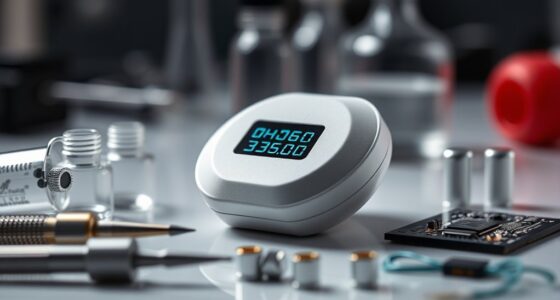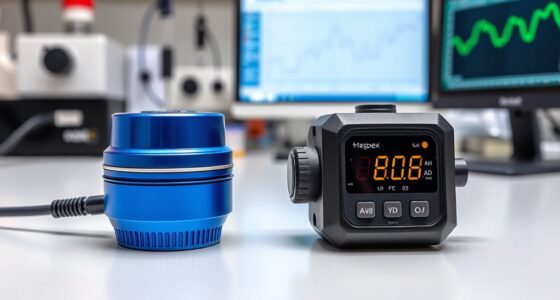
Wearable devices now use advanced air quality sensors to monitor pollutants like PM2.5, VOCs, CO2, and NO2 in real time. These compact sensors deliver immediate data, helping you recognize pollution hotspots indoors and outdoors. By combining sensor insights with smart algorithms, your device can provide personalized alerts and health tips. This technology puts environmental awareness directly in your hands, making it easier to protect your health and adjust your activities—if you explore further, you’ll discover how these innovations work.
Key Takeaways
- Wearable devices incorporate compact, sensitive sensors to detect pollutants like PM2.5, VOCs, CO2, and NO2 in real-time.
- Integrated sensors enable continuous air quality monitoring outside traditional static stations, improving personal environmental awareness.
- Smart algorithms interpret sensor data, providing users with air quality indices, alerts, and actionable insights.
- User-friendly interfaces in wearables facilitate quick understanding of air pollution levels and support activity adjustments.
- Advances in sensor technology and integration are making wearables essential tools for personal health and environmental management.

As concerns about air pollution grow, wearable devices equipped with air quality sensors are becoming essential tools for monitoring your environment in real time. These devices offer a convenient way to stay informed about the air you breathe, empowering you to make healthier choices daily. With advancements in sensor integration, they can continuously track pollutants like particulate matter (PM2.5 and PM10), volatile organic compounds (VOCs), carbon dioxide (CO2), and nitrogen dioxide (NO2). This integration allows for seamless data collection, providing you with immediate feedback on your surroundings without the need for bulky equipment or invasive testing methods.
When you wear a device with integrated air quality sensors, you’re taking an active role in air pollution monitoring. The sensors are compact, yet highly sensitive, capable of detecting even small changes in pollutant levels. They process this data in real time, often displaying it on your device’s screen or syncing with a mobile app for detailed analysis. This continuous monitoring helps you identify pollution hotspots—whether you’re outdoors in traffic-heavy areas or indoors in spaces with poor ventilation. As a result, you can adjust your activities, such as avoiding outdoor exercise during high pollution times or improving indoor air circulation, to protect your health.
Sensor integration in wearable devices isn’t just about detecting pollutants; it also involves smart algorithms that interpret the data. These algorithms filter out noise and provide meaningful insights, like air quality indices or personalized alerts when pollutant levels spike. Some devices even combine air quality data with other health metrics, such as heart rate or activity levels, giving you a thorough view of how your environment affects your well-being. This synergy between sensors and software ensures you receive accurate, actionable information, making it easier to respond proactively to air quality changes.
The portability of these wearables means you’re no longer limited to static monitoring stations or guessing based on weather reports. Instead, you get personalized, on-the-go air pollution monitoring that adapts to your routines and locations. The fusion of sensor integration and user-friendly interfaces means you can quickly understand what’s happening around you and take steps to minimize exposure. As technology advances, expect even more refined sensors and smarter integration, making these wearables indispensable tools for anyone concerned about air quality and health. They bring the power of professional air pollution monitoring directly into your hands, helping you breathe easier and stay healthier every day.
Additionally, leveraging Personality Traits such as resilience and adaptability can enhance your ability to respond effectively to fluctuating air quality levels, ensuring better health management in changing environments.
Frequently Asked Questions
How Accurate Are Wearable Air Quality Sensors Compared to Professional Devices?
You might find wearable air quality sensors reasonably accurate, but their data reliability depends on proper sensor calibration. While they provide useful real-time insights, professional devices generally offer higher accuracy due to advanced calibration and more precise technology. Keep in mind that wearable sensors may have limitations in consistency and precision, so for critical measurements, relying on professional equipment remains the best choice. Calibration guarantees your wearable sensor stays as accurate as possible.
What Are the Battery Life Implications of Integrating Air Quality Sensors?
Adding air quality sensors is like fueling a busy engine, increasing battery consumption and draining your device faster. You’ll notice shorter battery life because sensors constantly draw power. To keep your device running smoothly, manufacturers focus on power optimization techniques, like low-power modes and selective sensing. This way, you get accurate air quality readings without sacrificing too much battery life, letting you stay aware without constantly hunting for a charger.
Can Wearable Air Quality Sensors Detect Specific Pollutants?
Yes, wearable air quality sensors can detect specific pollutants thanks to sensor specificity. They use advanced detection techniques to identify pollutants like particulate matter, VOCs, or gases such as CO and NO2. By calibrating sensors for particular pollutants, you get accurate pollutant detection. This allows you to monitor air quality more precisely, enabling proactive responses to pollution exposure and better understanding of personal environmental risks.
How Do Environmental Factors Affect Sensor Readings on Wearables?
When it comes to environmental interference and calibration challenges, your wearable’s sensor readings can be thrown off by factors like humidity, temperature, and pollutants. These elements can distort data, making it seem less reliable than it truly is. You need to be aware that environmental factors can influence accuracy, so regular calibration and considering external conditions help ensure your device provides trustworthy information, keeping your health insights on point.
Are Wearable Air Quality Sensors Suitable for Clinical Health Monitoring?
Wearable air quality sensors can be suitable for clinical health monitoring if they undergo proper sensor calibration to guarantee accurate readings. However, you should also consider data privacy, as sensitive health information is involved. While these devices offer real-time insights, they may not yet replace professional medical assessments. Always verify the device’s calibration and privacy features before relying on it for clinical decisions.
Conclusion
Imagine walking through your day with a tiny guardian on your wrist, silently alerting you to hidden dangers in the air. Just like a trusted friend, wearable air quality sensors empower you to make healthier choices, reducing exposure to pollutants. With over 80% of urban dwellers affected by poor air quality, these devices become your personal shield. Embrace this technology and take control—because your breath, and your health, deserve that protective edge.

In the dynamic world of air purifiers and clean air advocacy, Aire stands out as a beacon of knowledge and passion. As the Editor in Chief of Aero Guardians, Aire has been instrumental in shaping the platform’s voice and direction, ensuring that every piece of content resonates with clarity, authority, and authenticity.