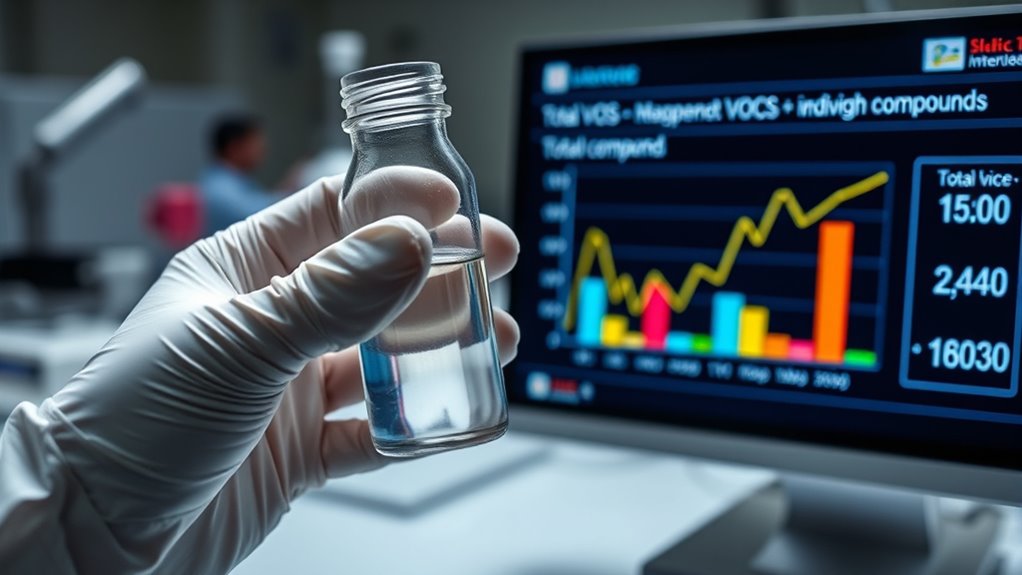
When comparing measuring total VOCs versus individual compounds, you should consider your goal. Total VOC measurements give you a broad picture of overall air quality and potential hazards, using instruments like PIDs. Meanwhile, analyzing specific compounds with GC-MS lets you identify particular sources and health risks. Choosing the right approach depends on your needs—staying safe or pinpointing sources—and continuing this exploration will help clarify which method fits best for you.
Key Takeaways
- Total VOCs are measured using real-time detectors like PIDs or FIDs, providing overall air quality levels.
- Individual VOC compounds are identified and quantified with GC-MS, offering detailed compound-specific information.
- Total VOC measurements are quicker and suitable for general assessments, while individual analysis allows hazard identification.
- The choice depends on whether the goal is overall air quality monitoring or identifying specific hazardous compounds.
- Combining both methods provides comprehensive data for effective air quality management and health risk assessment.
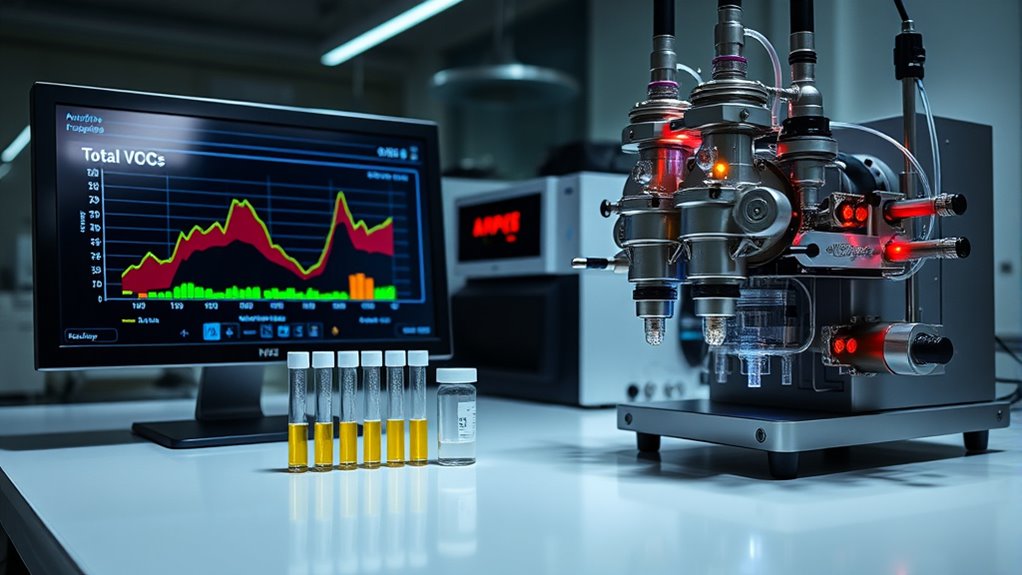
Volatile Organic Compounds (VOCs) are gases emitted by various household products, industrial processes, and natural sources, and measuring their levels is essential for evaluating air quality and health risks. When you set out to measure VOCs, understanding the differences between sampling techniques and analytical methods becomes crucial. Sampling techniques determine how you collect air samples, while analytical methods help you analyze those samples to identify and quantify the compounds present. Both steps are vital for obtaining accurate and meaningful data about VOC concentrations in your environment.
Measuring VOCs is key to assessing air quality and health risks.
You might start with active sampling, where you draw air through a sorbent tube or canister using a pump. This approach allows you to collect a known volume of air, which is especially useful when VOC levels are low. Passive sampling offers an alternative, relying on diffusion to collect VOCs over time without the need for pumps. It’s less intrusive and more convenient for long-term monitoring, but it can be less precise when quantifying very low concentrations. Your choice of sampling technique depends on factors like the environment, target compounds, and required detection limits.
Once you’ve collected your samples, analytical methods come into play. Gas chromatography (GC) coupled with mass spectrometry (MS) is the gold standard for identifying and quantifying individual VOC compounds. This method separates the compounds based on their chemical properties and then detects them with high sensitivity. Alternatively, you might use photoionization detectors (PIDs) for real-time measurement of total VOCs, which provide rapid results but lack specificity for individual compounds. For measuring total VOCs, you could also employ Fourier-transform infrared spectroscopy (FTIR) or flame ionization detectors (FIDs), which give you an overall concentration rather than detailed profiles. Recognizing analytical method capabilities helps you select the most appropriate tools for your specific needs.
Understanding these techniques helps you interpret your data correctly. For example, if your goal is to identify specific hazardous compounds, you’ll need to rely on analytical methods like GC-MS. Conversely, if you’re more interested in overall air quality, total VOC measurements with PIDs or FIDs may suffice. The key is to select the appropriate combination of sampling techniques and analytical methods based on your specific objectives, environment, and resources. By doing so, you guarantee that your VOC measurements accurately reflect the air quality and potential health risks, guiding effective mitigation strategies and compliance with safety standards.
Frequently Asked Questions
How Do I Interpret Total VOC Readings Versus Individual Compound Levels?
When interpreting VOC data, consider that total VOC readings give an overall picture of airborne contaminants, but they don’t specify which compounds are present. For better VOC measurement accuracy, look at individual compound levels to identify specific sources or hazards. This helps you assess health risks more precisely, as some VOCs are more harmful than others. Comparing both types of data provides a clearer understanding of your indoor air quality.
What Are the Limitations of Measuring Total VOCS?
Like a knight’s armor, measuring total VOCs has limitations. It can mask specific compound levels, affecting VOC measurement accuracy. You might miss hazardous pollutants lurking in the mix, risking non-compliance with regulations. Relying solely on total VOCs can lead to overlooked hazards, making it harder to ensure safety. For precise regulatory compliance and accurate assessments, you need to analyze individual compounds alongside total VOC measurements.
Which Industries Primarily Monitor VOCS and Why?
You’ll find that industries like manufacturing, painting, and cleaning primarily monitor VOCs to maintain indoor air quality and control industrial emissions. They do this to protect worker health, meet regulations, and reduce environmental impact. By tracking VOCs, they identify pollution sources, guarantee compliance, and improve safety standards. Regular monitoring helps prevent health issues, minimize odor problems, and keep emissions within legal limits, ensuring a safer, healthier environment for everyone involved.
How Often Should VOC Testing Be Conducted for Safety?
Think of indoor air as a delicate dance floor, where chemical exposure can step in unexpectedly. You should conduct VOC testing regularly—at least every three to six months or whenever new chemicals are introduced—to keep the environment safe. Consistent testing guarantees you’re catching any spikes in VOCs early, protecting your space from harmful chemical exposure. Staying vigilant helps maintain healthy indoor air quality for everyone inside.
Are There Standard Guidelines for Acceptable VOC Levels?
You should refer to regulatory standards for acceptable VOC levels, as they set the safe limits to protect health. Standard guidelines often specify VOC measurement methods, such as using specific detectors or sampling techniques, to guarantee accurate assessment. Regulatory agencies like OSHA or EPA provide these standards, which you must follow to stay compliant and maintain safe indoor air quality. Regular testing helps confirm your environment remains within those acceptable VOC levels.
Conclusion
So, when deciding between measuring total VOCs or individual compounds, think about your specific needs and goals. Do you want a quick overview or detailed insights? While total VOC measurement offers simplicity, analyzing individual compounds provides precision. Ultimately, which approach will give you the most accurate picture of your air quality? Remember, understanding these differences helps you make smarter decisions to protect health and guarantee a safer environment.

In the dynamic world of air purifiers and clean air advocacy, Aire stands out as a beacon of knowledge and passion. As the Editor in Chief of Aero Guardians, Aire has been instrumental in shaping the platform’s voice and direction, ensuring that every piece of content resonates with clarity, authority, and authenticity.