To instantly see if a purifier is big enough, use CADR math: multiply your room’s square footage by the recommended air changes per hour (ACH), then divide that number by 60. This gives you the target CADR value needed for effective cleaning. If the purifier’s CADR meets or exceeds this number, it’s the right size. Keep exploring to learn how precise calculations can make choosing the perfect purifier easier.
Key Takeaways
- Calculate room size in square feet and determine desired air changes per hour (ACH), typically 4-6 for good air quality.
- Multiply room square footage by ACH to find total air exchanges needed per hour.
- Divide the total air exchanges per hour by 60 to get the target CADR in cubic feet per minute (CFM).
- Select a purifier with a CADR rating equal to or higher than this calculated value for effective coverage.
- Account for filter maintenance costs, airflow efficiency, and real-world conditions to ensure the purifier remains adequately sized.
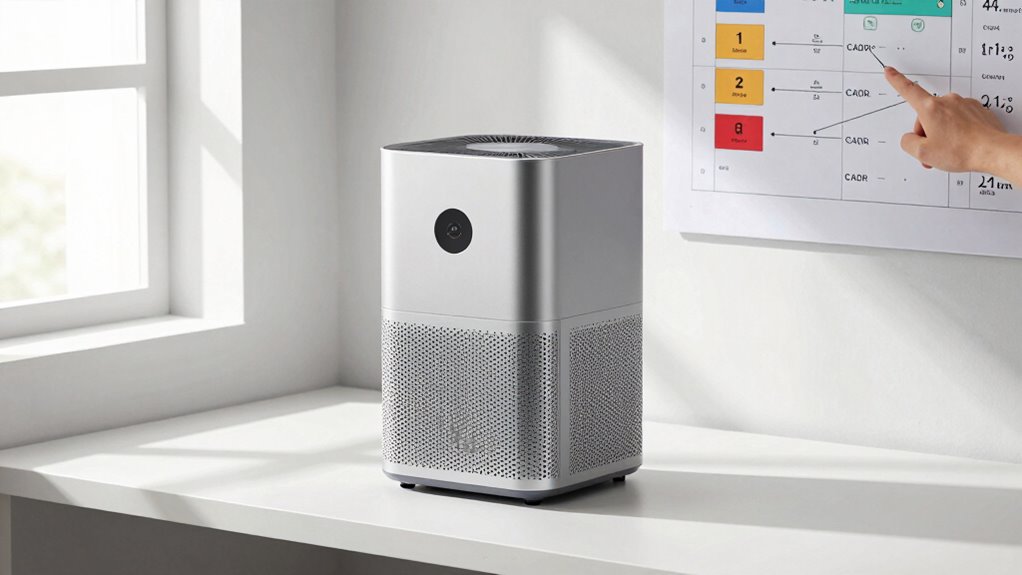
Choosing the right air purifier size depends on understanding CADR (Clean Air Delivery Rate) math. This measurement tells you how effectively a purifier cleans the air in a given space by factoring in airflow efficiency and filtration power. When selecting an air purifier, you want to guarantee it can handle the room’s size without wasting energy or sacrificing performance. If you pick a unit that’s too small, it won’t clean the air efficiently; if it’s too large, you might unnecessarily increase your energy bills and wear out filters faster. That’s where CADR math comes in—it gives you a straightforward way to determine the right fit.
To start, you need to know the room’s square footage and the recommended CADR for your space. For example, a 200-square-foot room typically requires a purifier with a CADR of around 100 to 120. This ratio ensures the air is exchanged multiple times per hour, maintaining a healthy environment. But it’s not just about size; airflow efficiency plays an essential role. A purifier with high airflow efficiency moves more air through its filters with less energy, making it both effective and economical. When you choose a model, check its airflow efficiency ratings—these tell you how well the device circulates and filters the air relative to its power consumption.
Another vital factor is filter replacement. An efficient purifier won’t just do a good job initially; it needs to maintain that performance over time. Cheaper filters or infrequent replacements diminish airflow efficiency, causing the purifier to work harder and less effectively. Regular filter replacement ensures consistent airflow efficiency, maximizing the benefits of your CADR calculations. It’s worth investing in a model with accessible, affordable filters to keep maintenance manageable. Remember, a higher CADR isn’t just about raw numbers—it’s about how well the purifier maintains airflow efficiency and filters the air over its lifespan.
When you do the math, multiply the room’s square footage by the recommended ACH (air changes per hour), then divide by 60 to convert to minutes. This will give you a target CADR value. Selecting a purifier with a CADR that meets or exceeds this number guarantees your space gets cleaned efficiently. And don’t forget to factor in filter replacement costs and frequency, as these impact the overall performance and your budget. By understanding CADR math, you prevent guesswork and guarantee your air purifier is just the right size—delivering clean air effectively while maintaining airflow efficiency and minimizing ongoing costs. Additionally, considering projector technology and how it affects image quality can help optimize your home cinema setup for the best viewing experience.
Frequently Asked Questions
How Do I Convert CADR to Room Size in Square Feet?
To convert CADR to room size in square feet, divide the CADR number by 1.55. This calculation helps you determine the air exchange rate for different pollutant types. For example, a CADR of 155 means the purifier effectively covers about 100 square feet. Confirm your purifier’s CADR matches your room size to optimize air exchange and efficiently clear pollutants like dust, smoke, or pollen.
Can CADR Be Inaccurate for Certain Air Pollutants?
Yes, CADR can be inaccurate for certain air pollutants due to pollutant variability and measurement limitations. You might find that CADR ratings don’t fully account for how different pollutants behave or react in your space. As a result, the purifier may not perform as expected for specific contaminants, especially those with complex or fluctuating levels. Always consider pollutant types and measurement constraints when choosing an air purifier.
Is a Higher CADR Always Better for Air Purification?
Think of CADR as the heartbeat of your air purifier. A higher CADR often means better airflow efficiency, clearing pollutants faster. But it’s not just about numbers—if you don’t place your purifier correctly, even the highest CADR can fall flat. So, while a bigger number is tempting, remember that ideal placement and proper airflow maximize its true power. Bigger isn’t always better without strategic positioning.
How Often Should I Check My Purifier’s CADR Rating?
You should check your purifier’s CADR rating at least once a year, especially after filter maintenance. Regularly verifying guarantees it’s still effective and matches your room size needs. Keep an eye on noise levels too; if your purifier becomes louder or quieter, it might indicate a filter or motor issue. Proper maintenance helps maintain peak CADR performance, ensuring cleaner air without unnecessary noise disruptions.
Does Room Layout Affect the Effectiveness of CADR Measurements?
Sure, your room layout totally decides how well your purifier works, because airflow patterns and furniture placement can turn it into a fancy paperweight. If your furniture blocks airflow or creates dead zones, CADR measurements might give you a false sense of security. To get the most out of your purifier, keep airflow clear and furniture minimal. Don’t let your décor sabotage your clean air goals!
Conclusion
Now that you know how to use CADR math, you can confidently choose the right purifier size for your space. Remember, “Measure twice, cut once,” and in this case, calculate once to avoid costly mistakes. With these simple formulas, you’ll never guess if a purifier is big enough again. Trust the math, and breathe easy knowing your air quality is in your hands. Better safe than sorry—always double-check your numbers!