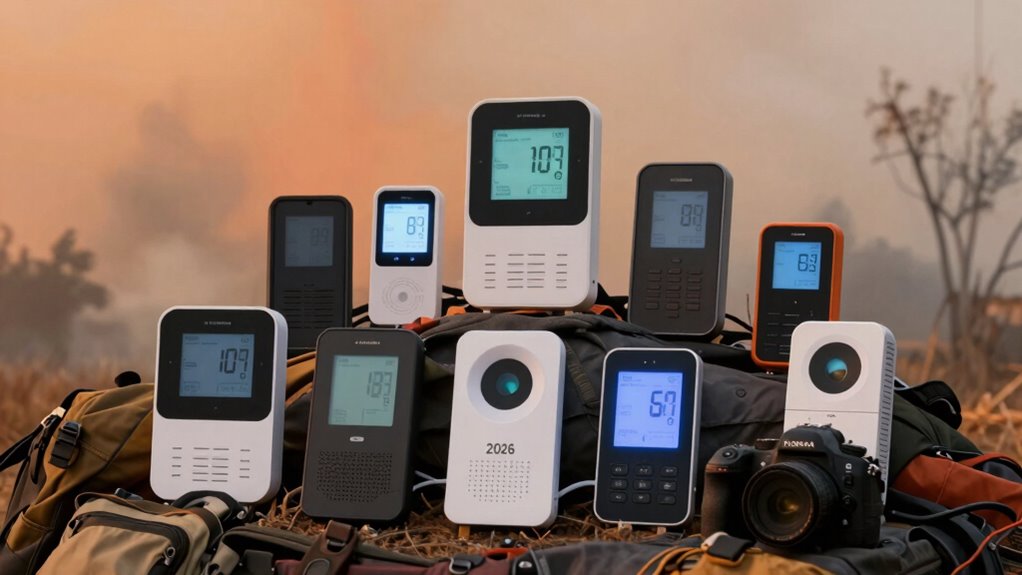

Wildfire smoke can push indoor PM2.5 to unsafe levels hours before you smell it, which is why an air quality monitor for wildfire season is one of the most useful devices you can own from spring through fall. My top pick overall is the Airthings View Plus, because its laser-scattered PM2.5 sensor is accurate enough to trust for smoke decisions and it syncs with an app so you can check readings remotely or on a smart display. If you want a budget-friendly option, the Amazon Smart Air Quality Monitor makes the most sense for Alexa households, while the GoveeLife Smart Monitor offers app alerts and solid PM2.5 tracking at a lower commitment. The main tradeoff in this category is between smart monitors with fewer but more reliable sensors and multi-parameter 16-in-1 units that measure formaldehyde, CO2, and TVOC but sacrifice accuracy on the particle readings that matter most during fires. Read on for the full breakdown, including who each model suits and who should skip it.

Get garden gear delivered free with Prime
- Fast, free delivery on millions of items
- Prime Video, Amazon Music and more included
- Member-only deals all year
Complete the kit



Key Takeaways
- PM2.5 accuracy separates the top picks: the Airthings View Plus uses a laser particle sensor that tracks wildfire smoke reliably, while most budget 16-in-1 units use estimated PM readings that lag or drift during rapid smoke events.
- App connectivity and alerts matter more than screen size for smoke season — the Airthings, Amazon, and GoveeLife models all push notifications so you know when to close windows or run a purifier, a feature almost every 7-inch display unit lacks.
- The 16-in-1 and 10-in-1 models earn their spots for households that want one device covering formaldehyde, CO2, TVOC, and temperature year-round, but their wildfire-specific value depends on whether the PM2.5 channel is a real sensor or a computed estimate.
- Big 7-inch display models like the Sainlogic 9-in-1 and bonoch AirSentry trade portability and smart features for glanceable, multi-room readability — a fair deal if you mainly want at-a-wall readings rather than phone alerts.
- None of these indoor monitors replace outdoor AQI apps for forecasting; their job is telling you whether smoke is actually infiltrating your home and whether your purifier is keeping up.
| Airthings View Plus Indoor Radon and Air Quality Monitor |  | Best Overall for Wildfire Season | Sensors: Radon, PM2.5, CO2, VOCs, humidity, temperature, air pressure | Connectivity: Wi-Fi with app and notifications | Power: Battery-powered | VIEW ON AMAZON | See Our Full Breakdown |
| 16-in-1 Indoor Air Quality Monitor with HD Real-Time Color Screen (Vibrant Orange) |  | Best for Quick Room-by-Room Checks | Parameters measured: PM1.0, PM2.5, PM10, CO2, TVOC, HCHO, temperature, humidity | Sampling interval: 1.5 seconds | Battery runtime: 4–5 hours continuous use | VIEW ON AMAZON | See Our Full Breakdown |
| 16-in-1 Smart Indoor Air Quality Monitor with PM2.5, CO2, TVOC, HCHO, AQI, Temperature & Humidity (Grey) |  | Best Budget Multi-Parameter Pick | Sensors: PM1, PM2.5, PM10, CO2, TVOC, HCHO, AQI, temperature, humidity | Display: Ultra-high definition color screen | Battery: 2000mAh rechargeable, ~7 hours continuous use | VIEW ON AMAZON | See Our Full Breakdown |
| 10-in-1 Indoor Air Quality Monitor with CO2 Detector |  | Best Battery Life for All-Day Monitoring | Measurements: CO2, HCHO, TVOC, benzene, AQI, PM1.0, PM2.5, PM10, temperature, humidity | Measurement error margin: Less than ±5% | Display: HD color screen | VIEW ON AMAZON | See Our Full Breakdown |
| 16-in-1 Indoor Air Quality Monitor with Color Screen |  | Best Simple Plug-In Starter Option | Measurements: PM1.0, PM2.5, PM10, CO2, TVOC, HCHO, temperature, humidity | Sampling interval: 1.5 seconds | Battery runtime: 4–5 hours per charge | VIEW ON AMAZON | See Our Full Breakdown |
| ZEMEOLLO 10-in-1 Indoor Air Quality Monitor |  | Best Grab-and-Go Spot Checker | Measurements: CO₂, HCHO, TVOC, benzene, PM2.5, PM10 | Claimed error margin: Less than ±5% | Display: HD color screen with real-time data and color alerts | VIEW ON AMAZON | See Our Full Breakdown |
| Amazon Smart Air Quality Monitor |  | Best for Smart Home Automation | Sensors: PM2.5, VOCs, carbon monoxide, humidity, temperature | Connectivity: Works with Alexa | Display: Color-coded LED indicator | VIEW ON AMAZON | See Our Full Breakdown |
| GoveeLife Smart Air Quality Monitor with PM2.5, Temperature, and Humidity Sensors |  | Best for Wildfire Data Tracking | Measurements: PM2.5, temperature, humidity | PM2.5 accuracy: ±15 µg/m³ (0-100); ±15% (100-1000 µg/m³) | Response time: 2 seconds | VIEW ON AMAZON | See Our Full Breakdown |
| 16-in-1 Indoor Air Quality Monitor with HD Color Screen (Terracotta Orange) |  | Best Simple Option for Seniors | Parameters: PM1.0, PM2.5, PM10, TVOC, HCHO, temperature, humidity | Sampling interval: 1.5 seconds | Battery runtime: 4-5 hours | VIEW ON AMAZON | See Our Full Breakdown |
| Air Quality Monitor with Dual Chip – AQI, CO2, PM2.5, HCHO & TVOC Detector |  | Best Feature-Rich All-Rounder | Monitors: AQI, CO₂, PM1.0, PM2.5, PM10, TVOC, HCHO, temperature, humidity | Chip architecture: Dual-chip | Display: HD LCD with color-coded status bars | VIEW ON AMAZON | See Our Full Breakdown |
| Sainlogic 9-in-1 Indoor Air Quality Monitor with 7.2-Inch Display |  | Best Big-Screen Readout | Monitored parameters: CO2, PM1.0, PM2.5, PM10, AQI, HCHO, TVOC, temperature, humidity | Display: 7.2 inches; 3 brightness levels | Alerts: 7 customizable thresholds; tri-color LED | VIEW ON AMAZON | See Our Full Breakdown |
| BREATHE Airmonitor Plus Gen 2 Indoor Air Quality Monitor |  | Best for Remote Alerts | Measurements: CO2, PM1, PM2.5, PM10, TVOC, formaldehyde, temperature, humidity | CO2 sensor: NDIR | Connectivity: 2.4 GHz Wi-Fi | VIEW ON AMAZON | See Our Full Breakdown |
| Lecoolife AK27 10-in-1 Indoor Air Quality Monitor |  | Best for Nurseries and Bedrooms | Measurements: PM1.0, PM2.5, PM10, HCHO, TVOC, temperature, humidity, AQI, time | Display: Large full-color screen | Alerts: Color-coded AQI indicator with real-time alerts | VIEW ON AMAZON | See Our Full Breakdown |
| 16-in-1 Indoor Air Quality Monitor with 7-Inch Display |  | Caution Pick — Vague Documentation | Measurements: CO2, TVOC, PM2.5, PM1.0, PM10, HCHO, temperature, humidity, AQI | Display: 7 inches | Alerts: AQI alerts | VIEW ON AMAZON | See Our Full Breakdown |
| bonoch AirSentry 16-in-1 Indoor Air Quality Monitor with 7″ Display |  | Best Customizable Alarms | Parameters tracked: CO2, PM2.5, PM1.0, PM10, HCHO, TVOC, temperature, humidity, AQI, time | Display: 7 inches | Sensor accuracy: 0.001-level with external sensors | VIEW ON AMAZON | See Our Full Breakdown |
| air quality monitor for wildfire season | Display |
|---|---|
| Airthings View Plus Indoor Rad | Customizable eInk screen |
| 16-in-1 Indoor Air Quality Mon | HD real-time color screen |
| 16-in-1 Smart Indoor Air Quali | Ultra-high definition color screen |
| 10-in-1 Indoor Air Quality Mon | HD color screen |
| 16-in-1 Indoor Air Quality Mon | HD color screen |
| ZEMEOLLO 10-in-1 Indoor Air Qu | HD color screen with real-time data and color alerts |
| Amazon Smart Air Quality Monit | Color-coded LED indicator |
| GoveeLife Smart Air Quality Mo | — |
| 16-in-1 Indoor Air Quality Mon | HD real-time color screen |
| Air Quality Monitor with Dual | HD LCD with color-coded status bars |
| Sainlogic 9-in-1 Indoor Air Qu | 7.2 inches; 3 brightness levels |
| BREATHE Airmonitor Plus Gen 2 | — |
| Lecoolife AK27 10-in-1 Indoor | Large full-color screen |
| 16-in-1 Indoor Air Quality Mon | 7 inches |
| bonoch AirSentry 16-in-1 Indoo | 7 inches |
More Details on Our Top Picks
Airthings View Plus Indoor Radon and Air Quality Monitor
For wildfire smoke specifically, the Airthings View Plus stands out because it’s the only option in this lineup built around a true laser PM2.5 sensor paired with cloud-based trend history. When smoke rolls in overnight, the app notifications matter more than a screen you’re not looking at — and this is the one pick that will wake your phone while you sleep. Compared with the 16-in-1 monitors in this guide, it trades a busy multi-parameter display for dependable particulate readings and long-term data logging, which is what actually helps you decide when to run an air purifier or seal a room. The battery power also means placement is flexible near windows or in a bedroom. The tradeoff is real, though: no app, no account, no internet means no data at all, and your readings live in the cloud rather than on the device.
Pros:- Accurate laser-based PM2.5 sensing, the metric that matters most for wildfire smoke
- Phone notifications alert you to smoke events even when you’re asleep or away
- Battery power allows cable-free placement near windows or in bedrooms
- Connects with additional Airthings units for whole-home monitoring
Cons:- Requires an account, app, and constant internet access to see and store data
- All data is stored in the cloud rather than locally on the device
Best for: Homeowners who want overnight smoke alerts, multi-room expansion, and months of PM2.5 trend data to track wildfire events
Not ideal for: Anyone who wants a plug-and-play screen with no account setup — this monitor is app-dependent and cloud-reliant
- Sensors:Radon, PM2.5, CO2, VOCs, humidity, temperature, air pressure
- Connectivity:Wi-Fi with app and notifications
- Power:Battery-powered
- Display:Customizable eInk screen
- Sensor type:Electrochemical
- Operating temperature:4 to 40°C (39 to 104°F)
- Warranty:Optional registration extends warranty to 5 years
Our verdict“If wildfire smoke alerts and reliable long-term PM2.5 data are the priority, this is the monitor to beat.”
16-in-1 Indoor Air Quality Monitor with HD Real-Time Color Screen (Vibrant Orange)
Where the Airthings View Plus is a set-and-forget sentinel, this 16-in-1 unit is a handheld diagnostic tool — the right choice if you want to walk through the house during a smoke event and find which room is leaking the most PM2.5. The 1.5-second refresh rate is faster than anything else here, so readings respond almost immediately when you carry it near a drafty window. One-button operation keeps it accessible for older family members who just want to see a color-coded number, and the included AC adapter lets you run it plugged in despite the short battery life. The tradeoff versus the Grey 16-in-1 model: no app, no logged data, and no alerts — once the smoke clears, the numbers are gone. The 4–5 hour battery runtime also rules it out as an unplugged overnight monitor.
Pros:- 1.5-second real-time refresh reacts immediately as you move between rooms
- Color-coded HD screen makes PM2.5 danger levels readable at a glance
- One-button operation is genuinely simple for elderly family members
- Includes AC adapter so it can run continuously while plugged in
Cons:- 4–5 hour battery runtime makes unplugged all-day monitoring impractical
- No app connectivity, remote monitoring, or data logging of any kind
Best for: Households who want to spot-check different rooms during a smoke event and see instant color-coded readings without any app
Not ideal for: Anyone who wants remote alerts or stored history — this is a live-readout device only, with no smart connectivity
- Parameters measured:PM1.0, PM2.5, PM10, CO2, TVOC, HCHO, temperature, humidity
- Sampling interval:1.5 seconds
- Battery runtime:4–5 hours continuous use
- Charging:USB Type-C with included cable and AC adapter
- Display:HD real-time color screen
- Weight:14 ounces
- Warranty:12-month quality support
Our verdict“A capable portable checker for finding smoke entry points in your home, as long as you don’t need alerts or history.”
16-in-1 Smart Indoor Air Quality Monitor with PM2.5, CO2, TVOC, HCHO, AQI, Temperature & Humidity (Grey)
This grey 16-in-1 monitor earns its spot by adding features the similarly named Vibrant Orange model lacks: buzzer alerts that flag rising PM2.5 without you watching the screen, and a wall-mounting hole that turns it into a semi-permanent fixture rather than a gadget in a drawer. For wildfire season, the buzzer is the headline — a fixed unit on the wall of a kid’s room that sounds off when smoke particulates climb is more useful than a portable checker you forgot to plug in. Its double ventilation design also helps airflow over the sensors, which matters for response accuracy. Compared with the Airthings View Plus, you give up app alerts and logged trends, and the roughly 7-hour battery still trails the 10-in-1 CO2 Detector’s 20 hours — so plan on keeping it on USB power for continuous use.
Pros:- Buzzer alerts notify you when particulate levels rise without watching the screen
- Wall-hanging hole enables fixed, always-on placement in one room
- Double ventilation design improves sensor airflow and reading accuracy
- 7-hour battery outlasts the 4–5 hours of comparable 16-in-1 portables
Cons:- Battery life still caps out around 7 hours, requiring USB power for continuous monitoring
- Needs about 30 minutes of operation before entering energy-saving mode
Best for: Budget-conscious buyers who want a wall-mountable bedroom or nursery monitor with audible smoke-level alerts
Not ideal for: Data nerds who want trend charts and remote notifications — there’s no app or history here, just live readings
- Sensors:PM1, PM2.5, PM10, CO2, TVOC, HCHO, AQI, temperature, humidity
- Display:Ultra-high definition color screen
- Battery:2000mAh rechargeable, ~7 hours continuous use
- Charging:USB Type-C
- Special features:Buzzer alerts, energy-saving mode, wall-hanging hole
- Use cases:Home, office, grow rooms, kitchens, schools, cellars, cars
Our verdict“The smart choice if you want audible wildfire-smoke warnings on a wall-mounted budget device, not a smart-home ecosystem.”
10-in-1 Indoor Air Quality Monitor with CO2 Detector
Battery life is where this 10-in-1 pulls ahead of the pack: at up to 20 hours per charge, it nearly triples the Vibrant Orange 16-in-1’s runtime and almost triples the Grey model’s, which makes it the only portable here that can genuinely run unplugged through an entire multi-day smoke event with a single overnight recharge. During power outages that sometimes accompany wildfires, that endurance stops being a convenience and becomes the whole point. It also adds benzene sensing, a parameter none of the 16-in-1 units in this batch cover, plus voice broadcast alerts and one-touch auto-calibration. The tradeoff for that focus: the manufacturer doesn’t publish sensor detection ranges, so buyers comparing measurement precision against the Airthings View Plus‘s documented specs are working blind. And the voice alerts can be loud — check whether they can be muted before putting it in a bedroom.
Pros:- Up to 20 hours of battery life, by far the longest unplugged runtime in this batch
- Voice broadcast alerts flag dangerous readings without checking the screen
- One-touch auto-calibration keeps readings consistent over a long smoke season
- Adds benzene detection beyond the PM, CO2, and VOC coverage of similar models
Cons:- Manufacturer does not specify sensor detection ranges or calibration methods
- Voice alerts may be too loud for bedroom or overnight use
Best for: Buyers in outage-prone wildfire regions who need a monitor that runs all day and night away from an outlet
Not ideal for: Specification-driven buyers who want documented sensor ranges and calibration details before trusting the readings
- Measurements:CO2, HCHO, TVOC, benzene, AQI, PM1.0, PM2.5, PM10, temperature, humidity
- Measurement error margin:Less than ±5%
- Display:HD color screen
- Alerts:Voice broadcast alarm
- Calibration:One-touch auto-calibration
- Battery:2000mAh rechargeable lithium, up to 20 hours per charge
- Charging:USB charging cable included
- Temperature units:Celsius or Fahrenheit
Our verdict“The pick for all-day unplugged monitoring during extended smoke events, provided you accept thinner published specs.”
16-in-1 Indoor Air Quality Monitor with Color Screen
This AirWhisper 16-in-1 is essentially the entry-level version of the Vibrant Orange model — same AK16C platform, same 1.5-second sampling, same core sensors — but with adjustable audio prompts instead of a fixed interface, which makes it friendlier as a bedside unit during smoke nights. It’s the pick for someone who wants a no-setup, no-account device that starts showing PM2.5 the moment it’s plugged in, and the included AC adapter effectively neutralizes the short battery runtime for anyone using it as a stationary monitor. Compared with the Grey 16-in-1, you lose the buzzer alerts and wall mount; compared with the Airthings View Plus, you lose everything smart. What’s left is a straightforward, readable screen that answers one question: is the smoke inside yet? Just know that beyond that live readout, this device offers no history and little depth.
Pros:- Zero-setup operation — plug it in and PM2.5 readings appear within seconds
- 1.5-second sampling interval keeps the display responsive as conditions change
- Adjustable audio prompts make it usable as a bedside unit without noise annoyance
- AC adapter and USB-C cable included for continuous powered operation
Cons:- 4–5 hour battery runtime is the shortest in this batch
- No app, alerts, data logging, or smart connectivity of any kind
Best for: First-time buyers who want an affordable, plug-in-and-read PM2.5 display with zero setup or app requirements
Not ideal for: Anyone needing alerts, logged data, or long battery life — this is a live readout only, with 4–5 hours unplugged
- Measurements:PM1.0, PM2.5, PM10, CO2, TVOC, HCHO, temperature, humidity
- Sampling interval:1.5 seconds
- Battery runtime:4–5 hours per charge
- Charging:USB Type-C
- Display:HD color screen
- Weight:14.4 ounces
- Included accessories:Type-C charging cable, AC power adapter, user manual
- Quality support:12 months
Our verdict“A sensible, minimal first monitor for answering ‘is smoke in my house right now’ — and nothing more.”
ZEMEOLLO 10-in-1 Indoor Air Quality Monitor
This option stands out for wildfire-season spot checks — carrying it from the bedroom to the living room to a hotel room is effortless at just 7 ounces, and the 20-hour battery outlasts both the 16-in-1 Terracotta Orange model (4-5 hours) and the dual-chip detector (7-15 hours). One-button operation means there’s no app setup standing between you and PM2.5 readings when smoke rolls in. Compared with the GoveeLife H5106, you get CO₂, formaldehyde, and benzene coverage rather than just particulates, though the GoveeLife publishes documented accuracy figures while ZEMEOLLO only claims a vague ±5% margin without per-sensor detail. The color-alert screen makes danger levels obvious at a glance, which matters more than raw numbers during a smoke event.
Pros:- Covers CO₂, HCHO, TVOC, benzene, PM2.5 and PM10 in one handheld device
- 20-hour battery life is the longest runtime in this batch
- Featherweight 7-ounce design moves anywhere without setup
- Color-alert screen flags threshold breaches instantly
Cons:- No published measurement range or per-sensor accuracy specs
- No app connectivity or data history for tracking smoke events over time
Best for: Renters and travelers who want a battery-powered monitor they can move between rooms or pack during evacuation
Not ideal for: Data-driven users who want historical logging or documented sensor accuracy — there’s no app connectivity and no published per-sensor specs
- Measurements:CO₂, HCHO, TVOC, benzene, PM2.5, PM10
- Claimed error margin:Less than ±5%
- Display:HD color screen with real-time data and color alerts
- Battery:2000mAh rechargeable lithium polymer
- Battery life:Up to 20 hours
- Weight:7 ounces
- Dimensions:5.39 × 4.06 × 1.85 inches
Our verdict“A solid pick if you want long battery life and portability over smart features and verifiable accuracy data.”
Amazon Smart Air Quality Monitor
Where the ZEMEOLLO and Terracotta Orange monitors are handheld checkers, this one is built for set-and-forget smoke awareness. Its real strength is Alexa Routines: when PM2.5 climbs during a wildfire event, it can automatically kick on a purifier or shut a smart thermostat’s fan mode — something no battery monitor in this lineup can do. Phone notifications and Echo announcements mean you’ll hear about a spike even from another room. The tradeoff is transparency: there’s no numeric display, so you’re trusting Amazon’s air quality score rather than reading raw µg/m³ values the way you can on the GoveeLife or the dual-chip detector. It also tracks only five factors, skipping formaldehyde and CO₂ entirely.
Pros:- Automates purifiers, fans, and thermostats via Alexa Routines when smoke raises PM2.5
- Push alerts to phones and Echo announcements keep you informed anywhere in the house
- Plug-in design enables true 24/7 continuous monitoring
- Setup takes minutes through the Alexa app
Cons:- No numeric display — you only get a color LED and an app-based score
- Fully dependent on the Alexa ecosystem and a compatible phone
- Skips CO₂, formaldehyde, and PM10 measurements
Best for: Alexa households that want automatic purifier and HVAC responses to smoke instead of manual monitoring
Not ideal for: Anyone outside the Alexa ecosystem or who wants exact PM2.5 numbers on the device itself — it’s nearly useless without the app
- Sensors:PM2.5, VOCs, carbon monoxide, humidity, temperature
- Connectivity:Works with Alexa
- Display:Color-coded LED indicator
- Alerts:Phone notifications and Echo announcements
- Setup:Plug in and connect via Alexa app
- Power:Wired plug-in (no battery)
Our verdict“The right choice if you already run Alexa and want your home to react to wildfire smoke automatically rather than just report it.”
GoveeLife Smart Air Quality Monitor with PM2.5, Temperature, and Humidity Sensors
For wildfire season specifically, this model’s two-second refresh rate and 13-day graphs make it the best tool for actually understanding how smoke behaves in your home over time — when it infiltrates, how fast your purifier clears it, whether sealing windows worked. It’s the only option in this batch that publishes hard accuracy specs (±15 µg/m³ at low PM2.5 concentrations), which matters when you’re comparing readings against official AQI numbers. The dual-chip detector and ZEMEOLLO offer more parameters, but neither documents sensor performance this precisely. The main limitation is scope: PM2.5 only, no PM10 or CO₂, and it must stay plugged into USB-C, so it lives in one room rather than traveling with you.
Pros:- Two-second PM2.5 refresh catches smoke spikes in near real time
- 13-day on-device graphs with 2 years of exportable app history
- Documented accuracy specs you can trust against official AQI readings
- Automation hooks for GoveeLife purifiers and appliances
Cons:- Wired power only — no battery for portable or blackout use
- No CO₂, formaldehyde, or PM10 coverage
- Time display feature requires 2.4 GHz Wi-Fi
Best for: Analytical users who want logged, exportable PM2.5 data to verify purifier performance and correlate with outdoor AQI
Not ideal for: Anyone wanting a portable checker or broader coverage — it’s wired to one spot and measures only particulates plus climate
- Measurements:PM2.5, temperature, humidity
- PM2.5 accuracy:±15 µg/m³ (0-100); ±15% (100-1000 µg/m³)
- Response time:2 seconds
- Connectivity:Bluetooth and 2.4 GHz Wi-Fi
- Data history:13-day graphs; 2-year export
- Power:USB-C wired, no battery
- Dimensions:5.31 × 1.57 × 2.47 inches
Our verdict“The data nerd’s pick: fewer parameters than rivals, but the most trustworthy and best-logged PM2.5 record for wildfire tracking.”
16-in-1 Indoor Air Quality Monitor with HD Color Screen (Terracotta Orange)
This pick makes the most sense for buyers who want zero learning curve — one button, a big color-coded screen, and readings that refresh every 1.5 seconds. Unlike the ZEMEOLLO, it adds PM1.0 (the finest particulate fraction, which penetrates deepest into lungs during smoke events) and temperature/humidity, and the display’s color levels make it readable for elderly family members who won’t fumble with an app. The compromise is stamina and memory: at 4-5 hours per charge, it can’t run overnight like the ZEMEOLLO’s 20 hours, and it keeps no history — every reading disappears when you power off. The included AC adapter softens the battery issue for stationary use.
Pros:- Single-button operation genuinely usable without instructions
- Covers PM1.0 in addition to PM2.5/PM10, TVOC, HCHO, temp and humidity
- Fast 1.5-second refresh keeps pace with changing smoke conditions
- Includes AC adapter so it can run plugged in indefinitely
Cons:- 4-5 hour battery is the shortest runtime in this batch
- No app connectivity or data logging whatsoever
Best for: Older adults or tech-averse households who need an at-a-glance smoke-level readout with one-button simplicity
Not ideal for: Anyone wanting overnight monitoring on battery or logged data — the short runtime and lack of history rule it out
- Parameters:PM1.0, PM2.5, PM10, TVOC, HCHO, temperature, humidity
- Sampling interval:1.5 seconds
- Battery runtime:4-5 hours
- Charging:Type-C fast charging
- Display:HD real-time color screen
- Audio prompt:Adjustable, double-tap to disable
- Warranty:12 months
Our verdict“The easiest monitor here to use, ideal for seniors — just don’t expect it to log smoke events or last the night unplugged.”
Air Quality Monitor with Dual Chip – AQI, CO2, PM2.5, HCHO & TVOC Detector
This model pairs the broadest sensor suite in this batch — AQI, CO₂, all three particulate sizes, TVOC, formaldehyde, and climate — with WiFi app access the Terracotta Orange and ZEMEOLLO monitors lack entirely. You can check home air quality remotely during a wildfire evacuation, and the app stores history the GoveeLife matches but the handheld-only options can’t touch. The 3000mAh battery gives 7-15 hours unplugged, sitting between the GoveeLife (wired only) and the ZEMEOLLO (20 hours), and wall-mounting plus screen-off monitoring make it viable as a permanent fixture. Frustrations are real though: 2.4 GHz-only WiFi forces compatibility-mode fiddling on modern routers, and the app accepts just one phone at a time — awkward for couples.
Pros:- Most complete parameter list here, including AQI, CO₂ and full PM1.0/2.5/10 range
- WiFi remote monitoring with app-based historical data storage
- Dual-chip design delivers fast, stable readings during rapid smoke changes
- Wall-mountable with screen-off mode for continuous discreet monitoring
Cons:- 2.4 GHz-only WiFi requires compatibility mode on WiFi 6+ routers
- App allows only one connected phone at a time
- 7-15 hour battery means it’s best left plugged in for round-the-clock use
Best for: Tech-comfortable users who want maximum parameters, remote monitoring while away, and a device that doubles as a fixed wall unit
Not ideal for: Households sharing access across multiple phones, or anyone on a WiFi 6+ router who wants painless setup
- Monitors:AQI, CO₂, PM1.0, PM2.5, PM10, TVOC, HCHO, temperature, humidity
- Chip architecture:Dual-chip
- Display:HD LCD with color-coded status bars
- Battery:3000mAh rechargeable, Type-C
- Battery life:7-15 hours continuous use
- WiFi:2.4 GHz only (compatibility mode for WiFi 6+)
- Apps:Smart Life, Tuya Smart
- Mounting:Wall-mountable
Our verdict“The most capable do-everything monitor in this group, provided you tolerate its fussy WiFi limits and single-phone app.”
Sainlogic 9-in-1 Indoor Air Quality Monitor with 7.2-Inch Display
When smoke rolls in, you want numbers you can read from the couch, and this option delivers that better than anything else here. The 7.2-inch display with three brightness levels makes PM2.5 and AQI visible across a room, and readings refresh every 1–2 seconds — faster than the Lecoolife AK27, which updates on a similar interval but packs its data into a smaller screen. I like the seven customizable alert thresholds with a tri-color LED, which lets you set a personal smoke-day trigger rather than relying on generic color bands. The 2500 mAh battery gives up to 8 hours cordless, edging out the BREATHE Airmonitor Plus by two hours. The real tradeoff: no app or Wi-Fi, so there’s no history, no remote alerts, and no way to check your air while away from home.
Pros:- Nine monitored parameters including PM2.5, PM10 and AQI — the core wildfire metrics
- 7.2-inch screen with adjustable brightness is the most readable display in this lineup
- Eight hours of cordless runtime, the best battery life among these five picks
- Seven customizable alert thresholds instead of fixed alarm points
Cons:- No app, Wi-Fi, or data history — what you see on screen is all you get
- Eight-hour battery still requires daily charging if used unplugged
Best for: Households who want at-a-glance smoke readings from across the room without fiddling with an app
Not ideal for: Anyone who wants historical data or remote phone alerts during evacuation planning — this is display-only
- Monitored parameters:CO2, PM1.0, PM2.5, PM10, AQI, HCHO, TVOC, temperature, humidity
- Display:7.2 inches; 3 brightness levels
- Alerts:7 customizable thresholds; tri-color LED
- Reading refresh:Every 1–2 seconds
- Battery:2500 mAh; up to 8 hours wireless
- Charging:USB-C
- Connectivity:None — no app or Wi-Fi required
- Humidity range:0–99% RH (±2–3% RH)
Our verdict“Buy this if you want the biggest, fastest-refreshing screen for spotting smoke intrusions in real time; skip it if phone alerts and history matter to you.”
BREATHE Airmonitor Plus Gen 2 Indoor Air Quality Monitor
This is the only pick in this batch that connects to your phone, and during wildfire season that difference matters more than any sensor spec. With 2.4 GHz Wi-Fi and the companion app, you get push alerts when PM2.5 spikes while you’re at work, plus graphs and up to 90 days of history — useful for judging whether your purifier is actually keeping up over a multi-week smoke event. The NDIR CO2 sensor is also a step above the generic sensors in the bonoch AirSentry, which matters if ventilation decisions are part of your routine. Compared with the Sainlogic, you trade screen real estate for connectivity and data. The catch: six hours of battery is the shortest runtime here, and the app refuses to cooperate with 5 GHz-only networks.
Pros:- Wi-Fi app with remote readings, configurable alerts, and data export
- 90 days of stored history for tracking multi-day smoke episodes
- NDIR CO2 sensor for accurate ventilation monitoring
- Two-year warranty, longer backing than most budget monitors
Cons:- Requires 2.4 GHz Wi-Fi — incompatible with 5 GHz-only networks
- Six-hour battery is the weakest portable runtime in this group
Best for: People who want phone notifications and 90-day PM2.5 trend data to track smoke events remotely
Not ideal for: Homes with only 5 GHz Wi-Fi, or buyers who want a big always-on display — the screen here is modest
- Measurements:CO2, PM1, PM2.5, PM10, TVOC, formaldehyde, temperature, humidity
- CO2 sensor:NDIR
- Connectivity:2.4 GHz Wi-Fi
- App features:Remote readings, alerts, graphs, data export
- History:Up to 90 days
- Battery life:Up to 6 hours; USB-C for continuous use
- Warranty:2 years
Our verdict“The clear choice if wildfire prep means alerts on your phone and data you can review later, not just a glowing number on a shelf.”
Lecoolife AK27 10-in-1 Indoor Air Quality Monitor
Not everyone needs a lab-grade station — sometimes you just want a quiet, friendly device that answers ‘is the air okay in here right now?’ That’s where this model earns its spot. The color-coded AQI indicator translates raw particulate numbers into green/yellow/red at a glance, which is exactly what a sleep-deprived parent or office worker needs during a smoke event. Compared with the Sainlogic 9-in-1, it trades CO2 tracking and battery power for a compact desktop design that fits unobtrusively on a nightstand. The full-color screen is genuinely readable from across a room, though it’s smaller than the Sainlogic’s 7.2-inch panel. The honest weakness: long-term reliability is unproven given how new this model is, and there’s no battery option, so it lives tethered to an outlet.
Pros:- Ten measurements covering particulates, gases, temperature, humidity and AQI
- Color-coded AQI alerts communicate danger level without interpretation
- Full-color screen readable from across a room
- Compact footprint suits nightstands and desks
Cons:- Very new model with little track record, so durability is unknown
- No battery or portable power option — outlet only
- Does not measure CO2
Best for: Parents and office workers who want a simple, glanceable air safety light for a bedroom, nursery, or desk
Not ideal for: Data-minded buyers who want CO2 readings, battery power, or app history — this covers none of those
- Measurements:PM1.0, PM2.5, PM10, HCHO, TVOC, temperature, humidity, AQI, time
- Display:Large full-color screen
- Alerts:Color-coded AQI indicator with real-time alerts
- Design:Compact desktop form factor
- Power:AC powered — no battery mentioned
- Model:AK27
Our verdict“A sensible low-stress pick for a bedroom or nursery if you want a traffic-light answer rather than a dataset.”
16-in-1 Indoor Air Quality Monitor with 7-Inch Display
On paper this monitor covers the same wildfire essentials as better-documented rivals: PM2.5, PM1.0, PM10, CO2, TVOC, HCHO, temperature, humidity and AQI, all on a 7-inch screen. In practice, the listing is thin — the description is incomplete and repetitive, and a ‘7-hour feature’ is mentioned without any explanation of what it does. That opacity matters when you’re comparing it with the Sainlogic 9-in-1, which spells out its refresh rate, brightness levels, battery capacity and alert thresholds in full detail. For a device you’ll trust to warn you about smoke intrusions, undocumented behavior is a real drawback: you can’t verify sensor accuracy claims, alert customization, or power options before buying. The large display is the one clearly confirmed strength. This pick makes the most sense only for buyers comfortable gambling on a cheaper big-screen unit and willing to return it if it underdelivers.
Pros:- Covers the core wildfire metrics including all three particulate sizes
- 7-inch display matches the largest screens in this roundup
- AQI alerts are included
- Time display adds everyday clock utility
Cons:- Product documentation is incomplete and repetitive, leaving key behaviors unknown
- The ‘7-hour feature’ is unexplained and power details are absent
- No stated accuracy figures or alert customization details
Best for: Budget-focused buyers willing to accept vague specs in exchange for a large multi-parameter display
Not ideal for: Anyone who needs documented accuracy, alert behavior, or battery details before trusting a smoke-day device
- Measurements:CO2, TVOC, PM2.5, PM1.0, PM10, HCHO, temperature, humidity, AQI
- Display:7 inches
- Alerts:AQI alerts
- Additional features:Time display; unspecified 7-hour feature
- Power:Not documented
Our verdict“Only worth the risk if price is your priority and you’ll test it against a trusted monitor before relying on it.”
bonoch AirSentry 16-in-1 Indoor Air Quality Monitor with 7″ Display
Where this model separates itself is alert flexibility: seven customizable alarm modes with a mute button, so you can set a buzzer for the PM2.5 threshold that matters to your household and silence it without digging through menus — handy at 2 a.m. when smoke drifts in. The external high-precision sensors with 0.001-level resolution and enhanced airflow design should react faster to a sudden smoke intrusion than internally mounted sensors like those in the Lecoolife AK27. The 7-inch display sits between the Sainlogic’s panel and smaller rivals, and the one-touch °F/°C and 12/24-hour switching is a small but real convenience. Two genuine annoyances: the external sensors are sensitive to touch, perfume and strong odors, so placement discipline matters, and adjusting the clock requires awkward multi-step button sequences.
Pros:- Seven customizable alarm modes let you pick your own wildfire alert threshold
- Dedicated mute button for silencing alerts instantly
- External high-precision sensors with enhanced airflow for fast smoke detection
- One-touch °F/°C and 12/24-hour switching
Cons:- External sensors are easily skewed by touch, perfume, or strong household odors
- Time setting requires frustrating multi-step button sequences
- No app, Wi-Fi, or data history
Best for: Light sleepers and caregivers who want an audible, tunable smoke alert they can mute instantly without leaving bed
Not ideal for: Households that frequently move or handle their gadgets — the exposed sensors throw off readings when touched
- Parameters tracked:CO2, PM2.5, PM1.0, PM10, HCHO, TVOC, temperature, humidity, AQI, time
- Display:7 inches
- Sensor accuracy:0.001-level with external sensors
- Alarm modes:7 customizable AQI alert buzzers with mute
- Temperature units:°F / °C switchable
- Time format:12/24-hour
Our verdict“The pick for anyone whose wildfire plan depends on being woken by an alarm they control — just mount it high and leave it alone.”

How We Picked
Because this roundup is judged through a wildfire-smoke lens, I weighted PM2.5 measurement quality above everything else. Fine particulate from smoke is the single pollutant that spikes fastest and matters most during fire season, so monitors with dedicated particle sensors — like the Airthings View Plus and GoveeLife — earned higher placement than multi-parameter units that estimate or under-spec their PM channel. Second, I prioritized alerting and connectivity: wildfire smoke often arrives while you are asleep or away, so app notifications, smart home integrations, and remote viewing directly affect whether a monitor changes your behavior.
From there, I scored each model on sensor breadth, display usability, calibration and maintenance, and overall value. The 16-in-1 and 10-in-1 units were compared against each other on which readings are genuinely useful versus spec padding, and the large-display models were judged on readability and placement flexibility. Ranking reflects fit for wildfire season first and general air quality monitoring second — a model that is excellent for year-round VOC tracking but weak on smoke particles will sit lower here than a simpler, sharper PM2.5 monitor.
Factors to Consider When Choosing Air Quality Monitor For Wildfire Season
Before picking a monitor, it helps to understand what actually matters when wildfire smoke is the threat — because the feature list on the box rarely matches the priorities of smoke season.PM2.5 Sensor Quality: The Only Reading That Really Matters for Smoke
Wildfire smoke is overwhelmingly a fine particulate (PM2.5) problem, so this one sensor should drive your buying decision more than any other spec. There is a real difference between monitors using laser scattering particle sensors and cheaper units that compute an estimated PM value from a TVOC or composite sensor — the estimates respond slowly and can miss the sharp spikes that define smoke events. A quality PM2.5 sensor reacts within minutes of smoke entering a room, which is what lets you close windows, seal gaps, or crank a purifier before levels climb. If a product listing is vague about how it measures particulate, treat that as a signal, not an oversight. Also check whether the monitor reports PM1.0 and PM10 alongside PM2.5; smoke skews fine, so PM1.0 data can reveal infiltration even when PM2.5 looks borderline. Buyers who already own an air purifier should think of the monitor as the purifier’s eyes — without trustworthy PM2.5 data, you are guessing about when and how hard to run it.
Alerts and Smart Features Versus Screen-Only Designs
A common mistake is buying a monitor with a beautiful screen but no connectivity, then discovering that a screen-only device cannot warn you when smoke arrives at 3 a.m. or while you are at work. Monitors with Wi-Fi and app alerts — or Alexa integration — let you set thresholds so your phone buzzes when PM2.5 crosses into unhealthy territory, which is the moment to act. Screen-only units still have a place: they are simpler to set up, there is no app account to manage, and a 7-inch display is readable from across a room. But for wildfire season specifically, passive monitoring is a missed opportunity, because the value lies in prompting action, not just displaying numbers. If you travel or leave windows open on mild days, lean toward a connected model. If someone is always home and can glance at a display, a large-screen unit is a reasonable trade.
Sensor Count: When 16-in-1 Helps and When It Is Padding
Multi-parameter monitors are tempting because a long spec sheet feels like better value, but during a fire the extra channels mostly sit idle. CO2 monitoring is genuinely useful year-round for ventilation decisions, and formaldehyde or TVOC readings can matter in newer homes or after renovations — but none of them respond to smoke. Where the 16-in-1 approach pays off is year-round air quality awareness: one device covering smoke season, winter stuffiness, and off-gassing concerns. Where it falls short is accuracy spread — packing many sensors into a budget device usually means each one is adequate rather than excellent. My advice is to decide whether you are buying primarily for wildfire season or for continuous monitoring; the answer changes the ranking entirely. A dedicated, accurate PM2.5 monitor plus a cheap CO2 tracker often outperforms one do-everything box.
Calibration, Drift, and Long-Term Reliability
Particle and chemical sensors drift over time, and budget monitors rarely include a calibration path, which means readings you trusted in June may be off by September — right in the middle of fire season. Look for models that support background calibration, app-guided fresh-air calibration, or replaceable sensor modules; the premium brands tend to handle this better than generic multi-parameter units. Electrochemical and NDIR sensors (common for CO2 and formaldehyde) hold calibration longer than early-generation MOS-type VOC sensors, which can swing with temperature and humidity alone. Placement also affects reliability: monitors near kitchens, windows, or humidifiers will report conditions that do not reflect the room as a whole. Plan to cross-check your monitor against a public AQI station on a clear day occasionally — if it disagrees wildly at baseline, you will know to discount its smoke readings too.
Display, Placement, and Portability
Think about where the monitor will live, because placement determines usefulness. A battery-powered or compact unit can move between a bedroom at night and a living room by day, which matters if smoke infiltration varies by room. Large 7-inch display models are designed to sit on a shelf and be read from a distance — great for families, awkward for small apartments. Also consider that a monitor placed right next to an air purifier will read clean air while the far corner of the room stays smoky; ideally position it where you actually breathe, at breathing height, away from direct airflow. Some households solve this with two inexpensive monitors rather than one premium unit, and for wildfire season that is a legitimate strategy. Finally, check power requirements — many big-screen units need constant USB power, which limits where they can go.
Matching the Monitor to Your Air Purifier Strategy
An air quality monitor without a response plan is just an anxiety machine, so buy with your mitigation setup in mind. If you run a smart air purifier, choose a monitor that can trigger it automatically or at least alert you fast enough to act manually — app-connected monitors pair naturally with this workflow. If your purifier is a basic dial model, the monitor’s job is telling you when to turn it on, when to raise the fan speed, and when levels have dropped enough to switch it off, saving filter life during long fire seasons. Filter costs compound quickly during heavy smoke weeks, so data that prevents over-running a purifier has real dollar value. Some buyers also use monitors to test DIY measures — sealing a window, taping a filter to a box fan, moving a purifier between rooms — and a responsive PM2.5 reading is the only way to know whether any of it worked. Decide whether you want the monitor to be the brain of that system or just a dashboard, and buy accordingly.
Frequently Asked Questions
Do I really need a PM2.5 monitor if I can just check outdoor AQI apps?
Outdoor AQI apps tell you what is happening in your neighborhood’s air, not inside your home, and the gap between the two is exactly what a monitor measures. A house with closed windows and a running purifier might hold indoor PM2.5 at a fraction of outdoor levels, while a leaky older home can approach outdoor concentrations within hours. Knowing your indoor number tells you when to seal up, when it is safe to ventilate, and whether your purifier is actually keeping pace. During extended smoke events, outdoor apps also report from stations that may be miles away and can lag rapid changes. Think of the outdoor forecast as the warning system and the indoor monitor as the ground truth for your actual living space.
Are the cheap 16-in-1 monitors accurate enough for wildfire smoke?
They vary widely, and the honest answer is that their non-particulate sensors are usually the weaker links while PM2.5 performance depends on whether a real particle sensor is inside. Some of these units track smoke spikes acceptably for a budget device; others produce slow or smoothed readings that understate rapid changes, which is precisely the pattern wildfire smoke produces. Without independent lab verification for most generic models, the practical approach is to test yours against a trusted outdoor station on a clean day and during a known smoke event. If the baseline is plausible and it responds within minutes of visible smoke, it is doing its job for the price. Just do not expect the formaldehyde or TVOC channels to be laboratory-grade in this class.
Can an air quality monitor connect to my air purifier or smart home?
The app-connected models in this lineup — Airthings, Amazon’s Smart Air Quality Monitor, and the GoveeLife — integrate with smart home ecosystems and can be the trigger in automation routines, such as turning a compatible purifier to high when PM2.5 crosses a threshold. The screen-only multi-parameter units generally cannot, so automation-minded buyers should prioritize connectivity over sensor count. If your purifier is not smart, you can still use app alerts as a manual prompt. One caveat: automations are only as good as the monitor’s sensor, so pairing an estimated-PM budget device with an automated purifier can produce false triggers or missed events. For automation, accuracy and alerts together are worth paying for.
Where should I place my monitor during a wildfire smoke event?
Place it in the room where you spend the most time, at breathing height, away from direct airflow from purifiers, open windows, or HVAC vents. A monitor sitting in a purifier’s clean-air stream will read artificially low numbers while the rest of the room stays smoky, which is one of the most common setup mistakes. Avoid kitchens, where cooking generates its own PM2.5 spikes that muddy your smoke data, and avoid exterior walls or drafty doorways. If you can only afford one monitor, the bedroom makes a strong case since you spend eight hours there and cannot react to readings while asleep. If your model supports battery power, moving it between rooms for a day each can reveal where smoke infiltrates worst.
Is it worth paying more for the Airthings View Plus over a budget monitor?
The premium price buys three things budget units generally do not: a higher-grade particle sensor, a mature app with history and alerts, and long-term firmware and calibration support. For wildfire season, the sensor difference is the one that matters — a trustworthy PM2.5 reading lets you make real decisions rather than second-guessing the device. That said, if you also want formaldehyde and TVOC coverage on a tight budget, a multi-parameter unit plus disciplined use of outdoor AQI data can cover the basics. The Airthings also adds radon and CO2 monitoring that serves you the rest of the year, softening the cost across seasons. Buyers who only need occasional smoke checks can skip it; anyone with health-sensitive household members or a purifier strategy worth protecting will get their money’s worth.
Conclusion
The right choice here depends less on price and more on how you plan to use the data. For the best overall wildfire-season monitor, the Airthings View Plus stands out with its accurate particle sensor, reliable app alerts, and year-round radon and CO2 coverage. For the best value, the GoveeLife Smart Air Quality Monitor delivers the two things smoke season demands — credible PM2.5 tracking and phone alerts — without the premium price, while the Amazon Smart Air Quality Monitor is the best pick for beginners thanks to dead-simple Alexa setup and clean, color-coded guidance.
For specific needs: the Sainlogic 9-in-1 and bonoch AirSentry 16-in-1 make the most sense for families who want a large, glanceable 7-inch display rather than phone-based monitoring, while the various 16-in-1 and 10-in-1 multi-parameter units suit households prioritizing year-round coverage of formaldehyde, CO2, and TVOC alongside smoke tracking. Whatever you choose, remember the monitor is only half the system — pair it with a purifier, place it where you actually breathe, and let its alerts, not your nose, tell you when smoke has arrived.