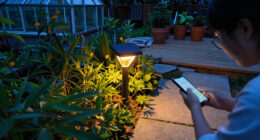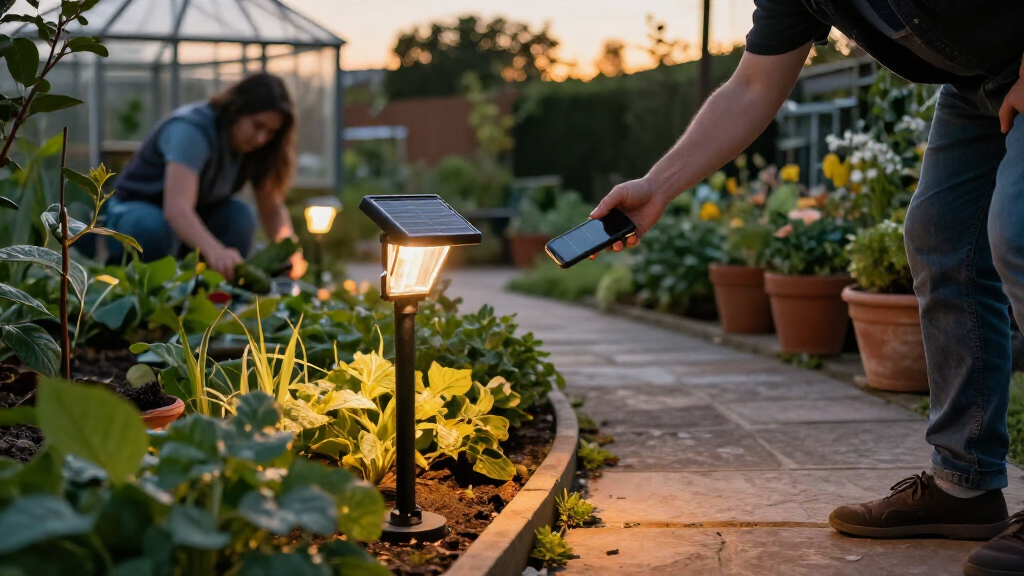

When choosing solar garden lights with smart control, the real decision is how much control you need after installation. App-controlled models connect to a phone, and sometimes to a wider smart-home system, so you can change schedules, brightness, and lighting zones without walking around the garden. Timer- and sensor-controlled models use simpler automation: they switch on at dusk, run for a set period, or respond to movement.

Get garden gear delivered free with Prime
- Fast, free delivery on millions of items
- Prime Video, Amazon Music and more included
- Member-only deals all year

Linkind Smart Solar Spot Lights SL5C – IP67 Waterproof
- ✔ Maximum light output: 150 lumens
- ✔ Color: 16 million RGB colors and tunable white
- ✔ Control: AiDot app, push button; optional Bluetooth Mesh Hub for voice

Linkind Smart Solar Spot Lights Outdoor SL5C, IP67
- ✔ Maximum light output: Up to 800 lumens claimed in this listing
- ✔ Color: 16 million colors
- ✔ Control: AiDot app; voice assistants via optional Bluetooth Mesh Hub

Linkind Smart Solar Spotlights SL5 with Motion Sensor, Christmas Decoration
- ✔ Lighting modes: Motion, luminance/dusk-to-dawn, and continuous
- ✔ Light sources: 28 LEDs listed
- ✔ Color: RGB with cool and warm white options
That flexibility can be useful for a large garden, changing routines, or decorative lighting that you want to adjust for different occasions. It can also add setup steps, compatibility questions, and a higher purchase price. Simpler models suit people who want dependable lighting with little ongoing attention. The comparison below focuses on control, installation, reliability, lighting behavior, weather exposure, and value, so you can decide whether app access solves a real problem in your garden.
At a Glance
| Criteria | App-controlled solar garden lights | Timer- and sensor-controlled solar garden lights | Winner |
|---|---|---|---|
| Control and scheduling | Phone app can offer adjustable schedules, brightness, and group control; features vary by model. | Typically offers dusk-to-dawn operation, a fixed timer, or motion activation. | A |
| Setup and everyday ease | May require app pairing, permissions, and a compatible phone or hub. | Usually ready to use with a switch or simple setting and little configuration. | B |
| Reliability and dependence | Basic lighting can often run from local settings, but remote features depend on the app, radio connection, or hub. | Often works without an app or internet connection, though sensor performance depends on placement. | B |
| Lighting flexibility | More likely to support dimming, zones, scenes, or schedule changes. | Usually limited to built-in modes and fixed brightness. | A |
| Solar and placement constraints | Solar exposure still determines charging; wireless range and hub location may also matter. | Needs good sun and suitable sensor placement, without app connectivity requirements. | B |
| Cost and value | Usually costs more; worthwhile when remote adjustments or grouped control will be used. | Usually less expensive; better value when basic automatic lighting is enough. | Depends |
Linkind Smart Solar Spot Lights SL5C – IP67 Waterproof
For most buyers looking to add smart accents across a garden, this SL5C listing offers the most balanced combination of app scheduling, group syncing, tunable white, and RGB color. Its AiDot app can manage up to 32 lights in as many as eight groups, which is useful when a path, planting bed, and focal tree need different settings without adjusting each fixture individually. The listed maximum output is 150 lumens per fixture, while MPPT charging and up to 14 hours of stated runtime give it a clear role for evening ambience where sunshine is adequate.Compared with the other SL5C listing, this version has a more modest stated output but a clear scheduling emphasis. The other listing claims up to 800 lumens and adds music sync, though its output conflicts with this listing’s 150-lumen figure. We would choose this model when coordinated scenes and flexible color matter more than chasing the largest brightness claim. Its IP67 protection and 360-degree horizontal, 180-degree vertical adjustment also make aiming and outdoor placement more forgiving than the IP65 SL5.The main compromise is that smart control has limits: the listing specifies Bluetooth, and voice operation requires an additional Mesh Hub. There is also no solar fixture that can overcome a shaded location; reduced sun can undermine both charging and runtime. This makes the SL5C a stronger fit for sunny beds and patios than for deeply shaded corners. Buyers who need motion-triggered security-style lighting should look to the SL5 instead, which explicitly lists motion mode.
Pros:
- App schedules and group control for up to 32 lights across eight groups
- RGB colors and tunable white give flexibility for everyday lighting and seasonal displays
- IP67 weather protection with broad horizontal and vertical aiming adjustment
- MPPT charging technology and up to 14 hours of stated continuous runtime
Cons:
- Voice control requires a separate Bluetooth Mesh Hub
- The stated 150-lumen maximum may not suit buyers seeking high-output task lighting
- Charging and runtime depend on sufficient sunlight
Best for: Gardeners who want app schedules, coordinated groups, and flexible color or white-light accents in a reliably sunny area.
Not ideal for: Buyers who need motion activation, built-in voice control without extra hardware, or dependable performance in shaded locations.
Bottom line: We recommend this SL5C as the most balanced smart garden pick when app scheduling and grouped ambience matter more than motion sensing or a higher claimed output.
“We recommend this SL5C as the most balanced smart garden pick when app scheduling and grouped ambience matter more than motion sensing or a higher claimed output.”
Linkind Smart Solar Spot Lights Outdoor SL5C, IP67
This SL5C listing is the feature-rich choice for shoppers who want their garden lights to act as part of a coordinated display. It lists AiDot app control, music synchronization, RGB color, and grouping for up to 32 fixtures. The standout distinction is its stated maximum output of up to 800 lumens, which is substantially higher than the 150-lumen figure in the other SL5C description. Because both listings identify SL5C spotlights yet provide sharply different output claims, we would confirm the specifications for the exact product variant before choosing based on brightness alone.Against the first SL5C, this one is more compelling for colorful events and music-reactive effects, while the first listing makes app scheduling and its 150-lumen specification more explicit. Both describe IP67 protection and broad aiming adjustment; both also rely on sunlight and require an optional Bluetooth Mesh Hub for voice assistant use. The listing says Bluetooth and Wi-Fi, but describes app control through AiDot, so buyers should confirm what connectivity is available for their intended setup rather than assume every smart feature works remotely.Its tradeoffs are practical. The mount choices are limited to wall or ground positions, and a high stated output does not remove the need for a good solar charging location. Music effects may be entertaining, but they are less useful for a quiet everyday path than scheduling or automatic operation. We place this behind the more balanced SL5C because the conflicting brightness details make its main differentiator harder to assess with confidence. It remains the better match for buyers who value music sync and display-oriented color effects and can verify the listing’s output first.
Pros:
- Music synchronization supports dynamic color displays
- App control and group syncing cover up to 32 lights in eight groups
- IP67 protection and versatile horizontal and vertical aiming
- Listing states up to 14 hours of illumination with MPPT charging
Cons:
- Its 800-lumen claim conflicts with the 150-lumen figure in the other SL5C description
- Alexa and Google Home support requires a separate Bluetooth Mesh Hub
- Solar charging can weaken in low-light conditions
Best for: Buyers planning colorful garden displays who want music sync and are willing to verify which output specification applies to their chosen listing.
Not ideal for: Shoppers who need an unambiguous brightness specification, motion-triggered operation, or voice control without an added hub.
Bottom line: Choose this SL5C for music-reactive color effects, but verify its exact brightness specification before making output the deciding factor.
“Choose this SL5C for music-reactive color effects, but verify its exact brightness specification before making output the deciding factor.”
Linkind Smart Solar Spotlights SL5 with Motion Sensor, Christmas Decoration
The SL5 earns a distinct place in this lineup because it is the only option that explicitly lists motion, dusk-to-dawn, and continuous lighting modes. That makes it a better fit for a garden entrance or a planting area where lights should react to movement or follow a basic night-time routine. It also offers RGB and cool-to-warm white illumination through the AiDot app, plus group control for up to 32 lights and music sync for decorative scenes.Compared with either SL5C, this model puts operating modes ahead of the higher brightness claim or IP67 protection. Its IP65 rating is lower than the SL5C models’ IP67, so we would consider placement and exposure when deciding between them. The SL5 descriptions list a 3-watt fixture and 28 light sources, but do not provide a maximum lumen figure here; the SL5C listings offer stated maximum outputs, albeit conflicting ones. If brightness is the priority, the SL5C options are easier to compare by their listed output, with the caveat that those figures disagree.Setup also calls for patience: the product details specify about 48 hours of direct sunlight for the initial charge, and there is no built-in battery indicator to help judge charge status. Voice assistant integration again depends on buying a separate BLE Mesh Hub. We would favor this model over the SL5C when automatic behavior is central to the job, but skip it if the lights will sit in a partly shaded spot or need the stronger listed weather protection of IP67. Its motion feature gives it a practical role; its charging and weather tradeoffs keep it from being the broadest recommendation.
Pros:
- Motion, dusk-to-dawn, and continuous modes support different automatic routines
- RGB and cool-to-warm white options add everyday and decorative flexibility
- App control and group syncing for up to 32 lights
- Wall or ground mounting with broad aiming adjustment
Cons:
- IP65 protection is lower than the IP67 rating on both SL5C listings
- Initial charging is specified as about 48 hours in direct sunlight
- No built-in battery indicator; voice assistant control needs an optional hub
Best for: People who want motion-triggered or dusk-to-dawn garden lighting and value automatic modes over the SL5C’s higher stated weather rating.
Not ideal for: Buyers who prioritize IP67 protection, want a stated lumen maximum, or cannot provide direct sun for initial charging.
Bottom line: Pick the SL5 when motion response and automatic night-time modes matter more than IP67 protection or a clearly stated lumen output.
“Pick the SL5 when motion response and automatic night-time modes matter more than IP67 protection or a clearly stated lumen output.”
As an Amazon Associate we earn from qualifying purchases.
Key Differences
The largest difference is ongoing control. App-controlled lights can let you adjust a schedule or dim a group from indoors, which helps when sunset times change, guests are coming, or you want different settings for a path and a seating area. Basic timer and sensor models are less adaptable, but their limited controls are often easier to understand and less likely to require troubleshooting. For a small garden where the lights can stay on the same routine, that simplicity is a practical advantage.
Neither control style can overcome weak sunlight. Panel placement, seasonal daylight, shade, and battery capacity affect how long solar lights can run. Smart features can add another constraint if the chosen model depends on a phone connection, hub, or particular ecosystem. Buyers should check the product’s documented controls and compatibility rather than assuming every light offers remote operation or works with every smart-home platform.
Price should follow use, not feature count. A premium makes sense when you will regularly change settings, coordinate multiple zones, or want remote adjustments. If you only need lights to switch on at dusk or respond to movement, a basic model is usually the better value. The key question is whether flexible control will make the garden more useful, rather than merely adding another app to maintain.
Detailed Comparison
Control and scheduling (App-controlled solar garden lights wins — moderate)
App-controlled lights win by a moderate margin for people who actually adjust their lighting. Depending on the model, the app may offer schedules, dimming, or control of grouped lights; a timer or sensor generally gives a smaller set of preset behaviors. This means less walking outside to change settings, but only if the app’s features match the buyer’s needs. Someone who leaves lights on the same routine gains little from the extra control.
Setup and everyday ease (Timer- and sensor-controlled solar garden lights wins — moderate)
Timer- and sensor-controlled lights win by a minor to moderate margin for straightforward setup. They commonly need only a switch or mode selection, while app models may require pairing and account or hub configuration. In daily use, both can be automatic after setup. The difference matters most to buyers who want lighting to work without tending to phone settings or troubleshooting a connection.
Reliability and dependence (Timer- and sensor-controlled solar garden lights wins — moderate)
Basic controls have a moderate practical advantage when independence is the priority: a timer or motion sensor can operate without an app or internet connection. Smart models may retain local schedules, but remote control and some integrations can depend on a radio link, hub, software, or phone. Check whether the light continues its core schedule if those features are unavailable. Neither category is immune to battery or sensor problems.
Lighting flexibility (App-controlled solar garden lights wins — moderate)
App-controlled models win by a moderate margin where the garden has distinct uses. Adjustable brightness or separate groups can make it easier to keep a path lit while lowering decorative lights, if the product supports those functions. Basic models tend to offer fixed modes. For a single entrance or short path, the limited settings may be entirely adequate and can reduce decision fatigue.
Solar and placement constraints (Timer- and sensor-controlled solar garden lights wins — minor)
Basic models have a minor advantage because they do not add wireless range or hub placement to the installation checklist. Both types still need suitable sun exposure for their panels, and trees, walls, and seasonal shade can reduce charging. Motion sensors also need a clear view of the area they should detect. App control cannot compensate for a shaded panel, so prioritize solar placement before choosing advanced controls.
Cost and value (moderate difference)
There is no universal winner. Basic models usually cost less and deliver better value when dusk-to-dawn, timer, or motion operation covers the need. App-controlled lights justify a higher price for buyers who will use schedules, dimming, or group adjustments often enough to value the convenience. Compare the actual feature list, battery and panel specifications, and replacement options; the word “smart” alone does not guarantee a better light.
App-controlled solar garden lights: Pros and Cons
Pros:
- Can offer remote schedule and brightness changes.
- May group several lights or zones for coordinated control.
- More adaptable when routines or lighting needs change.
Cons:
- Usually costs more than simpler automated lights.
- Setup and some features may depend on an app, hub, or wireless connection.
- Extra controls do not solve poor solar exposure or limited battery capacity.
Timer- and sensor-controlled solar garden lights: Pros and Cons
Pros:
- Usually simpler to install and operate.
- Basic automatic operation often needs no app or internet.
- Lower purchase cost suits straightforward lighting needs.
Cons:
- Fewer ways to adjust schedules, brightness, or groups.
- Fixed modes may not suit different garden zones or changing routines.
- Motion sensors can require careful positioning to avoid missed or unwanted activation.
Who Should Choose What
Choose App-controlled solar garden lights if:
- You want to change schedules or brightness from indoors.
- Your garden has several lighting zones that you plan to control separately.
- You expect to use the app features regularly and have checked compatibility.
Choose Timer- and sensor-controlled solar garden lights if:
- You want lights to switch on at dusk, run on a timer, or respond to movement with little setup.
- You prefer controls that work without phone access or a smart-home hub.
- Your garden is small or your lighting routine is unlikely to change.
Skip both if: Skip solar models if the intended locations receive too little direct sunlight for reliable charging, or if you need guaranteed all-night output independent of weather. Consider wired lighting or a separately powered system.
Value for Money
Pay more for app control only when its flexibility will change how you use the lights. Frequent schedule changes, dimming, and control of several zones can make the premium worthwhile for a larger or more actively used garden. If your main goal is simply automatic path or entrance lighting, a timer- or sensor-controlled set is typically the stronger value. Check each model’s panel, battery, runtime claims, control features, and replacement support: a basic light with suitable charging and a useful sensor can be a better purchase than a smart model whose app features go unused.
Final Verdict
For most buyers who want simple garden lighting, choose timer- or sensor-controlled solar lights. They cost less, take less effort to configure, and cover the common job of switching on automatically. Choose app-controlled lights if remote adjustments, dimming, or managing multiple zones are specific features you expect to use; then the higher cost buys useful flexibility. The deciding factor is not whether a product is labeled smart, but whether app control solves a recurring inconvenience in your garden. In either case, confirm that the panels will receive enough sun and that the product’s stated controls match your needs.
Frequently Asked Questions
Do app-controlled solar garden lights need Wi-Fi?
It depends on the model. Some use Bluetooth or a local radio connection for nearby control; others require a hub or network for remote access and integrations. Check the product details for which functions work without internet access.
Are smart solar lights brighter than timer-controlled lights?
Smart control does not itself make a light brighter. Brightness depends on the light’s design, battery, and available charge. An app may allow dimming on supported models, but compare the stated light output and runtime rather than the control label.
Are motion sensors or app schedules better for a garden path?
A motion sensor suits an entrance or path used intermittently, since it activates when movement is detected. A schedule suits areas you want lit at predictable times. Some app models offer schedules but not motion sensing, so confirm the specific functions before buying.
Is smart control worth paying extra for?
It is worth the extra cost when you will regularly adjust brightness or timing, or control several groups of lights. For a fixed dusk-to-dawn routine, basic timer or sensor automation usually offers better value.