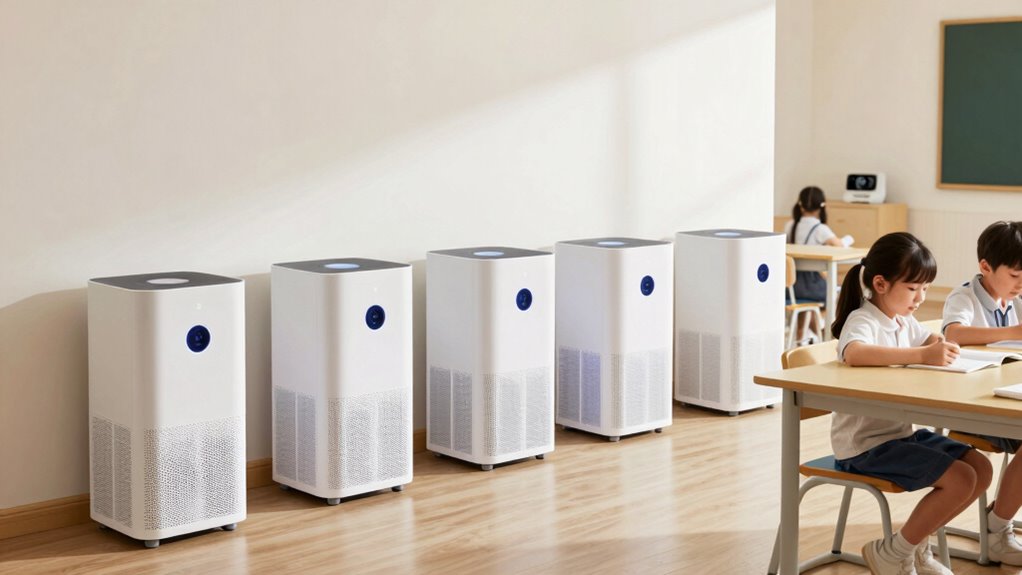
Choosing an air purifier for a classroom comes down to three competing demands: enough clean air delivery for a 600–1,000 sq ft room of 25+ students, quiet operation that won’t disrupt lessons, and a price plus filter-replacement schedule a school budget can actually sustain. The LEVOIT Vital 200S-P earns my best overall pick because it balances high coverage (up to 1,875 sq ft), a true auto mode, and app scheduling that lets custodial staff manage it remotely. The Blueair Blue Pure 211i Max is the stronger choice if raw air changes per hour matter most, while the budget-priced GermGuardian AC4825E proves a basic HEPA unit can still make sense for a single small classroom. The main tradeoff in this category is performance versus noise and filter costs — read on for the full breakdown of all 12 models.

Get garden gear delivered free with Prime
- Fast, free delivery on millions of items
- Prime Video, Amazon Music and more included
- Member-only deals all year
Complete the kit


Key Takeaways
- Auto mode with a real particle sensor separated the LEVOIT Vital 200S-P, Blueair 211i Max, and DREO from basic models like the GermGuardian AC4825E, which rely on manual speed control and can’t respond to rising particle counts during busy classroom hours.
- Washable pre-filters or dual filters (Dhyala, Blueair) noticeably cut long-term costs — a real advantage when a single classroom unit may need filter changes 2–3 times per year under heavy daily use.
- Budget models under $60 like the MOOKA and VOOPNU are rated for small spaces only; they work for resource rooms and offices but cannot deliver enough air changes for a full-size classroom of 25–30 students.
- Night/sleep mode performance mattered more than expected — classrooms used for after-school programs and evening events benefit from units like the FreAire and Tolife that stay under 30 dB on low.
- Smart WiFi features divided the lineup sharply: the Dhyala and LEVOIT allow remote scheduling by front-office staff, while simpler units require physical access every time settings need adjusting — a hassle for mounted or hard-to-reach placements.
| MOOKA Air Purifier for Home, White |  | Best Overall | Coverage: Up to 2,200 sq ft | Filtration: Three-stage with HEPA and washable pre-filter | Air quality monitoring: PM2.5 sensor and digital display | VIEW ON AMAZON | See Our Full Breakdown |
| VOOPNU Air Purifier with High-Efficiency Filter, White |  | Best Compact Pick | Coverage area: Up to 1,076 ft² | Dimensions: 6.69 × 6.69 × 9.84 inches | Filtration: Three-layer filtration system | VIEW ON AMAZON | See Our Full Breakdown |
| MOOKA PR1 Air Purifier for Large Rooms, White |  | Best for Classrooms with Pets | Coverage area: Up to 2,200 sq. ft. | Filtration: Four-stage system with washable pre-filter | Fan modes: 6 (Sleep, I, II, III, Auto, Pet) | VIEW ON AMAZON | See Our Full Breakdown |
| Dhyala HEPA Air Purifier for Large Rooms up to 3000 sq ft |  | Best Premium Smart Pick | Coverage area: Up to 3,000 sq ft | CADR: 265 CFM | Filtration: 3-stage dual filters (pre-filter + HEPA + activated carbon) | VIEW ON AMAZON | See Our Full Breakdown |
| Purivortex PX700 HEPA Air Purifier for Home and Pets, White |  | Best Value for Large Coverage | Coverage: Up to 2,640 sq. ft. in one hour | Filtration: Three-layer: pre-filter, HEPA, activated carbon | Particle filtration: 99.97% of particles as small as 0.1 microns | VIEW ON AMAZON | See Our Full Breakdown |
| LEVOIT Vital 200S-P Smart Air Purifier for Large Rooms up to 1875 sq ft |  | Best Overall for Full-Classroom Coverage | Coverage Area: Up to 1875 sq ft | CADR Smoke: 250 CFM | CADR Dust: 254 CFM | VIEW ON AMAZON | See Our Full Breakdown |
| Blueair Blue Pure 211i Max Large Room Air Purifier, Blue |  | Best for Open-Plan Spaces and Combined Classrooms | Coverage Area: Up to 3,235 sq ft | Filtration Technology: HEPASilent dual filtration | Air Cleaning Rate: 674 sq ft in 12.5 minutes | VIEW ON AMAZON | See Our Full Breakdown |
| GermGuardian AC4825E 22-Inch HEPA Air Purifier, Gray |  | Best Budget Pick for Small Classrooms | Model: AC4825E | Height: 22 inches | Room Coverage: 153 sq ft every 12.5 minutes; up to 743 sq ft once per hour | VIEW ON AMAZON | See Our Full Breakdown |
| FreAire KN6391RGB Air Purifier for Bedroom, Up to 1086 Ft², Black |  | Best Quiet Option for Nap and Reading Corners | Model: KN6391RGB | Coverage Area: Up to 1086 sq ft per hour | Filtration: 3-level HEPA filtration system | VIEW ON AMAZON | See Our Full Breakdown |
| DREO Air Purifier with HEPA Filter, PM2.5 Monitor, Auto and Sleep Modes, and Scent Diffuser |  | Best for Air Quality Visibility on a Desk or Shelf | Model: DR-HAP008 (Dreo 338) | CADR: 115 CFM (AHAM verified) | Room Coverage: Up to 178 sq ft at 4.8 air changes per hour; up to 856 sq ft at 1 air change per hour | VIEW ON AMAZON | See Our Full Breakdown |
| Tolife Air Purifier for Large Rooms up to 1,095 sq ft with Sleep Mode |  | Best Set-and-Forget Scheduling | Filtration: H13 | Particle capture size: As small as 0.3 microns | Coverage area: Up to 1,095 sq ft | VIEW ON AMAZON | See Our Full Breakdown |
| Afloia Kilo Air Purifier for Home Large Rooms up to 1500 Sq Ft (White) |  | Best Confirmed-Quiet Option | Filter Type: 4-Stage (Washable Pre-Filter, HEPA, Activated Carbon) | Particle Retention Size: 0.3 microns | Coverage Area: Up to 1500 sq ft | VIEW ON AMAZON | See Our Full Breakdown |
| air purifier for classroom | Filtration | Coverage area |
|---|---|---|
| MOOKA Air Purifier for Home | Three-stage with HEPA and washable pre-filter | — |
| VOOPNU Air Purifier with High- | Three-layer filtration system | Up to 1,076 ft² |
| MOOKA PR1 Air Purifier for Lar | Four-stage system with washable pre-filter | Up to 2,200 sq. ft. |
| Dhyala HEPA Air Purifier for L | 3-stage dual filters (pre-filter + HEPA + activated carbon) | Up to 3,000 sq ft |
| Purivortex PX700 HEPA Air Puri | Three-layer: pre-filter, HEPA, activated carbon | — |
| LEVOIT Vital 200S-P Smart Air | — | Up to 1875 sq ft |
| Blueair Blue Pure 211i Max Lar | — | Up to 3,235 sq ft |
| GermGuardian AC4825E 22-Inch H | True HEPA; captures 99.97% of particles as small as 0.1 microns | — |
| FreAire KN6391RGB Air Purifier | 3-level HEPA filtration system | Up to 1086 sq ft per hour |
| DREO Air Purifier with HEPA Fi | — | — |
| Tolife Air Purifier for Large | H13 | Up to 1,095 sq ft |
| Afloia Kilo Air Purifier for H | — | Up to 1500 sq ft |
More Details on Our Top Picks
MOOKA Air Purifier for Home, White
For a standard classroom, this MOOKA model hits the sweet spot between 2,200 sq ft of coverage and day-to-day usability. The PM2.5 sensor with auto mode means the unit ramps up on its own when the air gets noticeably worse — say, after recess or a dusty art project — so a teacher never has to fiddle with settings mid-lesson. Compared with the Purivortex PX700, this model trades a bit of raw coverage for a quieter 20 dB sleep mode and a slightly more polished feature set, including a child lock that matters a lot in rooms full of curious hands. The washable pre-filter stretches filter budgets, which any school purchasing department will appreciate. The honest tradeoff: filters are a recurring cost, and you must remember to remove the protective plastic before first use or the unit will do nothing.
Pros:- Washable pre-filter extends HEPA filter life and cuts long-term costs
- PM2.5 display and auto mode respond to changing classroom air
- 20 dB sleep mode with lights off for quiet reading time
- Child lock prevents students from changing settings
Cons:- Replacement filters are a separate recurring expense
- Protective plastic must be removed manually before first use
Best for: Teachers who want set-and-forget operation in a full-size classroom with minimal supervision
Not ideal for: Buyers who want voice control or app scheduling — this unit has neither, unlike the Dhyala
- Coverage:Up to 2,200 sq ft
- Filtration:Three-stage with HEPA and washable pre-filter
- Air quality monitoring:PM2.5 sensor and digital display
- Fan speeds:4
- Timer settings:2, 4, 6, or 8 hours
- Sleep mode noise:As low as 20 dB
- Certifications:CARB, ETL, DOE
Our verdict“The most balanced pick for a typical classroom — broad coverage, automatic adjustment, and student-proof controls at a midrange commitment.”
VOOPNU Air Purifier with High-Efficiency Filter, White
At under 7 inches square, the VOOPNU is the smallest unit in this lineup, and that size is its entire argument. Not every teaching space is a full classroom — resource rooms, offices, therapy corners, and small intervention groups can’t justify a floor-standing tower like the MOOKA PR1. This one tucks onto a desk or shelf and still delivers 99.97% particle capture through 360-degree intake. It runs as low as 22 dB, quiet enough that it won’t compete with a reading circle. The realistic limitation is capacity: rated for 1,076 sq ft, it will run continuously just to keep pace in anything larger, and the manufacturer explicitly recommends always-on operation. It also depends on genuine replacement filters — off-brand filters can cut efficiency or damage the unit, which limits sourcing flexibility.
Pros:- Compact footprint fits desks, shelves, and corners
- Quiet 22 dB operation suits one-on-one sessions
- 360-degree surround intake improves airflow in tight spaces
- Essential oil tray adds optional calming scents
Cons:- Manufacturer recommends continuous operation for acceptable results
- Off-brand replacement filters may reduce efficiency or damage the unit
Best for: Teachers furnishing small resource rooms, offices, or intervention spaces who need desktop-scale purification
Not ideal for: Full-size classrooms — the 1,076 sq ft rating can’t keep up with 25+ students’ worth of dust and germs
- Coverage area:Up to 1,076 ft²
- Dimensions:6.69 × 6.69 × 9.84 inches
- Filtration:Three-layer filtration system
- Pollutant capture:99.97%
- Noise level:As low as 22 dB
- Airflow:360° surround air intake
- Certifications:DOE, ETL, FCC, CARB, CE, RoHS
Our verdict“A sensible small-space companion that trades coverage for placement flexibility — buy it for the reading corner, not the homeroom.”
MOOKA PR1 Air Purifier for Large Rooms, White
Where this MOOKA sibling separates itself from the standard MOOKA model is its dedicated Pet Mode and a fourth filtration stage. That combination makes it the clear pick for classrooms with a resident class hamster, guinea pig, or therapy animal, where hair and dander are a daily reality rather than an occasional nuisance. The six fan modes give finer control than most rivals here, and the washable pre-filter takes the brunt of pet hair so the inner filter lasts longer. It matches the 2,200 sq ft coverage of its stablemate and adds the same child lock and PM2.5 display that make MOOKA units classroom-friendly. Two things temper the recommendation: filters need replacing every 3–6 months, which adds up on a school budget, and the PM2.5 display can read 005 during normal operation, which may confuse anyone expecting a zero baseline.
Pros:- Pet Mode runs targeted airflow cycles for hair and dander
- Four-stage filtration adds capacity over three-stage rivals
- Washable pre-filter captures pet hair and extends filter life
- Child lock and quiet 26 dB sleep mode suit classroom hours
Cons:- Filter replacements every 3–6 months create ongoing costs
- PM2.5 display may show 005 during use, which can be misread
Best for: Classrooms with class pets or therapy animals where hair and dander drive air quality complaints
Not ideal for: Buyers wanting the widest coverage — the Dhyala’s 3,000 sq ft rating and CADR figure outclass it
- Coverage area:Up to 2,200 sq. ft.
- Filtration:Four-stage system with washable pre-filter
- Fan modes:6 (Sleep, I, II, III, Auto, Pet)
- Sleep mode noise:As low as 26 dB
- Sensor:PM2.5 air quality sensor
- Additional features:Timer, child lock, aroma function, filter reminder
- Filter replacement interval:Every 3–6 months
Our verdict“The pet-first choice — pick this over the standard MOOKA when a class animal makes dander and odor the primary problem.”
Dhyala HEPA Air Purifier for Large Rooms up to 3000 sq ft
This is the most feature-loaded option in the batch, and the only one with WiFi app control plus Alexa and Google Assistant. That matters in a classroom context: a teacher (or facilities manager) can schedule run times, check the AQI display, and adjust settings without walking across the room. With 3,000 sq ft of coverage and a 265 CFM CADR, it out-purifies the MOOKA PR1 and is the right scale for open-plan learning spaces or double classrooms. Dual washable pre-filters soften the replacement-cost blow, and the 15 dB sleep mode is the quietest here — effectively silent. The safety package is also the strongest, with tip-over auto shutoff and an anti-chew power cord. The catches: the main HEPA filters still need periodic replacement at unspecified cost, and smart features assume reliable school WiFi, which is not a given everywhere.
Pros:- Largest coverage in this batch at 3,000 sq ft with 265 CFM CADR
- WiFi app, Alexa, and Google Assistant control for remote management
- 15 dB sleep mode is the quietest of the group
- Tip-over shutoff and anti-chew cord add real classroom safety
Cons:- Main HEPA filters still require periodic replacement despite washable pre-filters
- Replacement filter costs are not specified upfront
Best for: Tech-forward schools with open-plan classrooms, WiFi access, and staff willing to manage settings remotely
Not ideal for: Classrooms without dependable WiFi — you’d be paying for smart features you can’t use
- Coverage area:Up to 3,000 sq ft
- CADR:265 CFM
- Filtration:3-stage dual filters (pre-filter + HEPA + activated carbon)
- Smart features:WiFi app, Alexa and Google Assistant voice control
- Air quality sensor:PM2.5 sensor with AQI display
- Noise level:As low as 15 dB in sleep mode
- Safety features:Child lock, anti-chew cord, tip-over auto shutoff
- Warranty:24 months
Our verdict“The premium pick for large, connected learning spaces where remote control and maximum throughput justify the extra features.”
Purivortex PX700 HEPA Air Purifier for Home and Pets, White
The PX700 stakes its claim on numbers: 2,640 sq ft of coverage per hour and filtration down to 0.1 micron particles, which undercuts finer than the typical 0.3 micron HEPA claim made by the VOOPNU. Read the coverage figure carefully, though — it describes one air refresh per hour, so in a full classroom it’s effectively a steady-circulation machine rather than an overpowered one. Its 30-minute Pet Mode cycle gives it some of the pet-handling capability of the MOOKA PR1 without that model’s fourth filtration stage. The PM2.5 readout with a color indicator is genuinely useful for students learning about air quality, and the 20 dB sleep mode with a dark display suits quiet-work periods. Odor control is the weak point: it’s rated for light household odors only, so a room with persistent smells needs more carbon.
Pros:- Covers up to 2,640 sq ft per hour at a value price point
- Captures particles as small as 0.1 microns
- PM2.5 numeric and color display makes air quality visible to students
- Washable pre-filter and 20 dB sleep mode with dark display
Cons:- Coverage figure reflects only one air change per hour, not high-frequency turnover
- Activated carbon handles light odors only, not persistent smells
Best for: Budget-conscious buyers who want maximum rated coverage and auto-adjusting operation without paying for smart features
Not ideal for: Rooms where odor is the main complaint — its carbon layer only handles light smells
- Coverage:Up to 2,640 sq. ft. in one hour
- Filtration:Three-layer: pre-filter, HEPA, activated carbon
- Particle filtration:99.97% of particles as small as 0.1 microns
- Pet Mode:30-minute airflow cycle
- Air quality monitoring:PM2.5 sensor with numeric and color display
- Sleep mode:As low as 20 dB, display off
- Pre-filter:Removable and washable
Our verdict“The coverage-per-dollar pick for a standard classroom — just don’t expect it to solve an odor problem.”
LEVOIT Vital 200S-P Smart Air Purifier for Large Rooms up to 1875 sq ft
For a standard classroom of 25–35 students, clean air delivery needs to be fast and independently verified, and this is where the Vital 200S-P pulls ahead of the pack. Its AHAM VERIFIDE certification means the CADR numbers aren’t marketing claims — the 250 CFM smoke rating is enough to cycle a typical classroom’s air several times per hour. Compared with the Blueair Blue Pure 211i Max, the LEVOIT covers less total square footage but costs less to keep running and the U-shaped inlet is a genuine classroom advantage, since glue, glitter, and tracked-in debris won’t clog the intake the way they can on 360-degree designs. The smart features let a teacher or facilities manager monitor air quality without hovering over the unit. The tradeoff: filters are a recurring budget line, and the footprint is generous for a cramped room.
Pros:- AHAM VERIFIDE certification with independently tested CADR ratings
- Smoke CADR of 250 CFM handles multiple air changes per hour in typical classrooms
- U-shaped inlet resists clogging from debris-heavy environments
- Smart controls allow remote monitoring without interrupting class
Cons:- Replacement filters represent a recurring expense for school budgets
- Bulky footprint is awkward in crowded or small classrooms
Best for: Schools and teachers who need verified, high-CADR purification for a full-size classroom on a daily basis
Not ideal for: Small resource rooms or offices under 300 sq ft, where this unit’s size and capacity are overkill
- Coverage Area:Up to 1875 sq ft
- CADR Smoke:250 CFM
- CADR Dust:254 CFM
- CADR Pollen:289 CFM
- Certification:AHAM VERIFIDE
- Smart Features:Yes
- Inlet Design:U-shaped anti-clog air inlet
Our verdict“The safest all-around choice when one unit has to reliably clean a full classroom every day.”
Blueair Blue Pure 211i Max Large Room Air Purifier, Blue
When the space to clean is a combined classroom, library corner, or open-plan commons area, raw airflow matters more than anything else, and the 211i Max delivers more of it than anything else in this lineup — cleaning 674 sq ft every 12.5 minutes. Where the LEVOIT Vital 200S-P tops out at 1875 sq ft of coverage, this Blueair pushes to 3235 sq ft, making it the obvious pick for schools with flexible, non-walled learning environments. The built-in air quality sensors automatically raise fan speed when a room full of students stirs up dust, so nobody has to manage it manually. Its weakness is physical: the 360-degree intake and large cylindrical body eat floor space and invite curious hands (and backpacks) to block airflow, so placement needs thought in a busy classroom.
Pros:- Highest airflow in the lineup, cleaning 674 sq ft in 12.5 minutes
- HEPASilent dual filtration captures smoke, allergens, dander, and mold particles
- Automatic sensors adjust fan speed without adult supervision
- Quiet and energy-efficient enough for reading time or testing periods
Cons:- Large cylindrical footprint consumes significant classroom floor space
- Ongoing filter costs for a unit this powerful
Best for: Open-plan schools, multipurpose rooms, and shared learning commons that need maximum airflow on autopilot
Not ideal for: Traditional enclosed classrooms under 500 sq ft with limited floor space near outlets
- Coverage Area:Up to 3,235 sq ft
- Filtration Technology:HEPASilent dual filtration
- Air Cleaning Rate:674 sq ft in 12.5 minutes
- Smart Features:Air quality sensors, auto fan speed, Blueair app control
- Filter Tracking:App-based filter life tracking
- Air Intake:360-degree
- Design:Scandinavian minimalist, blue
Our verdict“The right call when one big space — not one standard room — needs to stay clean all day.”
GermGuardian AC4825E 22-Inch HEPA Air Purifier, Gray
Not every classroom needs — or can fund — a smart, app-connected purifier. The AC4825E takes the opposite approach from the Blueair 211i Max: a straightforward tower with three speeds, True HEPA filtration down to 0.1 microns, and no connectivity to set up or fail mid-semester. For a self-contained classroom around 150–200 sq ft, its one-air-change-per-12.5-minute rating is adequate, and the activated carbon pre-filter quietly handles lunch-period odors and dry-erase marker smell. The Zero Ozone verification matters in schools where UV-C units sometimes raise parent questions. The honest tradeoff versus the LEVOIT Vital 200S-P is speed and coverage: in a larger room this unit works hard just to keep pace, so it’s best matched to the room it was sized for, not the biggest room in the building.
Pros:- True HEPA filtration captures 99.97% of particles down to 0.1 microns
- Activated carbon pre-filter reduces classroom and food odors
- Sleep mode runs quietly during quiet work time
- Zero Ozone Verified and CARB certified for school-sensitive settings
Cons:- Coverage is genuinely limited — best in small rooms only
- Ongoing replacement filters and optional UV-C bulbs add maintenance
Best for: Teachers funding a purifier out of pocket for a small self-contained classroom
Not ideal for: Large or open-plan rooms above roughly 300 sq ft, where the CADR can’t keep up with occupancy
- Model:AC4825E
- Height:22 inches
- Room Coverage:153 sq ft every 12.5 minutes; up to 743 sq ft once per hour
- Filtration:True HEPA; captures 99.97% of particles as small as 0.1 microns
- Additional Features:Activated carbon pre-filter; optional UV-C light
- Fan Speeds:3, including sleep mode
- Certifications:CARB Certified, ETL Certified, Zero Ozone Verified
- Compatible Filters:GermGuardian Filter B
Our verdict“A dependable, no-frills HEPA tower for small classrooms where upfront cost is the deciding factor.”
FreAire KN6391RGB Air Purifier for Bedroom, Up to 1086 Ft², Black
Early-childhood classrooms and rooms with a quiet corner have a specific need: a purifier that cleans without humming over story time. The FreAire’s 20 dB sleep mode is the quietest operation in this batch, quieter than the DREO’s sleep mode and far below the GermGuardian AC4825E at speed. Read the coverage claim carefully, though — 1086 sq ft is per hour, not per 12.5 minutes like the Blueair, so this unit refreshes a full classroom slowly and suits a dedicated quiet zone or smaller room far better. The 3-level HEPA filtration handles pollen and dust down to 0.3 microns, and the aromatherapy pad is a nice touch for calming environments, though oils come separately and some schools restrict them. Compared with the DREO, it trades real-time air monitoring for silence and ambient lighting.
Pros:- Sleep mode runs as low as 20 dB, the quietest in this lineup
- 3-level HEPA filtration captures particles down to 0.3 microns
- Dual-channel intake with 360-degree output for even circulation
- Three ambient light modes suit calming classroom corners
Cons:- 1086 sq ft coverage is per hour, so large rooms refresh slowly
- Essential oils for the aromatherapy pad are not included
Best for: Preschool and kindergarten teachers who need near-silent purification during naps and quiet activities
Not ideal for: Full-size classrooms needing rapid air changes, since its large coverage figure is per hour
- Model:KN6391RGB
- Coverage Area:Up to 1086 sq ft per hour
- Filtration:3-level HEPA filtration system
- Minimum Particle Size:0.3 microns
- Noise Level:As low as 20 dB (sleep mode)
- Air Design:Dual-channel inlet, 360-degree outlet
- Ambient Lights:3 modes
- Aromatherapy:Essential oil pad (oils not included)
Our verdict“A calm-corner specialist — pick it for silence and soft lighting, not for fast whole-room turnover.”
DREO Air Purifier with HEPA Filter, PM2.5 Monitor, Auto and Sleep Modes, and Scent Diffuser
The DREO’s standout classroom feature is the real-time PM2.5 display — teachers can literally show students the number drop after recess or during wildfire-smoke days, which turns air cleaning into a visible lesson. Where the LEVOIT Vital 200S-P offers smart control at classroom scale, the DREO delivers smart feedback at desk scale: 178 sq ft at 4.8 air changes per hour is its honest working size, making it ideal for a teacher’s desk zone, resource room, or small office rather than a room of 30 kids. Auto mode responds to the sensor without intervention, sleep mode darkens the display, and ENERGY STAR certification keeps operating costs low. The catch is simple: buy it for a small space, because its AHAM-verified coverage is the most limited in this batch.
Pros:- Real-time PM2.5 sensor with an easy-to-read AQI display makes air quality visible
- Auto mode adjusts fan speed without manual control
- Sleep mode turns off display lights for dark rooms
- ENERY STAR certified at roughly 125 kWh annually
Cons:- AHAM-verified coverage at 4.8 air changes per hour is limited to 178 sq ft
- No app connectivity, so monitoring requires line of sight to the unit
Best for: Teachers who want a visible, real-time air quality readout for a small classroom, office, or desk area
Not ideal for: Whole-classroom purification — its verified coverage tops out at 178 sq ft at proper air-change rates
- Model:DR-HAP008 (Dreo 338)
- CADR:115 CFM (AHAM verified)
- Room Coverage:Up to 178 sq ft at 4.8 air changes per hour; up to 856 sq ft at 1 air change per hour
- Filter:Three-layer filter: pre-filter, high-efficiency filter, activated carbon
- Modes:Auto, Turbo, Sleep, Normal
- Fan Speeds:4
- Air Quality Monitoring:PM2.5 sensor with AQI display (1–999)
- Certifications:AHAM Verified; ENERGY STAR
Our verdict“A compact, transparent air-quality sidekick for small spaces — not a whole-classroom workhorse.”
Tolife Air Purifier for Large Rooms up to 1,095 sq ft with Sleep Mode
School days run on schedules, and this is where the Tolife separates itself from packmates like the MOOKA PR1 or the GermGuardian AC4825E. Its daily cycle timer means a teacher can set it once and have it kick on before the first bell without touching it again, and the 2/4/6/8-hour timers cover shorter blocks like a single class period. Coverage up to 1,095 sq ft handles most classrooms comfortably, and the washable pre-filter keeps maintenance cheap when chalk dust and playground grit pile up. Sleep Mode with lights off makes it viable for rooms doubling as nap or reading spaces. The tradeoff: unlike the Afloia Kilo, no decibel rating is published, so noise-sensitive placements are a gamble, and the unspecified filter lifespan makes long-term budgeting harder.
Pros:- Daily cycle timer automates operation around school hours
- Washable pre-filter cuts replacement costs in dusty rooms
- 1,095 sq ft coverage suits full-size classrooms
- Sleep Mode with lights off works for nap and quiet time
Cons:- No published noise level, making loudness a guessing game
- Filter lifespan and replacement cost are unspecified
Best for: Teachers and administrators who want a purifier that runs on a preset daily schedule with zero daily fuss
Not ideal for: Noise-sensitive classrooms or special education spaces, since no sound output rating is published
- Filtration:H13
- Particle capture size:As small as 0.3 microns
- Coverage area:Up to 1,095 sq ft
- Fan speeds:3 (L1/L2/L3)
- Pre-filter:Washable
- Timer settings:2, 4, 6, and 8 hours
- Features:Sleep Mode, lights off, filter replacement reminder, daily cycle timer
Our verdict“Pick the Tolife if automated daily scheduling matters more to you than confirmed quiet operation.”
Afloia Kilo Air Purifier for Home Large Rooms up to 1500 Sq Ft (White)
Where the Tolife leaves its noise level a mystery, the Afloia Kilo answers the question outright with a 22 dB sleep mode, quieter than a whisper. For classrooms where testing, reading, or recorded lessons happen, that number is the whole argument. Its 4-stage filtration adds an activated carbon layer the basic HEPA-only models skip, helping with lunch smells, dry-erase marker fumes, and other classroom odors. The auto-dimming light and 16-hour timer cover a full school day on one setting, and specialty filters (Pet Allergy, Antibacterial) let schools tailor filtration to specific needs. Be realistic about coverage, though: 4 air changes per hour only applies to 374 sq ft, so a true 1,500 sq ft space gets cleaned just once per hour, far slower than the Blueair Blue Pure 211i Max at that size. Filters also need swapping every 4–6 months.
Pros:- Verified 22 dB sleep mode with auto-dimming light
- 4-stage filtration includes activated carbon for odors
- Specialty replacement filters for allergies and bacteria
- 16-hour timer covers a full school day
Cons:- Only 374 sq ft achieves 4 air changes per hour
- Replacement filters every 4-6 months add recurring cost
Best for: Schools prioritizing verified quiet operation during tests and quiet work, plus odor control from a carbon filter stage
Not ideal for: Gyms, cafeterias, or open-plan spaces near the 1,500 sq ft limit, where one air change per hour falls short
- Filter Type:4-Stage (Washable Pre-Filter, HEPA, Activated Carbon)
- Particle Retention Size:0.3 microns
- Coverage Area:Up to 1500 sq ft
- Noise Level:22 dB
- Timer Options:2, 4, 8, 16 hours
- Power / Wattage:AC, 23 watts
- Dimensions:8″D x 8″W x 15″H
- Weight:4.8 pounds
- Certification:CARB Certified
Our verdict“Choose the Kilo when a documented 22 dB rating and odor-fighting carbon stage matter more than maximum square footage.”

How We Picked
My ranking starts with clean air delivery relative to classroom size. A typical classroom runs 600–1,000 sq ft with 25–30 occupants generating constant particulates, so I prioritized units with adequate square-footage ratings and, where available, verified CADR figures. A unit that only covers a bedroom will circulate air in a small zone while the far side of the room stays untreated.
From there I weighed noise at classroom-relevant speeds, filter replacement costs and availability, auto-mode intelligence, and durability for 8-hour daily operation. Units with washable pre-filters or multi-year filter availability scored higher on total cost of ownership, which matters for schools buying on annual budgets. Finally, I considered ease of use for teachers and custodians — app control, clear air-quality displays, and simple controls all earned extra weight, while gimmicks like RGB lighting (FreAire) and scent diffusion (DREO) were treated as neutral at best in a classroom context.
Factors to Consider When Choosing Air Purifier For Classroom
Before settling on a specific model, it helps to understand what actually drives air quality outcomes in a classroom — because the wrong unit in the right room still fails students. These are the factors I weighed most heavily, plus the mistakes I see buyers make repeatedly.Match Air Changes to Room Size, Not the Box Rating
Manufacturers quote square footage based on roughly two air changes per hour, but classrooms ideally need four to six air changes per hour during occupancy. That means buying a unit rated for at least double your classroom’s actual square footage — a 700 sq ft room calls for a purifier rated around 1,400 sq ft or more. A common mistake is trusting the box number literally and ending up with a unit running at max speed all day, which is loud and burns through filters faster. Models like the Blueair 211i Max and LEVOIT Vital 200S-P give you headroom to run at medium speed where they’re quieter and more efficient. When in doubt, calculate coverage from the CADR figure: multiply CADR (cfm) by 60 and divide by room volume in cubic feet.
Noise Levels and Where the Unit Sits
In a classroom, noise isn’t a comfort issue — it’s a learning issue. Anything above roughly 50 dB competes with teacher instruction, especially for students sitting near the unit. Look at the lowest and medium speed ratings rather than the max, because a well-sized purifier should spend most of its day on low or auto. Placement matters too: corner placement behind a bookshelf chokes airflow, while center-of-room or near-teacher placement improves circulation but puts noise closer to students. Units with dedicated sleep modes (Tolife, FreAire, DREO) give flexibility for rooms that double as study halls or after-school spaces.
Total Cost of Ownership Over Three Years
The purchase price is often less than half the real cost. A classroom purifier running 8 hours daily may need filter replacements two to three times per year, and replacement filters range widely in price and availability. Before buying, check that replacement filters are stocked consistently and calculate three years of consumables. Washable pre-filters and dual-stage designs (Dhyala, Blueair) meaningfully reduce this burden because the washable layer catches large dust — and classrooms generate plenty of it. A cheap purifier with expensive, hard-to-find filters can cost more over three years than a premium unit with affordable, widely stocked replacements.
Auto Mode and Air Quality Sensors
A real particle sensor transforms how a purifier behaves in a classroom. Instead of guessing a speed setting, auto mode ramps up during high-particulate moments — recess re-entry, art projects, sweeping — and drops back down when air clears. Models with visible PM2.5 or AQI displays (DREO, Dhyala) also give teachers and parents visible proof the unit is working, which helps with buy-in for classroom air quality programs. The tradeoff: sensor-equipped units cost more upfront, and budget models like the GermGuardian and MOOKA skip this entirely. If the purifier will be managed by one attentive person, manual control is workable; if it’s teacher-managed among a dozen other responsibilities, auto mode pays for itself.
Safety, Build, and Classroom-Practical Features
Classrooms introduce risks a bedroom never sees: curious hands, tipped units, and cable hazards. Look for stable bases, child-lock features where available, and rounded corners over lightweight tall towers that tip easily. Avoid units with dangling cords near walking paths, and consider whether a scent-diffusion feature (like the DREO’s) is appropriate — many schools prohibit fragrance products due to allergies and asthma triggers. Wall-adjacent placement needs clearance on all air-intake sides, so verify the intake design before committing to a spot. Finally, filter access matters: teachers will be swapping filters, so tool-free, latch-based designs beat units requiring disassembly.
One Big Unit vs. Two Small Units
A pattern worth knowing: two mid-size purifiers often outperform one large unit in a rectangular classroom, because they create better air circulation and provide redundancy if one fails. Two units can also each run at lower, quieter speeds. The downside is doubled filter costs and twice the maintenance tracking. If your classroom has dead zones — a reading corner far from the main HVAC return — a second small unit like the MOOKA or VOOPNU placed in that zone may solve the problem for less than upgrading the primary unit. Sketch the room, note where students actually sit, and buy coverage for the occupied zones rather than the room’s total floor area.
Frequently Asked Questions
How many air changes per hour does a classroom purifier actually need?
Most experts recommend four to six air changes per hour for occupied classrooms, which is roughly double what most manufacturers base their square-footage ratings on. That means a 700 sq ft classroom needs a purifier rated for 1,400 sq ft or more, or equivalently a CADR around 230+ cfm. You can verify any unit with simple math: divide CADR by room volume in cubic feet, then multiply by 60. Units like the Blueair 211i Max and LEVOIT Vital 200S-P hit this threshold comfortably for standard classrooms, while bedroom-rated models fall short unless you run several of them. Undersizing is the single most common and expensive mistake in this category.
Is a smart WiFi purifier worth it in a school setting, or is it a security headache?
It depends on who manages the unit. If a custodian or facilities coordinator oversees multiple classrooms, app-based scheduling and remote control (available on the LEVOIT Vital 200S-P and Dhyala) save significant time — settings can be locked in once and adjusted without visiting each room. If a single teacher manages one unit, smart features add little value and a simple control panel works fine. Some school IT departments restrict WiFi-connected devices on their networks, so check with your district before buying a smart model. The pragmatic middle ground: models with auto mode and onboard scheduling work well even without WiFi connectivity.
Where should I place an air purifier in a classroom?
Placement affects performance as much as the unit itself. Position the purifier near the center of the occupied zone if possible, with at least 8–12 inches of clearance on all intake sides — corners and bookshelf alcoves choke airflow and can cut effective cleaning dramatically. Avoid placement directly next to the teacher’s desk if noise on higher speeds would be distracting, and keep cords routed along walls with covers to prevent trips. In rectangular rooms, two smaller units at opposite ends often circulate air better than one large unit at one end. Finally, keep units away from radiator vents and open windows, since competing airflow patterns reduce how much room air actually passes through the filter.
Can a cheap purifier like the GermGuardian or MOOKA work for a classroom, or do I need to spend more?
Budget units work in the right context. The GermGuardian AC4825E handles a small classroom or resource room around 300–400 sq ft adequately, and the MOOKA or VOOPNU suit offices and intervention spaces under 300 sq ft. The failure mode is asking a budget unit to clean a full 700–900 sq ft classroom of 25+ students — it will run at max speed constantly, stay loud, and still under-deliver air changes. Budget models also tend to lack auto mode and sensors, so someone must adjust them manually throughout the day. My rule: under $80 for spaces under 400 sq ft, and step up to a large-room model like the Tolife or Afloia Kilo for full-size classrooms.
How often will I need to replace filters, and what will that cost a school budget?
Under 8-hour school-day use, expect HEPA filter replacements every 4–6 months, with pre-filters cleaned monthly. That works out to two or three full filter changes per school year per unit, which should be line-itemed in annual budgets rather than treated as a surprise. Prices vary widely between brands, so check replacement availability before purchasing — an affordable purifier with scarce or expensive filters can cost more long-term than a premium unit. Washable pre-filters and dual-filter designs (the Dhyala and Blueair systems) reduce the frequency of paid replacements by capturing large dust before it loads the HEPA layer. One practical tip: order the first set of replacement filters with the unit so you’re never running a loaded filter while waiting on shipping.
Conclusion
The right pick depends entirely on your classroom’s size and who will manage the unit day to day. For best overall, the LEVOIT Vital 200S-P delivers large-room coverage, responsive auto mode, and app scheduling that facilities staff can control remotely — the most complete package for a full-size classroom. For best value, the Tolife and Afloia Kilo deliver genuine large-room coverage and sleep modes at a mid-range price, outclassing the budget small-room units for real classroom duty. The Blueair Blue Pure 211i Max stands as the best premium choice where maximum air changes per hour matter most — it simply moves more air than anything else here. For beginners and small spaces — resource rooms, offices, and classrooms under 400 sq ft — the GermGuardian AC4825E offers straightforward HEPA filtration without sensors or apps to learn. And for specific needs: the Dhyala for minimal filter costs thanks to washable dual filters, the DREO for visible PM2.5 feedback that builds trust with parents and staff, and a second MOOKA or VOOPNU for solving a dead-zone corner in an oversized room. Whatever you choose, size for double your room’s square footage and budget filters like clockwork — that discipline matters more than any single model choice.