
For most workshops, I would start with the ALORAIR Purecare 1350: its 360-degree intake and 1,350 CFM airflow make it the strongest all-around fit for circulating air in a dusty work area. The VEVOR 550 CFM Air Scrubber suits localized cleanup and negative-air setups, while the WEN 3410 is a simpler ceiling-mounted option for lighter dust control. The main tradeoff is between high-volume ambient filtration, portable multi-stage scrubbing, and more modest systems that may be easier to fit into a small shop. Filtration type, room layout, noise, and filter upkeep all affect which setup makes sense. Read on for the full breakdown and buyer guidance.

Get garden gear delivered free with Prime
- Fast, free delivery on millions of items
- Prime Video, Amazon Music and more included
- Member-only deals all year
Complete the kit


Key Takeaways
- The ALORAIR Purecare 1350 leads for general workshop circulation because its 360-degree intake and stated 1,350 CFM airflow are aimed at moving air across a broader space.
- The VEVOR and Abestorm 550 CFM scrubbers serve a different job: their portable, staged filtration is better suited to contained dust work or managing airflow at an opening than replacing a ceiling unit.
- Several products share the 1,350 CFM, 360-degree format, so the useful distinctions are controls and added features such as an ionizer, rather than a radically different airflow approach.
- The WEN 3410 and DEWALT DWXAF101 are the lower-airflow alternatives for smaller shops or lighter dust loads, though neither should be treated as a substitute for capturing dust at the tool.
- More filtration stages do not automatically mean a better workshop fit: choose based on the dust or fumes involved, air volume, filter replacement needs, and whether the unit can be positioned effectively.
| ALORAIR Purecare 1350 360-Degree Air Filtration System with Vortex Fan |  | Best for Large Workshops | Airflow: 1,050 / 1,350 CFM | Coverage: Up to 1,700 sq. ft. | Filter class: MERV 11 | VIEW ON AMAZON | See Our Full Breakdown |
| VEVOR Air Scrubber 550 CFM 3-Stage Filtration Stackable Negative Air Machine |  | Best for Fine-Dust Filtration | Airflow: Adjustable up to 550 CFM | Filtration: Three stages: MERV-10 pre-filter, carbon, H13 HEPA | Particle capture: 99.97% at 0.3 microns | VIEW ON AMAZON | See Our Full Breakdown |
| Abestorm DecDust 1350IG 360-Degree Intake Air Filtration System with Ionizer |  | Best for Flexible Installation | Airflow: 1,050–1,350 CFM | Coverage: Up to 1,700 sq. ft. | Filter type: MERV 11 | VIEW ON AMAZON | See Our Full Breakdown |
| Abestorm Air Scrubber with MERV-10 & HEPA/Activated Carbon Filter, 550 CFM, V2 |  | Best for Odor Control | Model: V2 | Maximum airflow: 550 CFM | Coverage: Up to 5,500 cu. ft. | VIEW ON AMAZON | See Our Full Breakdown |
| WEN 3410 3-Speed Remote-Controlled Air Filtration System (400 CFM) | 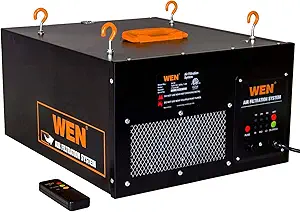 | Best for Small Workshops | Airflow: 300 / 350 / 400 CFM | Coverage: Up to 400 sq. ft. | Filters: 1-micron filter and 5-micron pre-filter | VIEW ON AMAZON | See Our Full Breakdown |
| ALORAIR Purecare 1350IG 360-Degree Air Filtration System with Ionizer |  | Best for Flexible Placement | Model: Purecare 1350IG | Airflow: 1,050/1,350 CFM | Coverage area: Up to 1,700 sq. ft. | VIEW ON AMAZON | See Our Full Breakdown |
| DEWALT DWXAF101 Air Filtration System Dust Collector |  | Best for Fine-Particle Filtration | Model: DWXAF101 | Filtration: Two-stage: static cotton pre-filter and H11 HEPA filter | Particle capture: Over 95% of 0.3 μm particles | VIEW ON AMAZON | See Our Full Breakdown |
| Abestorm S2 Air Scrubber with UV-C Light and 4-Stage Filtration |  | Best for Jobsite Cleanup | Model: S2 | Airflow: 550 CFM | Filtration: 4-stage; includes pre-filter, True HEPA, and activated carbon | VIEW ON AMAZON | See Our Full Breakdown |
| ABESTORM DecDust 1350IG Air Filtration System with Ionizer |  | Best for Large Hobby Workshops | Model: DecDust 1350IG | Airflow: 1,050–1,350 CFM | Coverage area: Up to 1,700 sq. ft. | VIEW ON AMAZON | See Our Full Breakdown |
| air purifier for workshop | Airflow | Coverage | Dimensions | Controls |
|---|---|---|---|---|
| ALORAIR Purecare 1350 360-Degr | 1,050 / 1,350 CFM | Up to 1,700 sq. ft. | 20.5 × 20.5 × 9.8 in. | IR remote; 1–9 hour timer |
| VEVOR Air Scrubber 550 CFM 3-S | Adjustable up to 550 CFM | Up to 5,500 cu. ft. | — | — |
| Abestorm DecDust 1350IG 360-De | 1,050–1,350 CFM | Up to 1,700 sq. ft. | 20.5 × 20.5 × 9.8 in. | Touch panel and remote; remote range up to 27 ft. |
| Abestorm Air Scrubber with MER | — | Up to 5,500 cu. ft. | — | — |
| WEN 3410 3-Speed Remote-Contro | 300 / 350 / 400 CFM | Up to 400 sq. ft. | 17 × 20.5 × 10 in. | — |
| ALORAIR Purecare 1350IG 360-De | 1,050/1,350 CFM | — | 20.5 × 20.5 × 9.8 in. | IR remote; 1–9-hour timer |
| DEWALT DWXAF101 Air Filtration | — | — | — | Remote control included |
| Abestorm S2 Air Scrubber with | 550 CFM | — | — | — |
| ABESTORM DecDust 1350IG Air Fi | 1,050–1,350 CFM | — | 20.5 × 20.5 × 9.8 in. | Touch panel and remote |
More Details on Our Top Picks
ALORAIR Purecare 1350 360-Degree Air Filtration System with Vortex Fan
For a larger woodworking shop that needs broad overhead circulation, the Purecare 1350 earns its place with airflow up to 1,350 CFM and a 360-degree intake. Its MERV 11 filter is suited to airborne shop dust, while ceiling or benchtop placement gives it more installation flexibility than the floor-oriented VEVOR Air Scrubber 550 CFM. A timer and IR remote make it easier to run during a work session without walking back to the unit. The tradeoff is filtration depth: unlike VEVOR’s H13 HEPA stage, this model’s listed MERV 11 filter does not claim capture down to 0.3 microns. It also reaches 69 dB, which can compete with conversation, and the supplied data says it cannot ship to California.
Pros:- Airflow reaches 1,350 CFM for larger shop spaces
- 360-degree intake draws air from around the unit
- Ceiling-hanging and benchtop installation options
- IR remote and 1–9 hour timer support convenient operation
Cons:- MERV 11 filtration is less fine-particle focused than the VEVOR scrubber’s H13 HEPA stage
- Noise reaches 69 dB
- Not available for shipping to California according to the supplied product data
Best for: Woodworkers with a large, open workshop who want high overhead airflow and remote timed operation.
Not ideal for: People who need HEPA filtration for very fine particles, work in a quiet space, or live in California.
- Airflow:1,050 / 1,350 CFM
- Coverage:Up to 1,700 sq. ft.
- Filter class:MERV 11
- Noise level:60–69 dB
- Dimensions:20.5 × 20.5 × 9.8 in.
- Electrical requirements:115 V, 60 Hz, 1.5 A
- Controls:IR remote; 1–9 hour timer
- Mounting:Ceiling hanging or benchtop
Our verdict“Choose the Purecare 1350 for high-volume air circulation in a large workshop if its MERV 11 filtration and noise level fit your needs.”
VEVOR Air Scrubber 550 CFM 3-Stage Filtration Stackable Negative Air Machine
The VEVOR Air Scrubber is the clearest fit here when fine-particle filtration matters more than overhead circulation. Its three stages pair a MERV-10 pre-filter and carbon filter with H13 HEPA filtration rated at 99.97% for particles as small as 0.3 microns. That gives it a filtration advantage over the MERV 11 WEN 3410, though WEN offers a simpler ceiling-hung format for routine shop use. VEVOR’s 550 CFM is adjustable, and up to three units can be daisy-chained for higher combined airflow. At 35 pounds with no assembly required, it is also easier to move and store than a fixed installation. Its tradeoff is lower single-unit airflow than the ALORAIR Purecare 1350, and filters still require manual replacement when the indicator calls for it.
Pros:- H13 HEPA stage is rated to capture 99.97% of particles as small as 0.3 microns
- Three-stage filtration includes a carbon filter for odors
- Stackable design weighs 35 pounds and requires no assembly
- Up to three units can be daisy-chained
Cons:- Single-unit airflow tops out at 550 CFM, well below the ALORAIR Purecare 1350
- Filter changes require manual attention when the indicator lights
- Daisy-chain capacity is limited to three units
Best for: Workshop owners who need HEPA-level particle capture in a portable unit, especially for dust or smoke cleanup.
Not ideal for: Those who want a ceiling-mounted ambient dust collector or need high airflow from one unit without connecting multiple scrubbers.
- Airflow:Adjustable up to 550 CFM
- Filtration:Three stages: MERV-10 pre-filter, carbon, H13 HEPA
- Particle capture:99.97% at 0.3 microns
- Coverage:Up to 5,500 cu. ft.
- Weight:35 lb
- Intake size:15.5 in.
- Outlet size:8.5 in.
- Daisy-chain capacity:Up to three units
Our verdict“Pick VEVOR when HEPA filtration and portability matter more than the broad overhead airflow of a dedicated workshop system.”
Abestorm DecDust 1350IG 360-Degree Intake Air Filtration System with Ionizer
The DecDust 1350IG matches the ALORAIR Purecare 1350’s listed airflow range and MERV 11 filter class, but adds a built-in ionizer and more mounting choices, including direct screw mounting. That makes it a better fit for a shop where placement options or odor treatment matter; the Purecare is the more straightforward pick if you want similar high airflow without the ionizer. Both units cover up to 1,700 square feet and reach 69 dBA, so neither is a quiet choice for a small shared workspace. The DecDust includes four replaceable filters, which gives buyers spares to hand, but its MERV 11 specification does not match the VEVOR scrubber’s stated H13 HEPA capture for 0.3-micron particles. California shipping restrictions also apply according to the supplied data.
Pros:- Airflow reaches 1,350 CFM across a 360-degree intake
- Ceiling hanging, benchtop placement, and direct screw mounting
- Remote and touch-panel controls
- Includes four replaceable MERV-11 filters
Cons:- MERV 11 does not provide the stated 0.3-micron HEPA capture of the VEVOR scrubber
- Noise reaches 69 dBA
- Not compliant with California air cleaner regulations according to the supplied data
Best for: Woodworkers who need high airflow but have unusual mounting constraints and want an ionizer feature.
Not ideal for: Buyers seeking HEPA-rated fine-particle filtration, quieter operation, or delivery in California.
- Airflow:1,050–1,350 CFM
- Coverage:Up to 1,700 sq. ft.
- Filter type:MERV 11
- Included filters:Four replaceable filters
- Noise level:60–69 dBA
- Dimensions:20.5 × 20.5 × 9.8 in.
- Weight:27 lb
- Controls:Touch panel and remote; remote range up to 27 ft.
Our verdict“Choose the DecDust 1350IG if flexible mounting and its ionizer matter more to your shop than HEPA filtration or quiet operation.”
Abestorm Air Scrubber with MERV-10 & HEPA/Activated Carbon Filter, 550 CFM, V2
The Abestorm V2 takes a more layered approach than the VEVOR Air Scrubber: it combines a MERV-10 pre-filter, HEPA, activated carbon, and UV-C light in a four-stage setup. That mix makes it the stronger candidate for workshops where airborne dust and odors both need attention, while VEVOR is lighter at 35 pounds and specifies its HEPA capture efficiency at 0.3 microns. Both offer up to 550 CFM and can connect up to three units, so the V2 suits a cleanup or restoration workflow better than routine overhead dust collection. The durable polyethylene body has a 10-year warranty, but that coverage applies only to the shell. UV-C also adds a bulb replacement task, and the industrial housing may be cumbersome in a compact home shop.
Pros:- Four filtration stages combine MERV-10, HEPA, activated carbon, and UV-C
- 550 CFM airflow and coverage up to 5,500 cubic feet
- GFCI daisy-chain connection supports up to three units
- Polyethylene body carries a 10-year shell warranty
Cons:- The 10-year warranty covers the polyethylene body only
- UV-C bulb needs periodic replacement
- Bulky industrial design can be awkward in a small residential workshop
Best for: Workshop and restoration crews handling dust alongside odors who want a portable scrubber with a durable shell.
Not ideal for: Small-shop owners who need a compact ambient filter or buyers who do not want UV-C bulb maintenance.
- Model:V2
- Maximum airflow:550 CFM
- Coverage:Up to 5,500 cu. ft.
- Filtration:Four stages: MERV-10 pre-filter, HEPA, activated carbon, UV-C
- Particle capture:99.97% of particles at 0.3 microns
- Daisy-chain connection:GFCI duplex; up to three units
- Body warranty:10 years on polyethylene body only
Our verdict“Choose the Abestorm V2 for portable dust and odor treatment when you can accommodate its bulk and UV-C upkeep.”
WEN 3410 3-Speed Remote-Controlled Air Filtration System (400 CFM)
For a compact shop, the WEN 3410 offers a simpler ceiling-style solution than the floor-standing scrubbers in this group. Its three speeds top out at 400 CFM, with a 1-micron filter and 5-micron pre-filter aimed at routine airborne woodworking dust. That is a more modest setup than the ALORAIR Purecare 1350, which moves up to 1,350 CFM and lists coverage to 1,700 square feet; WEN’s supplied coverage is up to 400 square feet. Its RF remote works without direct line of sight, so a blocked view or ceiling mount is less of a nuisance, and the programmable timer can shut it down after a session. The limits are lower capacity, filter replacement needs, and noise up to 60 dB.
Pros:- Three airflow settings let users balance circulation and noise
- Includes a 1-micron filter and 5-micron pre-filter
- RF remote works from up to 26 feet without line of sight
- Programmable timer supports automatic shutoff
Cons:- 400 CFM maximum is much lower than the ALORAIR Purecare 1350
- Coverage is limited to up to 400 square feet
- Frequent filter replacement is needed to maintain efficiency
Best for: Hobbyist woodworkers with a shop up to 400 square feet who want a ceiling-mounted filter and convenient remote controls.
Not ideal for: Large workshops or buyers who need HEPA filtration for particles as small as 0.3 microns.
- Airflow:300 / 350 / 400 CFM
- Coverage:Up to 400 sq. ft.
- Filters:1-micron filter and 5-micron pre-filter
- Dimensions:17 × 20.5 × 10 in.
- Electrical requirements:120 V, 60 Hz, 1 A
- Remote range:Up to 26 ft.
- Speed settings:Three
Our verdict“Pick the WEN 3410 for routine dust control in a smaller hobby shop where its modest airflow is enough.”
ALORAIR Purecare 1350IG 360-Degree Air Filtration System with Ionizer
The Purecare 1350IG suits a workshop where the ceiling, workbench, and floor are all possible mounting spots. Its 360-degree intake and airflow up to 1,350 CFM are aimed at moving air across a large area, while the remote and one-to-nine-hour timer let you control it from a work position. Compared with the ceiling-focused DEWALT DWXAF101, this model offers more placement flexibility but does not list a fine-particle capture percentage or automatic air-quality mode. Its MERV 11 filter and ionizer make it a dust-and-odor option, though the listing does not establish the ionizer’s effect on workshop pollutants. At up to 69 dB, it may compete with conversation, and California shipping is unavailable according to the product data.
Pros:- 360-degree intake supports air movement from multiple directions
- Airflow settings reach up to 1,350 CFM for larger workshop spaces
- Remote and one-to-nine-hour timer allow convenient operation
- Can be ceiling-hung, placed on a workbench, or set on the floor
Cons:- Noise can reach 69 dB, which may interrupt conversation or quiet work
- MERV 11 filtration has no stated fine-particle capture percentage
- Product data says it is unavailable for shipping to California
Best for: Woodworkers who want a high-airflow hanging unit with remote and timer controls, and need flexibility to place it on a workbench or floor instead.
Not ideal for: California buyers, people who need documented fine-particle capture performance, or anyone working in a quiet shared space.
- Model:Purecare 1350IG
- Airflow:1,050/1,350 CFM
- Coverage area:Up to 1,700 sq. ft.
- Filter class:MERV 11
- Dimensions:20.5 × 20.5 × 9.8 in.
- Noise level:60–69 dB
- Controls:IR remote; 1–9-hour timer
- Mounting:Ceiling hang, workbench, or floor
Our verdict“Choose the Purecare 1350IG if flexible placement and high airflow matter more to you than a stated HEPA-level capture rate or quieter operation.”
DEWALT DWXAF101 Air Filtration System Dust Collector
For a shop where fine airborne dust is the main concern, the DWXAF101’s two-stage filter gives it a clearer filtration case than the MERV 11 ABESTORM DecDust 1350IG: the listing specifies an H11 HEPA filter and capture of over 95% of 0.3 μm particles. Its automatic sensor mode can adjust operation to detected air quality, while low, medium, and high settings and a timer give you manual control too. The ceiling mount keeps floor space clear, but it depends on having a suitable overhead installation point. The washable pre-filter and replacement indicator help with upkeep; the HEPA filter itself still needs periodic replacement. The product data gives no airflow or coverage figure, so I would compare its filtration detail rather than assume it can handle the largest shops.
Pros:- H11 HEPA stage is specified to capture over 95% of 0.3 μm particles
- Automatic mode adjusts fan operation based on air-quality sensing
- Ceiling installation keeps the work area and floor clear
- Washable pre-filter and replacement indicator help manage maintenance
Cons:- Ceiling mounting may not suit every workshop layout
- HEPA filter requires periodic replacement even with a washable pre-filter
- Product data does not state airflow or coverage area
Best for: Woodworkers who prioritize stated fine-particle capture and have a suitable ceiling location for a fixed filtration unit.
Not ideal for: Renters or workshop owners without a safe ceiling mounting point, and buyers who need a published CFM or coverage figure before choosing.
- Model:DWXAF101
- Filtration:Two-stage: static cotton pre-filter and H11 HEPA filter
- Particle capture:Over 95% of 0.3 μm particles
- Working modes:HI, MID, LO, AUTO
- Timer:1, 2, 4, or 8 hours
- Controls:Remote control included
- Installation:Ceiling mount with hooks and chains
- Warranty:3 years
Our verdict“Pick the DWXAF101 if fine-particle capture and automatic control matter most and you can accommodate ceiling installation.”
Abestorm S2 Air Scrubber with UV-C Light and 4-Stage Filtration
The Abestorm S2 is the lineup’s portable jobsite choice: its 550 CFM airflow, stackable body, and daisy-chain connection suit temporary dust-control setups better than the hanging ALORAIR Purecare 1350IG. Its filtration stages include a pre-filter, True HEPA, and activated carbon, with UV-C light listed as an added feature. The daisy-chain GFCI duplex can connect units for a stated combined airflow of up to 1,650 CFM, which is useful when one machine is not enough for the work area. That flexibility comes with lower airflow from a single unit than the 1,050–1,350 CFM hanging models. Plan for UV-C bulb upkeep, and read the warranty scope carefully: the 10-year coverage applies to the polyethylene body.
Pros:- Pre-filter, True HEPA, and activated carbon provide multiple filtration stages
- Stackable portable design suits jobsite movement and storage
- Daisy-chain GFCI duplex supports connecting units for up to 1,650 CFM combined airflow
- Variable speed control and hour meter support managed operation
Cons:- Single-unit airflow is 550 CFM, below the listed airflow of the hanging 1350IG systems
- UV-C bulb requires replacement as part of maintenance
- 10-year warranty covers the polyethylene body only
Best for: Contractors and restoration crews who need a stackable, portable scrubber that can be linked with additional units for temporary work zones.
Not ideal for: Woodworkers seeking a single high-airflow ceiling unit for daily dust management, or buyers expecting the 10-year warranty to cover every component.
- Model:S2
- Airflow:550 CFM
- Filtration:4-stage; includes pre-filter, True HEPA, and activated carbon
- Technology:UV-C light
- Features:Stackable, variable speed, hour meter, daisy-chain GFCI duplex
- Combined airflow:Up to 1,650 CFM when units are daisy-chained
- Warranty:10 years on polyethylene body
Our verdict“Choose the S2 for portable, expandable filtration on job sites where stackability matters more than the high airflow of a fixed workshop unit.”
ABESTORM DecDust 1350IG Air Filtration System with Ionizer
The DecDust 1350IG is a strong fit for a large hobby shop that wants a ceiling-hung filter with remote operation: its listed coverage reaches 1,700 square feet, and airflow ranges from 1,050 to 1,350 CFM. The included four MERV 11 filters and two speed settings give it a straightforward setup compared with the more elaborate DEWALT DWXAF101, whose H11 HEPA capture figure is specified but whose airflow is not. Here, the tradeoff is less filtration detail: the DecDust lists no particle-size capture rate, and the ionizer’s benefit is not quantified. Its 27-pound weight calls for care during installation, while noise up to 69 dBA may be noticeable during quieter tasks. Remote and touch-panel controls add convenience after it is mounted.
Pros:- Airflow of 1,050–1,350 CFM is suited to larger workshop spaces
- Coverage is listed up to 1,700 sq. ft.
- Touch panel and remote provide two ways to operate the unit
- Four replaceable MERV 11 filters are included
Cons:- At 27 lb, installation may require a secure mounting point and assistance
- Noise can reach 69 dBA
- No particle-size capture percentage is provided for the MERV 11 filtration
Best for: Owners of spacious hobby workshops who want a high-airflow hanging filter with remote controls and replaceable MERV 11 filters.
Not ideal for: Buyers who need a documented HEPA capture rate, cannot safely mount a 27-pound unit, or work in a quiet space sensitive to fan noise.
- Model:DecDust 1350IG
- Airflow:1,050–1,350 CFM
- Coverage area:Up to 1,700 sq. ft.
- Filter type:MERV 11
- Included filters:Four replaceable filters
- Dimensions:20.5 × 20.5 × 9.8 in.
- Weight:27 lb
- Noise level:60–69 dBA
- Controls:Touch panel and remote
Our verdict“Choose the DecDust 1350IG for a spacious hobby workshop that needs substantial airflow and remote control, provided its weight and noise suit your setup.”

How We Picked
I compared these nine systems by their stated airflow, filtration design, intended placement, and practical fit for workshop tasks. For a general-purpose pick, I favored high-volume air movement and a 360-degree intake, since those features can help circulate air through a shared shop space. Portable scrubbers earned consideration for their staged filters and ability to support localized containment, while compact or lower-airflow units make more sense in smaller spaces and for lighter loads.
The ranking reflects those different roles rather than treating every model as interchangeable. I placed the ALORAIR Purecare 1350 first as the clearest all-around ambient filtration choice, then gave the VEVOR scrubber a strong position for portable cleanup. Models with similar airflow are separated by their filtration and added features; a UV-C light or ionizer does not by itself establish better dust removal. Since listed specs do not establish actual room performance, I also weigh layout, filter upkeep, and the need to pair air cleaning with source capture.
| air purifier for workshop | Coverage | Controls | Model |
|---|---|---|---|
| ALORAIR Purecare 1350 360-Degr | Up to 1,700 sq. ft. | IR remote; 1–9 hour timer | — |
| VEVOR Air Scrubber 550 CFM 3-S | Up to 5,500 cu. ft. | — | — |
| Abestorm DecDust 1350IG 360-De | Up to 1,700 sq. ft. | Touch panel and remote; remote range up to 27 ft. | — |
| Abestorm Air Scrubber with MER | Up to 5,500 cu. ft. | — | V2 |
| WEN 3410 3-Speed Remote-Contro | Up to 400 sq. ft. | — | — |
| ALORAIR Purecare 1350IG 360-De | — | IR remote; 1–9-hour timer | Purecare 1350IG |
| DEWALT DWXAF101 Air Filtration | — | Remote control included | DWXAF101 |
| Abestorm S2 Air Scrubber with | — | — | S2 |
| ABESTORM DecDust 1350IG Air Fi | — | Touch panel and remote | DecDust 1350IG |
Factors to Consider When Choosing Air Purifier For Workshop
Workshop air cleaning starts with identifying what gets into the air and how it moves through your space. These factors can help you choose between a ceiling unit, a portable scrubber, or a smaller system, and avoid expecting one machine to handle every hazard.
Match Airflow to Shop Layout
A stated CFM figure is a starting point, not a guarantee that every corner of your shop will receive clean air. Benches, cabinets, machinery, and partitions can block circulation, so a unit with a broad intake may still need careful placement. Measure the room and think about where dust is created and where air can travel back toward the intake. A central ceiling position can serve an open work area, while a portable unit may be easier to aim at a temporary work zone. Avoid choosing by room size alone if your shop has separated bays or tall storage. In those spaces, airflow paths and placement can matter as much as the headline capacity.
Separate Ambient Cleaning From Tool Capture
An air filtration unit cleans particles after they enter the room air; a dust extractor or hood captures debris near the tool. For sanding, routing, and cutting, source capture can reduce the amount that escapes in the first place. Ambient filtration can then address the fine dust that remains suspended. A common mistake is to expect a ceiling unit to control a plume produced directly at a saw or sander. Consider the tool, its port, and the material before deciding which equipment should take priority. If the task creates concentrated dust, pair room filtration with a suitable extraction setup.
Choose Filtration for the Contaminant
Filter labels describe different jobs, so check what a model’s stages are intended to capture before buying. A prefilter can intercept larger debris and help extend the life of finer media, while finer filters are relevant to small airborne particles. Activated carbon is aimed at some odors and gases, but its presence does not mean every fume is controlled. Wood dust, drywall dust, paint odor, and solvent vapor are not interchangeable problems. Do not assume an ionizer or UV-C feature replaces mechanical filtration or makes a system suitable for every contaminant. For hazardous dust or fumes, use controls and protective equipment appropriate to the material and task.
Plan for Filter Changes and Running Time
Workshop filters load as they collect dust, and a clogged filter can reduce airflow. Check how replacement filters are accessed, what stages need changing, and whether the maker gives maintenance guidance for your expected use. A shop that runs equipment every day will have a different upkeep burden from a hobby space used occasionally. Pre-filters can make routine cleaning more manageable, but they still need inspection. Think about where you can safely handle dirty filters without spreading collected dust back into the room. The easiest unit to maintain may be the one that stays in service consistently.
Balance Portability, Noise, and Installation
A ceiling-mounted filtration unit keeps floor space open and can circulate air over a fixed work area, but it requires a secure installation and a suitable location. A portable scrubber is easier to move between jobs and can support temporary containment, though its hoses and footprint may compete for shop space. Noise matters if the unit will run while you work or if the workshop shares walls with living areas. Remote controls and multiple speeds can make it easier to adjust operation without reaching the machine. Before purchase, check the mounting method, power access, and clearance around the intake. A feature is only useful if the unit can operate where the air needs cleaning.
Pay for Features That Solve Your Specific Problem
Higher airflow, extra filtration stages, and added treatment features can all raise complexity without improving every workshop setup. Pay more for capacity or filtration you can connect to a clear need, such as a larger open shop or portable containment work. For a small hobby shop with intermittent dust, a simpler unit may be easier to place and maintain. Compare replacement filter availability and operating requirements alongside the initial feature list. Do not treat an ionizer, UV-C lamp, or carbon stage as a universal upgrade. The best value is the system whose capabilities align with your materials, work schedule, and floor plan.
Frequently Asked Questions
Can a workshop air purifier replace a dust collector?
No. A room air filtration unit circulates and filters airborne particles, while a dust collector or tool extractor captures debris at or near its source. For tools that generate heavy dust, source capture can reduce the load reaching the room air cleaner. The two approaches complement each other. Choose extraction based on the tool and material, then use ambient filtration to address remaining airborne dust.
Should I choose a 1,350 CFM ambient unit or a 550 CFM air scrubber?
Choose based on the job and airflow path, not the CFM number alone. The 1,350 CFM class is aimed at circulating air in a general workshop, while a portable 550 CFM scrubber can be more useful for localized work or a temporary negative-air arrangement. A higher rating does not guarantee even coverage if walls or equipment interrupt circulation. Consider whether you need a fixed ambient system or a unit you can move between tasks. Check the manufacturer’s setup guidance for your room and intended use.
Do I need HEPA filtration for woodworking?
It depends on the particles you need to capture and the filter specification of the specific machine. A HEPA-labeled stage can be relevant for fine airborne particles, but the whole system’s airflow, sealing, and maintenance also affect performance. Coarse prefilters may catch larger debris and protect finer media. For dusty tools, effective source extraction remains important even when room filtration includes a fine filter. Confirm the filter rating and compatible replacements before relying on a model for a particular task.
Can an air purifier remove paint or solvent fumes from a workshop?
Do not assume a dust-focused air filtration system controls chemical vapors. Activated carbon can adsorb some odors and gases, but capacity and suitability depend on the contaminant, filter amount, and replacement schedule. Many workshop fumes call for ventilation and product-specific controls rather than recirculating air through a general purifier. Read the safety information for the paint or solvent and follow its ventilation guidance. Select equipment rated for the actual contaminant, and use appropriate protective measures.
Is an ionizer or UV-C feature worth choosing?
Those features should be secondary to airflow, mechanical filtration, and a workable maintenance plan. An ionizer does not replace a properly selected particle filter, and buyers should check the manufacturer’s information about emissions and use. UV-C is not a substitute for capturing workshop dust or controlling fumes. If two models otherwise fit your shop similarly, an added feature may influence your choice when its purpose is clear. Avoid paying for it as a blanket promise of cleaner air.
Conclusion
For most buyers seeking a fixed ambient system, I recommend the ALORAIR Purecare 1350 as best overall for its high stated airflow and 360-degree intake. The VEVOR 550 CFM scrubber is my value pick for portable, staged filtration and localized cleanup, while buyers who want a similar high-airflow format with an ionizer can compare the ALORAIR Purecare 1350IG and Abestorm DecDust options. The WEN 3410 is the more approachable choice for a smaller or lighter-use shop, and the Abestorm S2 is the pick to investigate for buyers who specifically want UV-C alongside four filtration stages. Choose by the dust or fumes you need to manage, the way air moves through your workspace, and the upkeep you can sustain; pair any room cleaner with source capture for dusty tools.
Halloween Picks
halloween
As an affiliate, we earn on qualifying purchases.