For an asthma household, an air quality monitor can help spot changing indoor conditions, but no single reading can predict or prevent an asthma attack. I’d put the BREATHE Airmonitor Plus Gen 2 first for buyers prioritizing a focused indoor monitoring experience, while the Amazon Smart Air Quality Monitor is a simpler choice for households already using Alexa and the Temtop LKC-1000S+ suits people who want a portable device. The main tradeoff is between broader sensor lists and clearer, more actionable readings: a “16-in-1” label alone does not show how well a device measures a specific pollutant. Sensor limits, placement, and alert options matter as much as the display. Read on for the full breakdown of all 15 options and how to match one to your household.

Get garden gear delivered free with Prime
- Fast, free delivery on millions of items
- Prime Video, Amazon Music and more included
- Member-only deals all year
Complete the kit


Key Takeaways
- Sensor relevance matters more than sensor count: the lineup includes many 10-in-1 and amazon.com/dp/B0HC6F5WNV?tag=aeroguardians-20&ascsubtag=dc-450362″ target=”_blank” rel=”nofollow sponsored noopener”>16-in-1 models, but asthma households should check whether a monitor measures fine particles such as PM2.5 and whether its other sensors address their actual home concerns.
- The BREATHE Airmonitor Plus Gen 2 stands apart from the display-heavy group: it is the lead pick for buyers seeking a more focused indoor monitoring option, while many of the other models emphasize broad sensor counts and large screens.
- The Amazon Smart Air Quality Monitor trades breadth for simplicity: Alexa integration may fit an existing smart home, though buyers should check which pollutants it measures before choosing it as their main monitor.
- The Temtop LKC-1000S+ fills a different role: its portable format is useful for checking more than one room, while larger-screen models are better suited to staying in a fixed, frequently viewed spot.
- Similar “16-in-1” names do not make the monitors interchangeable: the Sainlogic 7.2-inch model and several other large-screen options differ in presentation and stated sensor details, so buyers should compare the exact measurements and alert functions rather than the headline count.
| 16-in-1 Indoor Air Quality Monitor with HD Color Screen |  | Best for Quick Spot Checks | Monitored parameters: PM1.0, PM2.5, PM10, TVOC, HCHO, temperature, humidity | Display: HD real-time color screen | Sampling interval: 1.5 seconds | VIEW ON AMAZON | See Our Full Breakdown |
| Amazon Smart Air Quality Monitor |  | Best for Alexa Households | Monitored metrics: PM2.5, VOCs, carbon monoxide, humidity, temperature | Connectivity: Wi-Fi | Interface: Color-coded LED and Alexa app | VIEW ON AMAZON | See Our Full Breakdown |
| Zemeollo 10-in-1 Smart Air Quality Monitor |  | Best for Longer Portable Sessions | Monitored parameters: CO₂, HCHO, TVOC, benzene, PM2.5, PM10, temperature, AQI | Accuracy: ±5% error margin | Display: HD LED color screen | VIEW ON AMAZON | See Our Full Breakdown |
| LifeBasis 11-in-1 Indoor Air Quality Monitor |  | Best for Audible Alerts | Monitored indexes: AQI, CO₂, PM1.0, PM2.5, PM10, particles, HCHO, TVOC, temperature, humidity | Sensors: NDIR infrared, laser particle, semiconductor, photoelectric, temperature, humidity | Alerts: Color-coded visual indicators and audible alert | VIEW ON AMAZON | See Our Full Breakdown |
| ZEMEOLLO 10-in-1 Smart Indoor Air Quality Monitor |  | Best for Simple Portable Readouts | Detection range: CO₂, HCHO, TVOC, benzene, PM2.5, PM10, temperature, AQI | Accuracy: ±5% error margin | Display: HD LED color screen | VIEW ON AMAZON | See Our Full Breakdown |
| EG Air Quality Monitor: Formaldehyde, TVOC, and PM2.5 Detector |  | Best for Portable Spot Checks | Sensors: Laser sensor for PM2.5; electrochemical semiconductor sensor for HCHO/TVOC | Monitored readings: Formaldehyde, TVOC, PM2.5 | Display: 2.8-inch color LCD | VIEW ON AMAZON | See Our Full Breakdown |
| Temtop LKC-1000S+ 7-in-1 Air Quality Monitor |  | Best for Tracking More Pollutants | Model: LKC-1000S+ | Parameters: PM2.5, PM10, HCHO, TVOC, humidity, temperature, AQI | Sensors: Laser particle sensor; Dart electrochemical HCHO sensor | VIEW ON AMAZON | See Our Full Breakdown |
| 16-in-1 Indoor Air Quality Monitor with CO2 Detector and AQI Tester |  | Best for Flexible Room-to-Room Use | Listed functions: 16-in-1 | Named readings: CO2, PM1.0, PM2.5, PM10, HCHO, TVOC, temperature, humidity | AQI indicator: Seven-level color alert system | VIEW ON AMAZON | See Our Full Breakdown |
| Sainlogic 16-in-1 Indoor Air Quality Monitor with 7.2″ Display |  | Best for Easy-to-Read Household Monitoring | Parameters tracked: CO2, PM2.5, PM10, PM1.0, AQI, HCHO, TVOC, temperature, humidity | Display: 7.2 inches | Battery capacity: 2500mAh | VIEW ON AMAZON | See Our Full Breakdown |
| 16-in-1 Indoor Air Quality Monitor with CO2, TVOC, and PM Sensors |  | Best for Chemical Reading Detail | Readings: CO2, TVOC, PM1.0, PM2.5, PM10, HCHO, temperature, humidity, AQI | HCHO and TVOC resolution: 0.001 mg/m³ | Display: Color screen with three brightness levels | VIEW ON AMAZON | See Our Full Breakdown |
| 16-in-1 Indoor Air Quality Monitor with 7-inch Display |  | Best for a Fixed Home Display | Display: 7-inch LED | Parameters: CO2, PM1.0, PM2.5, PM10, HCHO, TVOC, temperature, humidity, AQI | Sensor accuracy: 0.001 units | VIEW ON AMAZON | See Our Full Breakdown |
| 16-in-1 Indoor Air Quality Monitor with Color Screen |  | Best for Quick Spot Checks | Measurements: PM1.0, PM2.5, PM10, CO2, TVOC, HCHO, temperature, humidity | Update interval: Every 1.5 seconds | Display: HD color screen | VIEW ON AMAZON | See Our Full Breakdown |
| YNAK 16-in-1 Indoor Air Quality Monitor with HD Screen | 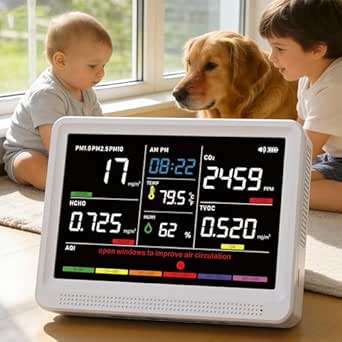 | Best for Cordless Room-to-Room Checks | Brand and model: YNAK USWBA03 | Display: 5.5-inch HD screen | Sensors: CO2, PM1.0, PM2.5, PM10, HCHO, TVOC, temperature, humidity, AQI | VIEW ON AMAZON | See Our Full Breakdown |
| BREATHE Airmonitor Plus Gen 2 Indoor Air Quality Monitor |  | Best for App-Based Tracking | Brand and model: BREATHE BTL40001 | Sensors: NDIR CO2, PM1, PM2.5, PM10, TVOC, HCHO, temperature, humidity | Battery life: 6 hours | VIEW ON AMAZON | See Our Full Breakdown |
| AirWhisper 16-in-1 Indoor Air Quality Monitor |  | Best for Simple Particle Checks | Brand and model: AirWhisper AK16C | Parameters: PM1.0, PM2.5, PM10, TVOC, HCHO, temperature, humidity | Display: HD color screen | VIEW ON AMAZON | See Our Full Breakdown |
| air quality monitor for asthma household | Display | Battery life |
|---|---|---|
| 16-in-1 Indoor Air Quality Mon | HD real-time color screen | 4–5 hours |
| Amazon Smart Air Quality Monit | — | — |
| Zemeollo 10-in-1 Smart Air Qua | HD LED color screen | Up to 20 hours |
| LifeBasis 11-in-1 Indoor Air Q | LCD with adjustable brightness | Up to 11–12 hours |
| ZEMEOLLO 10-in-1 Smart Indoor | HD LED color screen | Up to 20 hours |
| EG Air Quality Monitor: Formal | 2.8-inch color LCD | — |
| Temtop LKC-1000S+ 7-in-1 Air Q | Large IPS color display | 6–8 hours |
| 16-in-1 Indoor Air Quality Mon | Large screen | — |
| Sainlogic 16-in-1 Indoor Air Q | 7.2 inches | Up to 8 hours |
| 16-in-1 Indoor Air Quality Mon | Color screen with three brightness levels | Up to 12 hours |
| 16-in-1 Indoor Air Quality Mon | 7-inch LED | — |
| 16-in-1 Indoor Air Quality Mon | HD color screen | — |
| YNAK 16-in-1 Indoor Air Qualit | 5.5-inch HD screen | — |
| BREATHE Airmonitor Plus Gen 2 | — | 6 hours |
| AirWhisper 16-in-1 Indoor Air | HD color screen | 4–5 hours |
More Details on Our Top Picks
16-in-1 Indoor Air Quality Monitor with HD Color Screen
For asthma households that want to check a room or car on the move, this monitor pairs PM1.0, PM2.5, and PM10 readings with TVOC, formaldehyde, temperature, and humidity. Its color screen and 1.5-second updates make changing readings easy to follow, while single-tap operation keeps setup simple. Compared with the Amazon Smart Air Quality Monitor, it shows readings on the device and works without an Alexa setup; Amazon’s monitor adds app alerts and automation, including a carbon monoxide reading. The main tradeoff is 4–5 hours of battery life, which suits brief checks better than all-day monitoring. I’d use its readings to spot possible changes in conditions, not as a substitute for a certified smoke or carbon monoxide alarm or medical advice.
Pros:- Displays particulate, gas, temperature, and humidity readings on the device
- Frequent updates help show short-term changes
- Single-tap controls and color-coded readings are straightforward
- Portable and charges through USB Type-C
Cons:- Battery lasts only 4–5 hours per charge
- No app connectivity or data logging is listed
- Not a certified smoke or carbon monoxide alarm
Best for: Households that want a portable screen for occasional checks in different rooms or a vehicle.
Not ideal for: People who need continuous monitoring, app-based history, or a certified smoke or carbon monoxide alarm.
- Monitored parameters:PM1.0, PM2.5, PM10, TVOC, HCHO, temperature, humidity
- Display:HD real-time color screen
- Sampling interval:1.5 seconds
- Battery life:4–5 hours
- Charging:USB Type-C
- Warranty:12 months
Our verdict“Choose it for portable, at-a-glance checks; pick the Amazon Smart Air Quality Monitor if app alerts and Alexa routines matter more.”
Amazon Smart Air Quality Monitor
This is the clearest fit for asthma households already using Alexa: it tracks PM2.5, VOCs, carbon monoxide, humidity, and temperature, then sends alerts through the app and can trigger routines. That can make a reading more actionable—for example, by prompting a connected climate device—than the standalone screen on the 16-in-1 Indoor Air Quality Monitor with HD Color Screen. The tradeoff is that the monitor itself has only a color-coded status light, so checking detailed scores depends on the app. It also leans on an Alexa-enabled setup for its full value. The carbon monoxide measurement is not a replacement for a certified CO alarm; I’d choose this for connected household awareness, not as a safety device.
Pros:- Tracks PM2.5, VOCs, carbon monoxide, humidity, and temperature
- Alexa app provides detailed scores and real-time alerts
- Can connect readings to compatible automation routines
- Plug-in setup avoids managing a rechargeable battery
Cons:- Detailed numerical information requires the app
- Full functionality depends on an Alexa ecosystem and Wi-Fi
- Carbon monoxide monitoring does not replace a certified CO alarm
Best for: Alexa users who want air quality alerts and routines linked to compatible home devices.
Not ideal for: Buyers who want detailed readings on the monitor itself, offline operation, or a dedicated certified carbon monoxide alarm.
- Monitored metrics:PM2.5, VOCs, carbon monoxide, humidity, temperature
- Connectivity:Wi-Fi
- Interface:Color-coded LED and Alexa app
- Alerts:Real-time notifications
- Compatibility:Alexa and Amazon Smart Thermostat
- Automation:Voice control and routines
Our verdict“Pick it if Alexa alerts and automation are your priority; choose a standalone display model for quick on-device readings.”
Zemeollo 10-in-1 Smart Air Quality Monitor
Among the portable options here, the Zemeollo stands out for its up to 20-hour battery life and readings that include CO₂, formaldehyde, TVOC, benzene, and particulate matter. That makes it better suited than the 16-in-1 Indoor Air Quality Monitor with HD Color Screen for carrying between rooms or checking conditions over a longer stretch without frequent charging. Its color-changing screen gives a quick visual cue, and the listed ±5% error margin offers a stated accuracy figure. But breadth and portability do not add a record of past readings: no app or data logging is specified. For asthma households trying to connect symptoms with changes over time, that missing history may matter more than the extra battery capacity. Treat its alerts as informational rather than medical or life-safety guidance.
Pros:- Tracks CO₂, formaldehyde, TVOC, benzene, and particulates
- Up to 20 hours of stated battery life
- Color-changing screen makes threshold alerts easy to spot
- Compact design and switchable Celsius/Fahrenheit units
Cons:- No app connection or data logging is specified
- ±5% error margin may not suit buyers seeking professional-grade measurement
- No certified alarm function is listed
Best for: People who want a portable monitor for extended room-to-room checks and value CO₂ and benzene readings.
Not ideal for: Buyers who need app alerts, saved measurement history, or documented performance beyond the listed accuracy figure.
- Monitored parameters:CO₂, HCHO, TVOC, benzene, PM2.5, PM10, temperature, AQI
- Accuracy:±5% error margin
- Display:HD LED color screen
- Battery capacity:2000 mAh
- Battery life:Up to 20 hours
- Charging:USB
- Units:Celsius and Fahrenheit
Our verdict“Choose it for long battery life and broad portable readings; look to a connected monitor if you need alerts and measurement history.”
LifeBasis 11-in-1 Indoor Air Quality Monitor
The LifeBasis makes a useful case for households that may not always be looking at a screen: it combines color-coded readings with audible alerts when measurements exceed normal levels. Its listed sensors cover CO₂, PM1.0, PM2.5, PM10, formaldehyde, TVOC, temperature, and humidity, giving it broader room-monitoring coverage than the Amazon Smart Air Quality Monitor in particulate size ranges. Amazon counters with app notifications and Alexa routines, while LifeBasis keeps its alerts on the device. The 11–12-hour battery life is longer than the 16-in-1 HD screen model’s, though it still calls for recharging during frequent portable use. Adjustable display brightness helps in different rooms, but no app or saved history is specified for reviewing patterns later.
Pros:- Measures a broad mix of particles, gases, temperature, and humidity
- Visual and audible alerts can draw attention to changing readings
- Adjustable display brightness suits different rooms
- USB Type-C rechargeable battery lasts up to 11–12 hours
Cons:- Battery life requires regular recharging for ongoing use
- No app connectivity or data history is listed
- Audible alerts may not suit households that prefer silent monitoring
Best for: Households that want a broad set of readings and both visual and audible on-device alerts.
Not ideal for: People who need phone notifications, historical tracking, or uninterrupted monitoring without recharging.
- Monitored indexes:AQI, CO₂, PM1.0, PM2.5, PM10, particles, HCHO, TVOC, temperature, humidity
- Sensors:NDIR infrared, laser particle, semiconductor, photoelectric, temperature, humidity
- Alerts:Color-coded visual indicators and audible alert
- Display:LCD with adjustable brightness
- Battery capacity:2500 mAh
- Battery life:Up to 11–12 hours
- Charging:USB Type-C
Our verdict“Choose LifeBasis for on-device sound and visual alerts; pick Amazon’s monitor if you want app notifications and Alexa automation.”
ZEMEOLLO 10-in-1 Smart Indoor Air Quality Monitor
This ZEMEOLLO model is a straightforward pick for buyers who want CO₂, formaldehyde, TVOC, benzene, PM2.5, and PM10 on a portable color screen. It shares much of its profile with the Zemeollo 10-in-1 Smart Air Quality Monitor, including a 2000 mAh battery, up to 20 hours of stated runtime, and a ±5% error margin. Its listed weight of 7 ounces helps make it practical to move between rooms, while one-click startup keeps operation simple. The product data does not identify a meaningful measurement advantage over its Zemeollo counterpart, and neither lists app connectivity or data logging. That makes both better for spot checks than tracking possible household patterns over time. I’d treat the readings as a guide to conditions, not a diagnosis or alarm.
Pros:- Covers CO₂, gases, particulates, temperature, and AQI
- Up to 20 hours of stated battery life
- One-click operation and automatic detection on startup
- Listed weight is 7 ounces
Cons:- No app connectivity or data logging is specified
- Listed ±5% error margin may not meet professional measurement needs
- The product data does not establish a clear advantage over the other Zemeollo 10-in-1 model
Best for: Buyers who want a lightweight, handheld monitor with broad readings and simple startup.
Not ideal for: Households comparing the two Zemeollo models for app records, or buyers who need connected monitoring and long-term trends.
- Detection range:CO₂, HCHO, TVOC, benzene, PM2.5, PM10, temperature, AQI
- Accuracy:±5% error margin
- Display:HD LED color screen
- Battery type:Lithium Polymer
- Battery capacity:2000 mAh
- Battery life:Up to 20 hours
- Weight:7 ounces
- Package dimensions:5.39 × 4.06 × 1.85 inches
Our verdict“Choose it for simple, lightweight spot checks; if you already compare Zemeollo’s other 10-in-1 model, the listed specs offer little basis to distinguish them.”
EG Air Quality Monitor: Formaldehyde, TVOC, and PM2.5 Detector
For asthma households that want to check whether fine particles or chemical pollutants rise in a particular room, the EG monitor offers a focused, portable set of readings: PM2.5, formaldehyde, and TVOC. Its built-in fan supports real-time sampling, while the color screen makes readings easier to check as you move it between rooms. Compared with the Temtop LKC-1000S+, it tracks fewer measures and lacks the listed USB trend export, so it suits quick household checks better than documenting patterns over time. The 2200mAh battery is listed for up to two days of monitoring, which can help with checks away from an outlet. The tradeoffs are its limited pollutant range and older Micro USB charging; sensor readings also do not diagnose asthma triggers or replace medical advice.
Pros:- Measures PM2.5, formaldehyde, and TVOC in one portable device.
- Built-in fan supports real-time measurement.
- 2200mAh battery is listed for up to two days of continuous monitoring.
- 2.8-inch color LCD makes readings visible on the device.
Cons:- Tracks fewer parameters than the Temtop LKC-1000S+ and the 16-in-1 monitors in this roundup.
- Micro USB charging is less convenient if the household primarily uses USB-C.
- No listed data export for tracking changes over longer periods.
Best for: Asthma households that want a portable way to check PM2.5, formaldehyde, and TVOC in different rooms.
Not ideal for: Buyers who want CO2, PM10, humidity, temperature, or exported records to compare air quality over time.
- Sensors:Laser sensor for PM2.5; electrochemical semiconductor sensor for HCHO/TVOC
- Monitored readings:Formaldehyde, TVOC, PM2.5
- Display:2.8-inch color LCD
- Battery capacity:2200mAh
- Stated battery life:Up to two days of continuous monitoring
- Charging port:Micro USB, DC 5V
Our verdict“Choose the EG if you want portable PM2.5 and chemical checks with long stated battery life, and skip it if you need broader household trend tracking.”
Temtop LKC-1000S+ 7-in-1 Air Quality Monitor
The Temtop LKC-1000S+ is the more data-oriented choice for asthma households that want to compare multiple room conditions or keep records. It tracks PM2.5, PM10, formaldehyde, TVOC, humidity, temperature, and AQI, and its USB export to Excel can help users review changes after ventilation or cleaning. The Dart electrochemical HCHO sensor and large IPS screen distinguish it from the simpler EG monitor, which measures fewer pollutants and has no listed export feature. That breadth comes with practical limits: battery life is listed at just 6–8 hours, and the unit needs a 10-minute warm-up after a temperature change. Alcohol, perfume, and cleaning agents can also affect accuracy. It does not detect gas or carbon monoxide, so its readings cover indoor air indicators rather than household safety hazards.
Pros:- Tracks seven parameters, including PM2.5, PM10, HCHO, TVOC, humidity, and temperature.
- USB data export to Excel supports review of longer-term patterns.
- Dart electrochemical sensor is specified for formaldehyde detection.
- Built-in battery supports room-to-room spot checks.
Cons:- 6–8 hours of battery life may require recharging during extended monitoring.
- Needs a 10-minute warm-up after moving between different temperatures.
- Alcohol, perfumes, and cleaning agents can affect accuracy; it does not detect gas or CO leaks.
Best for: Asthma households that want to compare particle, chemical, and room-condition readings and export records for review.
Not ideal for: People seeking a low-maintenance monitor for continuous all-day use, or anyone expecting gas or carbon monoxide detection.
- Model:LKC-1000S+
- Parameters:PM2.5, PM10, HCHO, TVOC, humidity, temperature, AQI
- Sensors:Laser particle sensor; Dart electrochemical HCHO sensor
- Display:Large IPS color display
- Battery life:6–8 hours
- Connectivity:USB Type-C; USB data export to Excel
- Dimensions:6.97 × 1.26 × 2.56 inches
- Weight:14.4 ounces
Our verdict“Pick the Temtop for broader readings and exported trend data, provided its short battery life and sensor sensitivities fit your routine.”
16-in-1 Indoor Air Quality Monitor with CO2 Detector and AQI Tester
For households that want one monitor to move between bedrooms, shared spaces, and trips, this rechargeable portable model combines CO2, particle readings, HCHO, TVOC, temperature, and humidity. Its seven-level AQI color indicator gives a quick visual cue, while the broader mix of readings goes beyond the three measures on the EG monitor. That range can help users observe how room conditions change, but the listing does not provide data export or long-term logging like the Temtop LKC-1000S+. Its main caveat matters in asthma homes: the battery can warm the device and skew temperature readings, with further reduced temperature accuracy while charging. I would treat its temperature value as a rough room check, especially during charging, rather than rely on it for precise monitoring.
Pros:- Includes CO2, PM1.0, PM2.5, PM10, HCHO, TVOC, temperature, and humidity readings.
- Portable rechargeable design supports use in different indoor settings.
- Large display presents multiple readings at a glance.
- Seven-level AQI color indicator provides quick visual feedback.
Cons:- Battery heat can cause temperature deviations.
- Temperature accuracy is further reduced while the device is charging.
- No data export or logging capability is listed for tracking trends.
Best for: Families who want a portable monitor to move among rooms, a nursery, an RV, or other indoor spaces and view several readings at once.
Not ideal for: Buyers who need dependable temperature readings while charging or want to export data and compare air quality over time.
- Listed functions:16-in-1
- Named readings:CO2, PM1.0, PM2.5, PM10, HCHO, TVOC, temperature, humidity
- AQI indicator:Seven-level color alert system
- Display:Large screen
- Power:Built-in rechargeable battery
- Portability:Portable
- Listed settings:Home, office, nursery, classroom, RV, camping
Our verdict“Choose this model for portable, multi-reading checks across several spaces, but look elsewhere if precise temperature readings or data history matter.”
Sainlogic 16-in-1 Indoor Air Quality Monitor with 7.2″ Display
The Sainlogic puts its readings on a 7.2-inch display, making it a strong fit when several household members need to check room conditions from across a room. It tracks nine named indicators, including CO2, PM1.0/2.5/10, HCHO, TVOC, humidity, temperature, and AQI; tri-color LEDs and audible alerts add signals beyond the screen. Unlike the Temtop LKC-1000S+, it needs no app or Wi-Fi setup, but it also lacks that model’s listed Excel export for reviewing records. Its USB-C rechargeable battery supports up to eight hours of wireless use, enough for moving it around during the day but not a full day of untethered monitoring. For asthma households, the display aids quick checks; it does not establish which pollutant causes symptoms.
Pros:- Tracks nine named indicators, including particle sizes, HCHO, TVOC, and CO2.
- 7.2-inch display is easy to read from a distance.
- No app or Wi-Fi connection is required for setup.
- USB-C charging and portable design allow flexible placement.
Cons:- Battery life is listed at up to eight hours, limiting untethered continuous use.
- No smart home integration or remote data logging is listed.
- Audible alerts may be disruptive in quiet rooms.
Best for: Households that want a large, readable display and straightforward in-room checks without app or Wi-Fi setup.
Not ideal for: People who want all-day wireless monitoring, remote alerts, smart home integration, or exported records.
- Parameters tracked:CO2, PM2.5, PM10, PM1.0, AQI, HCHO, TVOC, temperature, humidity
- Display:7.2 inches
- Battery capacity:2500mAh
- Battery life:Up to 8 hours
- Charging port:USB-C
- Connectivity:No Wi-Fi or app required
- Alerts:Tri-color LED, audible, and visual
- Temperature range:14°F to 122°F
Our verdict“Choose the Sainlogic for glanceable readings and simple setup, but choose the Temtop if exported trend records matter more than display size.”
16-in-1 Indoor Air Quality Monitor with CO2, TVOC, and PM Sensors
Among these portable all-in-one options, this monitor emphasizes HCHO and TVOC resolution, listed at 0.001 mg/m³, while also showing CO2, PM1.0/2.5/10, temperature, humidity, and AQI. That makes it a candidate for asthma households interested in watching both particles and chemical indicators on one device. The Sainlogic is easier to read from a distance thanks to its 7.2-inch screen, while this model offers a stated resolution for HCHO and TVOC and up to 12 hours of battery life. That runtime exceeds the Sainlogic’s listed eight hours, though neither listing describes long-term data export. Audible alerts can be muted, but they may disturb quiet spaces if left on. Fine resolution describes the display or measurement increment; it does not by itself establish sensor accuracy.
Pros:- Lists nine readings, including CO2, three particle sizes, HCHO, TVOC, humidity, temperature, and AQI.
- Specifies 0.001 mg/m³ resolution for HCHO and TVOC.
- Up to 12 hours of stated battery life supports portable use.
- Color-coded AQI screen has three brightness levels and a mute button.
Cons:- Audible alerts may disrupt quiet rooms unless muted.
- Up to 12 hours of battery life still requires regular charging for continuous use.
- No data export or remote monitoring is listed.
Best for: Asthma households that want a portable monitor with stated HCHO and TVOC resolution plus particle and CO2 readings.
Not ideal for: Buyers who need remote monitoring, exported history, or alerts that never make sound.
- Readings:CO2, TVOC, PM1.0, PM2.5, PM10, HCHO, temperature, humidity, AQI
- HCHO and TVOC resolution:0.001 mg/m³
- Display:Color screen with three brightness levels
- Battery life:Up to 12 hours
- Design:Portable, rechargeable, external sensors
- Alerts:Audible alerts with mute button
- Additional controls:Built-in clock; °F/°C switch
Our verdict“Pick this model for portable particle and chemical readings with stated HCHO/TVOC resolution, and favor the Sainlogic if a larger display is your priority.”
16-in-1 Indoor Air Quality Monitor with 7-inch Display
For an asthma household that wants readings visible from across a room, this model’s 7-inch display and coverage of PM2.5, PM10, CO2, HCHO, and TVOC make it a practical stationary dashboard. Its seven AQI alert buzzers can call attention to changing readings without requiring someone to keep checking the screen. Compared with the portable YNAK 16-in-1, this monitor favors visibility over cordless flexibility; the YNAK’s stated 10-hour battery makes it easier to carry between rooms. Here, the external sensors are described as needing careful handling around perfumes and strong odors, and the multi-step time setting may frustrate anyone who wants a quick setup. I’d choose it for a central room where frequent glances matter more than portability.
Pros:- Tracks PM1.0, PM2.5, PM10, CO2, HCHO, and TVOC alongside temperature and humidity
- Large 7-inch LED display with three brightness levels
- Seven AQI alert sounds with mute functionality
- External sensors provide readings for multiple indoor air indicators
Cons:- External sensors need careful handling around perfumes and strong odors
- Setting the clock requires multiple button presses
- No battery runtime or app connectivity is specified
Best for: Households that want a large, easy-to-read monitor stationed in a shared room
Not ideal for: People who want to carry the monitor between rooms or need a simple setup process
- Display:7-inch LED
- Parameters:CO2, PM1.0, PM2.5, PM10, HCHO, TVOC, temperature, humidity, AQI
- Sensor accuracy:0.001 units
- Alerts:Seven distinct AQI alert buzzers; mute functionality listed
- Brightness:Three levels
- Time format:12- or 24-hour toggle
Our verdict“Choose this for a prominent room display and audible AQI alerts if you do not need the YNAK’s stated cordless runtime.”
16-in-1 Indoor Air Quality Monitor with Color Screen
This color-screen monitor updates its readings every 1.5 seconds, making it suited to checking whether conditions shift after cooking, cleaning, or opening a window. Its listed measurements include PM1.0, PM2.5, PM10, CO2, TVOC, HCHO, temperature, and humidity, which gives an asthma household more context than particle readings alone. Compared with the AirWhisper AK16C, it explicitly includes CO2, a useful distinction for people who also want an indicator of ventilation. Both have a stated 4–5-hour battery life, so neither is a strong pick for all-day cordless monitoring. The product description lists eight measurement types despite the 16-in-1 name, so I’d judge it by the stated measurements rather than that label. Its included adapter and USB-C cable support room use while charging.
Pros:- Lists CO2, three particle sizes, TVOC, HCHO, temperature, and humidity
- Readings update every 1.5 seconds on a color display
- Portable for use in rooms and vehicles
- USB-C cable and AC adapter are included
Cons:- Battery lasts only 4–5 hours per charge
- Product details list eight measurement types despite the 16-in-1 title
- No app, data history, or export capability is specified
Best for: People who want to carry a monitor for brief checks in different rooms or a vehicle
Not ideal for: Households seeking continuous cordless monitoring or a clearly documented 16 measurement types
- Measurements:PM1.0, PM2.5, PM10, CO2, TVOC, HCHO, temperature, humidity
- Update interval:Every 1.5 seconds
- Display:HD color screen
- Battery runtime:4–5 hours
- Charging port:USB-C
- Controls:Single-tap power and temperature unit switching; double-tap audio prompt toggle
- Included accessories:USB-C cable, AC adapter, user manual
- Warranty support:12 months
Our verdict“Pick this for fast, portable spot checks with CO2 readings, but choose the BREATHE Airmonitor Plus Gen 2 for recorded trends and remote alerts.”
YNAK 16-in-1 Indoor Air Quality Monitor with HD Screen
The YNAK pairs a 5.5-inch HD screen with a stated 10-hour battery, giving asthma households more freedom to check conditions in bedrooms, living areas, or other spots without keeping it plugged in. Its listed readings cover PM1.0, PM2.5, PM10, CO2, HCHO, TVOC, temperature, humidity, and AQI. That makes it more useful for ventilation checks than the AirWhisper AK16C, whose listed indicators omit CO2, while being easier to move than the 7-inch stationary display in this batch. The tradeoff is that it still relies on careful handling of its external sensors, and the clock-setting process can be fiddly. I’d favor it when moving the monitor around the home matters more than app-based history or remote alerts.
Pros:- Stated battery life of up to 10 hours for cordless checks
- Tracks PM1.0, PM2.5, PM10, CO2, HCHO, and TVOC
- 5.5-inch HD screen with adjustable brightness
- Includes USB-C cable and charging adapter
Cons:- External sensors need care around perfumes and strong odors
- Time setting involves multiple steps
- No app connectivity or data history is specified
Best for: Households that want to check several rooms during the day without keeping the monitor plugged in
Not ideal for: Buyers who need app alerts, stored readings, or a streamlined setup
- Brand and model:YNAK USWBA03
- Display:5.5-inch HD screen
- Sensors:CO2, PM1.0, PM2.5, PM10, HCHO, TVOC, temperature, humidity, AQI
- Battery:2500mAh; up to 10 hours
- Accuracy:0.001 units (general); ±1–3°F temperature; ±2–3% RH humidity
- Connectivity:USB-C
- Package contents:Monitor, charging adapter, USB-C cable, user manual
Our verdict“Choose the YNAK for cordless room-to-room monitoring, especially if CO2 readings matter more than the BREATHE model’s app history.”
BREATHE Airmonitor Plus Gen 2 Indoor Air Quality Monitor
For an asthma household trying to connect symptoms with changing indoor conditions, the BREATHE stands apart through 90-day data history, export options, and remote alerts in its app. Its NDIR CO2 sensor plus PM1, PM2.5, PM10, TVOC, and formaldehyde readings cover several indicators relevant to ventilation and airborne particles. Compared with the YNAK 16-in-1, it gives up four hours of stated battery life but adds Wi-Fi monitoring and a record of past readings, which can make patterns easier to discuss or investigate. Its six-hour battery supports short portable checks, while the 2.4 GHz Wi-Fi requirement may limit setup in some homes. I’d choose it when reviewing trends matters more than having the largest screen or longest cordless run time.
Pros:- 90-day data history with export capabilities
- App-based remote monitoring and real-time alerts
- NDIR CO2 sensor and readings for PM1, PM2.5, PM10, TVOC, and HCHO
- Two-year manufacturer warranty
Cons:- Requires a 2.4 GHz Wi-Fi network; 5 GHz support is not listed
- Six-hour battery life is shorter than the YNAK’s stated 10 hours
- App features depend on Wi-Fi connectivity
Best for: Households that want remote alerts and a history of readings to compare with symptoms or household routines
Not ideal for: People without a 2.4 GHz Wi-Fi network or those seeking extended cordless monitoring
- Brand and model:BREATHE BTL40001
- Sensors:NDIR CO2, PM1, PM2.5, PM10, TVOC, HCHO, temperature, humidity
- Battery life:6 hours
- Connectivity:2.4 GHz Wi-Fi
- Data history:90 days; export capabilities listed
- Charging:USB-C rechargeable
- Warranty:Two-year manufacturer warranty
Our verdict“Choose this if remote alerts and recorded trends are your priority; the YNAK is a better fit for longer cordless room checks.”
AirWhisper 16-in-1 Indoor Air Quality Monitor
AirWhisper keeps operation straightforward with single-tap controls and readings that refresh every 1.5 seconds. It tracks PM1.0, PM2.5, PM10, TVOC, HCHO, temperature, and humidity, so it can help a household watch particle levels alongside some gases and room conditions. Unlike the 16-in-1 Color Screen Monitor, its listed measurements do not include CO2, leaving out a useful indicator for ventilation. The HD color screen and adjustable audio prompts favor quick checks, but the stated 4–5-hour battery makes it less suited to monitoring multiple spaces all day without recharging. There is also no listed app connection or data export, so it offers less scope for reviewing patterns than the BREATHE Airmonitor Plus Gen 2. I’d choose it for simple, local readings rather than a tracking workflow.
Pros:- Tracks PM1.0, PM2.5, and PM10 as well as TVOC and HCHO
- Readings update every 1.5 seconds on an HD color screen
- Single-tap operation and adjustable audio prompts
- Type-C charging and a 12-month full-unit warranty
Cons:- Listed measurements do not include CO2
- Battery life is limited to 4–5 hours
- No app connectivity or data export is specified
Best for: Buyers who want quick, screen-based particle and humidity checks with minimal controls
Not ideal for: Households that need CO2 readings, longer cordless operation, or app-based tracking
- Brand and model:AirWhisper AK16C
- Parameters:PM1.0, PM2.5, PM10, TVOC, HCHO, temperature, humidity
- Display:HD color screen
- Update interval:Every 1.5 seconds
- Battery life:4–5 hours
- Charging:Type-C fast charging
- Weight and dimensions:14.4 ounces; 6.89 x 5.24 x 1.54 inches
- Warranty:12-month full-unit warranty
Our verdict“Choose AirWhisper for straightforward local readings, but pick the color-screen alternative if CO2 monitoring is a priority.”

How We Picked
I ranked these monitors around the decisions an asthma household actually faces: whether a device measures relevant pollutants such as PM2.5, whether its readings and alerts are easy to interpret, and whether it fits the way the household plans to use it. I also considered sensor breadth, display readability, smart-home or app features, portability, and the practical burden of keeping a monitor powered, placed, and in view. A broad sensor list can be useful for investigating indoor conditions, but it does not automatically make a monitor more accurate or more helpful.
The order gives more weight to asthma-relevant readings and usable day-to-day feedback than to a high sensor count or a large display by itself. That puts the BREATHE Airmonitor Plus Gen 2 at the front as the lead focused option, with the Amazon device and Temtop serving distinct smart-home and portable needs. The many similarly named 16-in-1 devices remain alternatives for shoppers who want a particular screen or listed sensor set; their names alone do not provide enough basis to claim that they measure better. Monitor readings can inform household decisions, but they are not medical advice or a substitute for an asthma action plan.
Factors to Consider When Choosing Air Quality Monitor For Asthma Households
Choosing a monitor starts with the indoor problem you want to notice, then narrows to how you’ll use the readings. A household concerned about particles from cooking or smoke has different needs from one investigating ventilation or possible chemical sources. These broader checks can help you interpret product specifications and avoid paying attention to features that won’t guide a useful decision.
Match the sensors to your likely triggers
Start with the pollutants you have a reason to track, rather than choosing by the largest “in-1” number. PM2.5 readings can help you notice changes in fine particles from cooking, smoke, or outdoor air entering the home, while carbon dioxide can offer clues about ventilation and occupancy. TVOC and formaldehyde readings address different concerns and should not be treated as direct measures of asthma risk. Check the product’s stated sensors and what units or ranges it reports before buying. If a trigger is uncertain, discuss the household’s concerns with a clinician or qualified indoor air professional rather than interpreting a generic sensor reading as a diagnosis. A monitor is most useful when its measurements connect to a practical next step, such as checking ventilation or identifying a recurring source.
Look for understandable readings and useful alerts
A monitor that displays many numbers can create more confusion than insight if it does not explain what changed. Consider whether you can quickly tell which reading is elevated, whether the device shows trends, and whether notifications reach the person who can respond. Alarms and app alerts can help when the screen is across the room, but frequent alerts may become easy to ignore if their thresholds are unclear. Check whether readings remain available without an account or a particular smart-home setup if that matters in your home. A straightforward display may suit a shared family space better than an app-first device that only one person knows how to use. Before relying on an alert, read the manufacturer’s guidance on its meaning and limits.
Choose a location before choosing a format
Placement changes what a monitor tells you: a device near a stove may capture cooking spikes, while one in a bedroom gives a view of that room’s conditions. Avoid tucking it behind furniture or placing it where airflow is blocked, and follow the maker’s placement instructions. If you want to compare rooms, a portable monitor such as the Temtop LKC-1000S+ may be more convenient than a larger unit intended to stay on a surface. For a single shared location, a prominent screen can make readings easier for the whole household to see. Moving a device often makes room-to-room comparisons harder unless you allow time for readings to settle. Think about power access and whether the screen will remain visible where you plan to put it.
Treat sensor claims as measurements with limits
Indoor monitors estimate conditions through sensors, and their readings can vary with placement, calibration, humidity, and the device’s measurement method. A label such as “16-in-1” does not tell you the sensor’s precision, how often it updates, or whether its reading is suitable for comparing small changes. Look for clear documentation about measurement ranges, maintenance, and any calibration procedure. Do not compare figures from different devices as if they were necessarily equivalent. If a result would drive a major home or health decision, confirm it using appropriate professional guidance or a measurement method designed for that purpose. These checks matter more than collecting a long list of loosely explained readings.
Weigh smart features against household simplicity
Smart-home compatibility is useful only if it fits the way your household already gets information. The Amazon Smart Air Quality Monitor is a natural candidate for Alexa users, but buyers should check its sensor coverage against their needs before making that integration the deciding factor. App access can help with trends and remote alerts, while a stand-alone screen avoids depending on a phone for every check. Consider who will act on a notification and whether that person can access the account. Also check connectivity requirements and what functions remain if Wi-Fi or an app is unavailable. A feature that adds setup or ongoing account friction may be less useful than a simple display everyone can read.
Decide what evidence would change your routine
Before buying, name the decision you expect the monitor to inform: for example, whether to ventilate after cooking, investigate a recurring particle spike, or compare conditions between rooms. This helps distinguish a genuinely useful feature from an impressive specification that does not affect your choices. Households managing asthma should keep following their clinician’s treatment guidance and action plan regardless of a monitor’s readings. If you need to track a suspected trigger, note the time, room, activity, and reading rather than reacting to one isolated number. A monitor cannot identify every source or determine whether symptoms are caused by a particular reading. Choosing around a clear use case keeps both spending and expectations grounded.
Frequently Asked Questions
Should I choose a monitor with more sensors for an asthma household?
Not automatically. A larger sensor count may cover more types of indoor conditions, but the number does not show measurement quality or tell you whether each sensor addresses your household’s concerns. Start by checking for the specific readings you want, such as PM2.5 for fine particles or carbon dioxide for a ventilation clue. Then look for clear documentation about how those readings are displayed and maintained. If two options cover the same needs, choose based on readability, alerts, placement, and ease of use.
Can an air quality monitor tell me whether a room is safe for someone with asthma?
No single monitor can certify a room as safe or predict how a person with asthma will respond. It can show measured conditions within the limits of its sensors, which may help you notice patterns or investigate a source. Different pollutants require different measurements, and a reading may not capture every potential trigger. Use readings as one source of information alongside symptom patterns and professional advice. Follow the person’s asthma action plan for health decisions.
Is PM2.5 or carbon dioxide more useful to track?
It depends on the question you are trying to answer. PM2.5 can help reveal fine-particle changes linked to activities such as cooking or smoke, while carbon dioxide is more commonly used as a rough indicator of ventilation and occupancy. Carbon dioxide is not a substitute for measuring particles, and neither reading identifies every asthma trigger. If your concern is a specific source, choose a monitor with sensors relevant to that source. Some households may find both useful for different reasons.
Should I buy an Alexa-connected monitor or a stand-alone display?
Choose the connected model if your household already uses Alexa and will benefit from its integrations or notifications. A stand-alone display may be easier for several people to check without opening an app or sharing an account. Before choosing either format, compare the actual sensor list, since smart-home compatibility does not guarantee the readings you want. Check what remains usable if Wi-Fi is down or a phone is unavailable. The best fit is the one your household will understand and check consistently.
Can one monitor cover bedrooms, the kitchen, and the living room?
One portable monitor can be moved between rooms, but it only reports the conditions around its current location. Readings from different rooms may not be directly comparable if you move it before the sensor has settled or if conditions change during the move. A fixed monitor is better for following one room’s patterns over time. If you suspect a source in a particular area, temporary checks in more than one location can help guide further investigation, but they do not prove where a pollutant came from. Follow the device’s placement and settling guidance when relocating it.
Conclusion
For an asthma household seeking a lead pick, I’d start with the BREATHE Airmonitor Plus Gen 2; choose the Amazon Smart Air Quality Monitor if Alexa integration and a simpler setup suit your home, and the Temtop LKC-1000S+ if portability matters most. For a value-minded buyer, compare the listed sensors and everyday controls across the 10-in-1 and 16-in-1 options, including the EG detector if formaldehyde and TVOC are central concerns; the product names alone do not establish value or measurement quality. Buyers seeking a premium choice should prioritize documented sensor performance, useful alerts, and clear trend access over a large screen or a longer sensor list. For beginners, favor a monitor whose readings are easy to interpret and whose placement and maintenance instructions are clear. Whichever model you choose, match its sensors to your question and use the readings as household information, not medical guidance.
Fall Picks
fall essentials
As an affiliate, we earn on qualifying purchases.