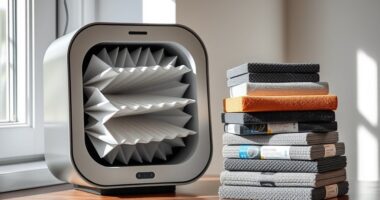
For most small businesses, I would start with the Carefor CF-60PP: its CSV reporting makes it a practical fit for teams that need to track readings over time. The Aranet4 is a focused choice for monitoring CO2 in offices, while the Airthings View Plus adds radon detection for workplaces where that risk matters. The main tradeoff is between targeted, interpretable measurements and broad sensor lists that may be harder to act on. I compare all 15 options by workplace fit, usability, reporting, and the limits of their stated features. Continue reading for the full breakdown and guidance on choosing a monitor for your space.

Get garden gear delivered free with Prime
- Fast, free delivery on millions of items
- Prime Video, Amazon Music and more included
- Member-only deals all year
Complete the kit


Key Takeaways
- Carefor CF-60PP stands out for small businesses that need CSV reports to review readings beyond the device display.
- Aranet4 focuses on CO2, which can make it easier to use for ventilation checks than a monitor presenting many different measurements.
- Airthings View Plus is the specialized pick for workplaces where radon tracking matters alongside broader air quality monitoring.
- Several options advertise 16-in-1 measurements or large displays, but a long sensor list alone does not show which readings are most useful for a particular business.
- Amazon Smart and Temtop S1 offer narrower, simpler approaches, while app-connected and export-oriented models better suit owners who need to review readings over time.
| Carefor CF-60PP Smart Air Quality Monitor with CSV Reporting |  | Best for Air Quality Reporting | Model: CF-60PP | Measurements: PM1.0, PM2.5, PM10, CO₂, TVOC, HCHO, pollen, AQI, temperature, humidity | Connectivity: Wi-Fi and mobile app | VIEW ON AMAZON | See Our Full Breakdown |
| Temtop M10+ 6-in-1 Indoor Air Quality Monitor |  | Best for Quiet, Low-Maintenance Monitoring | Model: M10+ | Measurements: CO₂, PM2.5, TVOCs, temperature, and humidity | Display: E-ink | VIEW ON AMAZON | See Our Full Breakdown |
| Amazon Smart Air Quality Monitor |  | Best for Alexa-Based Automations | Sensors: PM2.5, VOCs, carbon monoxide, humidity, and temperature | Connectivity: Works with Alexa | Display: Color-coded LED indicator | VIEW ON AMAZON | See Our Full Breakdown |
| Airthings 2960 View Plus Battery-Powered Radon & Air Quality Monitor |  | Best for Radon and Multi-Room Monitoring | Model: 2960 View Plus | Sensors: Radon, PM2.5, CO₂, VOC, humidity, temperature, and air pressure | Power: Battery-powered | VIEW ON AMAZON | See Our Full Breakdown |
| Temtop 7-in-1 Air Quality Monitor with PM2.5, PM10, HCHO, TVOC, Temperature, Humidity, AQI and Data Export |  | Best for Portable Spot Checks and USB Data | Model: LKC-1000S+ | Measured parameters: PM2.5, PM10, HCHO, TVOC, temperature, humidity, and AQI | Sensor types: Laser particle sensor and Dart electrochemical formaldehyde sensor | VIEW ON AMAZON | See Our Full Breakdown |
| BREATHE Airmonitor Plus Gen 2 Indoor Air Quality Monitor with CO2, PM & App |  | Best for App-Based Tracking | Measurements: CO2, PM1, PM2.5, PM10, TVOC, formaldehyde (HCHO), temperature, humidity | CO2 sensor: NDIR | Particle sensor: Laser | VIEW ON AMAZON | See Our Full Breakdown |
| 8-in-1 Indoor Air Quality Monitor with Color LED Display |  | Best for Quick Visual Checks | Measurements: HCHO, TVOC, AQI, temperature, humidity, PM1.0, PM2.5, PM10 | Display: Color LED screen with color-coded indicators | Particle sensor: Laser | VIEW ON AMAZON | See Our Full Breakdown |
| 16-in-1 Indoor Air Quality Monitor with High-Precision CO2 Sensor and HD Display | 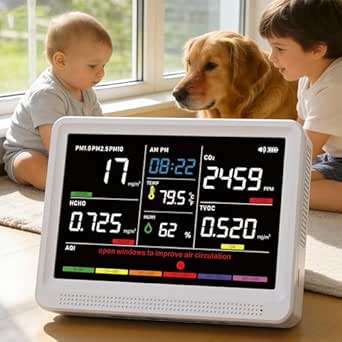 | Best for a Large Readout | Monitored parameters: CO2, PM1.0, PM2.5, PM10, HCHO, TVOC, temperature, humidity, AQI, time | Display: 5.5-inch LED | Alerts: 7 AQI alert buzzer options | VIEW ON AMAZON | See Our Full Breakdown |
| GoveeLife Smart Air Quality Monitor with PM2.5 Sensor (H5106) |  | Best for GoveeLife Automation | Measurements: PM2.5, temperature, humidity | PM2.5 accuracy: ±15 µg/m³ from 0 to 100 µg/m³; ±15% from 100 to 1000 µg/m³ | Temperature accuracy: ±0.54°F | VIEW ON AMAZON | See Our Full Breakdown |
| ZEMEOLLO 10-in-1 Indoor Air Quality Monitor |  | Best for Longer Cordless Checks | Detected parameters: CO2, HCHO, TVOC, benzene, PM2.5, PM10, PM0.3–1, temperature, AQI | Stated accuracy: Error margin under ±5% | Battery: 2000mAh rechargeable lithium polymer | VIEW ON AMAZON | See Our Full Breakdown |
| Temtop S1 PM2.5 Air Quality Monitor with Indoor Thermometer | 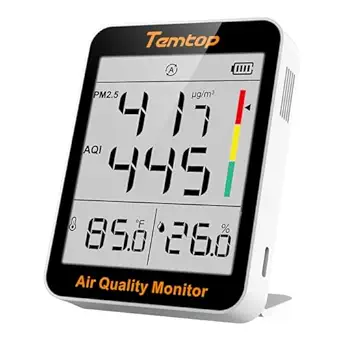 | Best for Long-Term Portable Checks | Measurements: PM2.5, AQI, temperature, and humidity | Particle sensor: Miniature laser sensor | Temperature and humidity sensor: Digital sensor | VIEW ON AMAZON | See Our Full Breakdown |
| 16-in-1 Indoor Air Quality Monitor with 7-Inch Display and Real-Time CO2 Detection |  | Best for a Shared Monitoring Station | Display: 7-inch LED | Detected parameters: CO2, PM2.5, PM1.0, PM10, HCHO, TVOC, temperature, humidity, AQI, and time | Alert functions: Seven AQI alert buzzers with mute function | VIEW ON AMAZON | See Our Full Breakdown |
| Aranet4 Indoor Air Quality Monitor, Wireless CO2 Detector for Home and Office |  | Best for Ventilation Tracking | Sensor type: NDIR CO2 sensor | Measured parameters: CO2, temperature, relative humidity, and atmospheric pressure | Display: E-ink | VIEW ON AMAZON | See Our Full Breakdown |
| AirKnight AT1000 Indoor Air Quality Monitor |  | Best for Portable Multi-Pollutant Checks | Model: AT1000 | Measurements: CO2, PM2.5, PM10, TVOC, formaldehyde (HCHO), temperature, humidity, and AQI | Display: LCD screen | VIEW ON AMAZON | See Our Full Breakdown |
| Sainlogic Indoor Air Quality Monitor, 16-in-1 VOC/CO2/HCHO/TVOC/PM2.5 Meter with 7.2″ Display |  | Best for Customizable On-Device Alerts | Display: 7.2 inches | Parameters tracked: CO2, PM1.0, PM2.5, PM10, AQI, HCHO, TVOC, temperature, and humidity | Sampling interval: 1.5 seconds | VIEW ON AMAZON | See Our Full Breakdown |
| air quality monitor for small business | Display | Battery life |
|---|---|---|
| Carefor CF-60PP Smart Air Qual | — | — |
| Temtop M10+ 6-in-1 Indoor Air | E-ink | Up to 60 days |
| Amazon Smart Air Quality Monit | Color-coded LED indicator | — |
| Airthings 2960 View Plus Batte | Customizable eInk screen | — |
| Temtop 7-in-1 Air Quality Moni | IPS color display | 6–8 hours |
| BREATHE Airmonitor Plus Gen 2 | — | Up to 6 hours |
| 8-in-1 Indoor Air Quality Moni | Color LED screen with color-coded indicators | 4–5 hours per charge |
| 16-in-1 Indoor Air Quality Mon | 5.5-inch LED | Up to 10 hours |
| GoveeLife Smart Air Quality Mo | — | — |
| ZEMEOLLO 10-in-1 Indoor Air Qu | HD LED color screen | Up to 20 hours per charge |
| Temtop S1 PM2.5 Air Quality Mo | Shows temperature, humidity, AQI, and PM2.5 | Up to 60 days per charge |
| 16-in-1 Indoor Air Quality Mon | 7-inch LED | — |
| Aranet4 Indoor Air Quality Mon | E-ink | Up to four years |
| AirKnight AT1000 Indoor Air Qu | LCD screen | — |
| Sainlogic Indoor Air Quality M | 7.2 inches | — |
More Details on Our Top Picks
Carefor CF-60PP Smart Air Quality Monitor with CSV Reporting
For a small business that needs records as well as live readings, the CF-60PP’s USB export and storage for up to a year make it more useful for tracking patterns than the Amazon Smart Air Quality Monitor, whose appeal centers on Alexa alerts and automations. Its wide sensor list includes CO₂, particles, VOCs, formaldehyde, and pollen, while on-screen charts make recent changes visible without opening the app. Custom thresholds can flag conditions that matter to a particular workspace. The tradeoff is that remote syncing depends on Wi-Fi, and the supplied product data does not state measurement accuracy. I’d choose it for a business that plans to review and export air quality records, but not for a buyer who needs documented precision or local-only monitoring.
Pros:- Measures particles, CO₂, VOCs, formaldehyde, pollen, temperature, and humidity
- Stores up to one year of historical sensor data
- Exports data over USB and shows charts on the device
- Custom alarms can trigger locally and through app notifications
Cons:- Wi-Fi is needed for app syncing and remote monitoring
- Product information does not specify measurement accuracy
Best for: Small offices, studios, or shops that want long-term sensor history and USB exports for internal air quality reports
Not ideal for: Businesses that require stated accuracy figures or need app monitoring without Wi-Fi
- Model:CF-60PP
- Measurements:PM1.0, PM2.5, PM10, CO₂, TVOC, HCHO, pollen, AQI, temperature, humidity
- Connectivity:Wi-Fi and mobile app
- Data storage:Up to one year
- Data export:USB
- On-screen history:4-minute, 6-minute, 2-hour, and 12-hour charts
- Pollen range:0–500 µg/m³
- Alarms:Customizable thresholds, local alarms, and app notifications
Our verdict“Choose the CF-60PP if your business needs broad readings and exportable history more than documented accuracy specifications.”
Temtop M10+ 6-in-1 Indoor Air Quality Monitor
The Temtop M10+ suits a small office that wants ongoing readings without leaving a monitor plugged in: its e-ink screen and stated battery life of up to 60 days support flexible placement, and the alarm can be muted for quiet spaces. It tracks CO₂, PM2.5, TVOCs, temperature, and humidity, giving a business useful coverage of ventilation, particles, and comfort. Compared with the Carefor CF-60PP, it is simpler and less suited to formal reporting: logging is hourly, connectivity is Bluetooth, and no USB export or year-long storage is listed. That local connection can also limit access when the person checking readings is away. I’d pick it for a small team that checks conditions nearby and values long battery life over remote oversight.
Pros:- Tracks CO₂, PM2.5, TVOCs, temperature, and humidity
- Battery life is listed as up to 60 days
- E-ink display supports at-a-glance readings
- Hourly app logging and a mute option are provided
Cons:- Bluetooth range limits remote monitoring
- Hourly logging offers less detail than frequent on-screen charts
- No data export method is listed
Best for: Small offices and studios where staff can check readings nearby and want a quiet monitor with infrequent charging
Not ideal for: Managers who need remote alerts, exported reports, or readings while away from the monitor
- Model:M10+
- Measurements:CO₂, PM2.5, TVOCs, temperature, and humidity
- Display:E-ink
- Connectivity:Bluetooth and app
- Data logging:Hourly
- Battery life:Up to 60 days
- Included items:M10+, charging cable, user manual
Our verdict“Pick the M10+ for quiet, battery-powered monitoring when nearby checks matter more than remote access or reporting.”
Amazon Smart Air Quality Monitor
For a small business already using Alexa, this monitor’s strongest advantage is what it can trigger: phone or Echo alerts and Routines that can activate compatible purifiers, fans, or dehumidifiers. Its sensors cover PM2.5, VOCs, carbon monoxide, humidity, and temperature, but readings are conveyed through a color-coded LED on the unit and more detail in the app. That makes it less direct for staff on site than the Temtop M10+, which has an e-ink screen, and less suited to recordkeeping than the Carefor CF-60PP, which offers USB export. The Alexa dependency is a real constraint: without that ecosystem, much of this model’s practical value falls away. I’d choose it when automatic responses matter more than a standalone display or exported history.
Pros:- Includes carbon monoxide alongside particle and VOC monitoring
- Can send real-time alerts to phones or Echo devices
- Alexa Routines can automate compatible air treatment and comfort devices
- Setup uses the Alexa app
Cons:- Requires the Alexa ecosystem for its main automation features
- The device has no built-in screen for detailed readings
- Product data does not list data export or historical storage
Best for: Small offices already equipped with Alexa devices that want alerts and compatible equipment to respond automatically
Not ideal for: Businesses seeking a standalone monitor, detailed readings on the device, or an Alexa-free setup
- Sensors:PM2.5, VOCs, carbon monoxide, humidity, and temperature
- Connectivity:Works with Alexa
- Display:Color-coded LED indicator
- Setup:Plug in and connect through the Alexa app
- Compatibility:Echo devices, Amazon Smart Thermostat, air purifiers, dehumidifiers, and fans
Our verdict“Choose this monitor if Alexa is already part of your business setup and you want readings to trigger compatible devices.”
Airthings 2960 View Plus Battery-Powered Radon & Air Quality Monitor
Among these five options, the Airthings View Plus is the specialist choice for a business concerned about radon as well as day-to-day air quality. It also measures PM2.5, CO₂, VOCs, humidity, temperature, and air pressure, and its battery-powered design allows placement where an outlet would be inconvenient. App trends and notifications can help a manager compare conditions across rooms when paired with other Airthings devices. By comparison, the Carefor CF-60PP offers USB data export and pollen readings, while the Airthings adds radon monitoring but relies on its app, account, internet access, and cloud storage. That connected setup may not suit businesses seeking local records. I’d prioritize it for multi-room monitoring where radon is a specific concern, rather than for straightforward USB reporting.
Pros:- Measures radon alongside PM2.5, CO₂, VOCs, and comfort conditions
- Battery power allows placement without a nearby outlet
- App provides notifications and trend analysis
- Supports multi-room setups with other Airthings devices
Cons:- Requires the Airthings app, an account, and internet access
- Cloud-based storage may not suit local-only data policies
- No USB export method is listed
Best for: Business owners monitoring multiple rooms who specifically want radon readings alongside common air quality measures
Not ideal for: Businesses that prefer local-only monitoring, do not want an app account, or need USB data export
- Model:2960 View Plus
- Sensors:Radon, PM2.5, CO₂, VOC, humidity, temperature, and air pressure
- Power:Battery-powered
- Connectivity:Wi-Fi
- Display:Customizable eInk screen
- Operating temperature:4 to 40°C / 39 to 104°F
- Radon detection:Passive diffusion chamber sampling with alpha spectrometry detection
- App requirement:Airthings app and account required
- Warranty:Five years with registration
Our verdict“Choose the View Plus when radon and flexible multi-room placement matter more than local data export.”
Temtop 7-in-1 Air Quality Monitor with PM2.5, PM10, HCHO, TVOC, Temperature, Humidity, AQI and Data Export
The Temtop LKC-1000S+ is the most portable reporting option here: its built-in battery supports 6–8 hours of spot checks, while USB export to Excel helps a small business keep its own records without an app. It measures PM2.5, PM10, formaldehyde, TVOCs, temperature, humidity, and AQI, and displays a 12-hour trend histogram. That makes it a better fit for moving between rooms or checking locations than the Wi-Fi-dependent Carefor CF-60PP, which is built around app syncing and longer-term stored history. The Temtop’s short battery life favors rounds of inspection over unattended monitoring; Type-C power supports continuous use at a chosen spot. Strong cleaning products and similar substances can affect readings, so I’d avoid relying on it during or just after such use.
Pros:- Measures PM2.5, PM10, formaldehyde, TVOCs, temperature, humidity, and AQI
- Exports data to Excel over USB without an app
- Portable battery supports spot checks, with Type-C power for continuous use
- Displays a 12-hour trend histogram
Cons:- Battery supports only 6–8 hours of use
- Does not detect gas or carbon monoxide leaks
- Readings may be affected by alcohol, perfumes, disinfectants, and strong cleaning agents
Best for: Facilities staff who move between rooms for air checks and want USB exports without app-based reporting
Not ideal for: Businesses needing unattended, battery-powered monitoring or carbon monoxide and gas-leak detection
- Model:LKC-1000S+
- Measured parameters:PM2.5, PM10, HCHO, TVOC, temperature, humidity, and AQI
- Sensor types:Laser particle sensor and Dart electrochemical formaldehyde sensor
- Display:IPS color display
- Data export:USB to Excel
- Battery life:6–8 hours
- Power:Type-C for continuous use
- Dimensions and weight:6.97 x 1.26 x 2.56 inches; 14.4 ounces
- Operating temperature:32°F to 122°F
Our verdict“Choose the LKC-1000S+ for mobile spot checks and USB records, provided short battery life fits your monitoring routine.”
BREATHE Airmonitor Plus Gen 2 Indoor Air Quality Monitor with CO2, PM & App
For a small business that needs a record of changing conditions as well as a live reading, the BREATHE Airmonitor Plus Gen 2 brings together eight measurements, remote app access, alerts, and CSV export. Its NDIR CO2 sensor can help staff spot when a busy room needs more ventilation, while particle, VOC, and formaldehyde readings cover more possible concerns than the GoveeLife H5106, which focuses on PM2.5, temperature, and humidity. The 90-day history gives this model a practical advantage for reviewing patterns, though it is not a substitute for calibrated compliance equipment. The tradeoff is that portable use lasts only up to six hours, and app connectivity requires 2.4 GHz Wi-Fi. It makes most sense where managers will use the logs and alerts, rather than just glance at a screen.
Pros:- Measures CO2, three particle sizes, TVOC, formaldehyde, temperature, and humidity
- NDIR CO2 and laser particle sensors provide distinct measurements useful for ventilation and particle monitoring
- App offers remote readings, configurable alerts, 90-day history, and CSV export
- USB-C supports continuous powered operation as well as portable use
Cons:- Portable battery life is limited to up to six hours
- App connectivity requires 2.4 GHz Wi-Fi
- More sensor coverage and app features may be unnecessary for businesses that only need PM2.5 readings
Best for: Small offices, studios, or shops that want broad sensor coverage and downloadable records to review indoor conditions over time
Not ideal for: Businesses that need a long-running cordless monitor, or whose Wi-Fi network does not support 2.4 GHz
- Measurements:CO2, PM1, PM2.5, PM10, TVOC, formaldehyde (HCHO), temperature, humidity
- CO2 sensor:NDIR
- Particle sensor:Laser
- Connectivity:2.4 GHz Wi-Fi
- App features:Remote readings, alerts, 90-day history, CSV export
- Battery life:Up to 6 hours
- Charging:USB-C; supports continuous operation
- Warranty:2 years
Our verdict“Choose the BREATHE if you want broad readings and app-based records for a small workplace and can keep it powered or near Wi-Fi.”
8-in-1 Indoor Air Quality Monitor with Color LED Display
The color-coded LED screen makes this monitor a straightforward choice for a reception area, treatment room, or small shop where staff need to read conditions at a glance. It tracks PM1.0, PM2.5, PM10, HCHO, TVOC, AQI, temperature, and humidity, so it covers more pollutant categories than the GoveeLife H5106, which concentrates on PM2.5 and comfort readings. That wider view comes without the BREATHE model’s stated CO2 sensing, app history, or CSV export, so it is less suited to managers who need ventilation readings or records for later review. Its 4–5 hour battery supports spot checks around a workplace, but frequent charging makes continuous cordless monitoring impractical. The listing also advises keeping it away from perfume and cleaning products, which can affect readings.
Pros:- Displays PM1.0, PM2.5, PM10, HCHO, TVOC, AQI, temperature, and humidity
- Color-coded screen makes readings easier to interpret quickly
- Portable form suits checking multiple rooms or locations
- Uses laser particle sensing and dedicated electrochemical HCHO and TVOC sensors
Cons:- No CO2 measurement is listed, limiting its use for ventilation monitoring
- Battery lasts only 4–5 hours per charge
- Perfume and cleaning products can affect readings, so placement needs care
Best for: Small business owners who want an easily interpreted screen for occasional room checks across several air quality indicators
Not ideal for: Ventilation-focused offices needing CO2 readings, app-based records, or continuous cordless monitoring
- Measurements:HCHO, TVOC, AQI, temperature, humidity, PM1.0, PM2.5, PM10
- Display:Color LED screen with color-coded indicators
- Particle sensor:Laser
- HCHO and TVOC sensors:Dual electrochemical sensors
- Processor:32-bit ARM chip
- Battery:1500mAh lithium
- Battery life:4–5 hours per charge
- Service:60-day replacement service
Our verdict“Pick this monitor for simple, on-screen spot checks, but choose a CO2-capable model if ventilation is your main concern.”
16-in-1 Indoor Air Quality Monitor with High-Precision CO2 Sensor and HD Display
When a monitor needs to be readable from across a counter or shared room, the 5.5-inch LED display gives this YNAK model an advantage over the more compact BREATHE Airmonitor Plus Gen 2. It lists CO2, PM1.0, PM2.5, PM10, HCHO, TVOC, temperature, humidity, AQI, and time, with seven AQI alert buzzer options to draw attention to changing conditions. The large screen and up-to-10-hour battery suit a manager who wants a visible, movable display for a shift. However, the “16-in-1” label includes alert options and time rather than 16 separate air measurements, and the supplied data does not specify an app, history, or export tools. Strong odors may also affect the sensors, so placement near cleaning supplies or fragrance is a poor fit.
Pros:- Large 5.5-inch LED display is easy to read in a shared room
- Lists CO2, particulate matter, HCHO, TVOC, temperature, humidity, and AQI
- Seven AQI alert buzzer options can draw attention to changing readings
- Up to 10 hours of cordless operation with USB-C charging
Cons:- The 16-in-1 designation includes alerts and time, not 16 separate air measurements
- No app, data history, or export feature is specified
- Perfume and other strong odors may affect sensor readings
Best for: Small offices, studios, and customer-facing spaces where staff want a large, visible display and audible AQI alerts
Not ideal for: Businesses that need downloadable trend records, remote monitoring, or a monitor whose measurement count is clear at a glance
- Monitored parameters:CO2, PM1.0, PM2.5, PM10, HCHO, TVOC, temperature, humidity, AQI, time
- Display:5.5-inch LED
- Alerts:7 AQI alert buzzer options
- Battery capacity:2500mAh
- Battery life:Up to 10 hours
- Charging:USB-C cable and adapter included
- Temperature accuracy:±1 to ±3 °F
- Humidity accuracy:±2% to ±3% RH
Our verdict“Choose the YNAK if a large screen and audible alerts matter more than app-based monitoring or historical records.”
GoveeLife Smart Air Quality Monitor with PM2.5 Sensor (H5106)
The GoveeLife H5106 is the focused pick for a small business that mainly wants to track airborne particles and link readings to compatible GoveeLife appliances. Its PM2.5, temperature, and humidity readings refresh every two seconds, with Bluetooth and Wi-Fi support for remote monitoring, graphs, and data export. Compared with the BREATHE Airmonitor Plus Gen 2, it covers fewer pollutants and omits CO2, HCHO, and TVOC, but it can make more sense when the business already uses compatible devices for automatic control. The four-level indicator offers a quick visual cue, while the wired USB-C power suits a fixed desk or shelf. That same setup rules it out for mobile checks, and automation works only with listed compatible appliances. Its PM2.5 accuracy is specified with a stated margin, so readings should be treated accordingly.
Pros:- Two-second response time for PM2.5, temperature, and humidity readings
- Bluetooth and 2.4 GHz Wi-Fi support remote monitoring
- Data graphs and export support help review conditions over time
- Can automate listed compatible GoveeLife appliances
Cons:- Measures only PM2.5, temperature, and humidity
- Requires USB-C wired power and has no built-in battery
- Smart control is limited to compatible GoveeLife devices
Best for: Small businesses using compatible GoveeLife appliances that want fixed-location PM2.5 monitoring, remote readings, and data exports
Not ideal for: Businesses that need cordless room checks, CO2 or gas readings, or broad pollutant coverage in one device
- Measurements:PM2.5, temperature, humidity
- PM2.5 accuracy:±15 µg/m³ from 0 to 100 µg/m³; ±15% from 100 to 1000 µg/m³
- Temperature accuracy:±0.54°F
- Humidity accuracy:±3% RH
- Response time:2 seconds
- Connectivity:Bluetooth and 2.4 GHz Wi-Fi
- Data storage:13-day graphs; export data from the past 2 years
- Power:USB-C wired; no built-in battery
Our verdict“Choose the H5106 for fixed-location PM2.5 tracking and GoveeLife automation, not broad air quality coverage.”
ZEMEOLLO 10-in-1 Indoor Air Quality Monitor
Among these five options, the ZEMEOLLO offers the longest stated cordless runtime: up to 20 hours from its rechargeable 2000mAh battery. That makes it practical for checking multiple rooms during a workday without keeping a cable nearby, unlike the GoveeLife H5106, which requires wired power. Its listed measurements include CO2, HCHO, TVOC, benzene, PM2.5, PM10, PM0.3–1, temperature, and AQI; the advertised 10-in-1 count is not fully reflected in that list of distinct parameters. A color-changing screen and one-button startup keep operation simple for staff without an app setup. The tradeoff is the absence of listed smart connectivity, remote alerts, or downloadable records. The supplied data also does not identify the sensor methods behind its stated accuracy margin.
Pros:- Up to 20 hours of stated battery life supports checks across a workday
- Lists CO2, HCHO, TVOC, benzene, particle measurements, temperature, and AQI
- Color-changing screen provides a quick visual signal when readings exceed thresholds
- One-button startup and switchable Celsius/Fahrenheit settings simplify operation
Cons:- No app or smart connectivity is specified
- No data history or export feature is listed
- The 10-in-1 designation does not match the nine distinct parameters supplied
Best for: Small business owners who need to move a monitor between rooms for extended cordless checks and prefer simple on-device operation
Not ideal for: Managers who need app access, remote alerts, documented data exports, or clearly specified sensor methods
- Detected parameters:CO2, HCHO, TVOC, benzene, PM2.5, PM10, PM0.3–1, temperature, AQI
- Stated accuracy:Error margin under ±5%
- Battery:2000mAh rechargeable lithium polymer
- Battery life:Up to 20 hours per charge
- Display:HD LED color screen
- Temperature units:Celsius or Fahrenheit
- Weight:7 ounces
- Package dimensions:5.39 × 4.06 × 1.85 inches
Our verdict“Pick the ZEMEOLLO for long cordless room checks and simple local readings, but look elsewhere for remote tracking or records.”
Temtop S1 PM2.5 Air Quality Monitor with Indoor Thermometer
I’d choose the Temtop S1 for a small office that needs occasional PM2.5 and comfort checks without frequent charging. Its laser particle sensor tracks PM2.5 and AQI, while temperature and humidity readings help staff distinguish a particle concern from a stuffy or uncomfortable room. The display keeps those readings together, and the stated battery life of up to 60 days suits moving the unit between rooms. Compared with the Aranet4, the S1 adds particle readings while Aranet4 focuses on CO2 and offers app-based history. The tradeoff is that an instant PM2.5 and AQI update requires pressing Settings, so it is less convenient for continuous glance checks. I’d pick it for simple spot monitoring, not for tracking ventilation trends or covering many pollutants.
Pros:- Combines PM2.5 and AQI with temperature and humidity
- Portable design with a clear, combined display
- Stated battery life of up to 60 days per charge
Cons:- Instant PM2.5 and AQI refresh requires a Settings button press
- Does not list CO2, VOC, or formaldehyde measurement
Best for: Small offices that want a portable PM2.5 spot checker with temperature and humidity readings and infrequent charging
Not ideal for: Businesses that need CO2 readings, historical graphs, or instant refreshes without pressing a button
- Measurements:PM2.5, AQI, temperature, and humidity
- Particle sensor:Miniature laser sensor
- Temperature and humidity sensor:Digital sensor
- Battery life:Up to 60 days per charge
- Display:Shows temperature, humidity, AQI, and PM2.5
- Instant refresh:Press Settings for an instant PM2.5 and AQI update
Our verdict“Choose the Temtop S1 for low-maintenance PM2.5 and comfort spot checks; choose the Aranet4 if CO2 trends matter more.”
16-in-1 Indoor Air Quality Monitor with 7-Inch Display and Real-Time CO2 Detection
For a small business that wants air readings visible to several people at once, this model’s 7-inch LED display is its clearest advantage. It lists CO2, PM1.0, PM2.5, PM10, HCHO, TVOC, temperature, humidity, AQI, and time, giving staff more context than the Temtop S1, which focuses on PM2.5 and comfort. Seven AQI alert buzzers can call attention to changing readings, and the mute function gives a manager control over the noise. The breadth suits a fixed break room or reception area better than a discreet portable monitor. The “16-in-1” label includes alert buzzers alongside monitored readings, so it should not be read as 16 distinct measurements. External sensors also need protection from contact, perfumes, and strong odors; manual setup adds some upkeep.
Pros:- Lists CO2, three particle sizes, HCHO, TVOC, and comfort readings
- Large 7-inch display has three brightness settings
- Seven AQI alert buzzers include a mute function
- External sensors are specified for detailed readings
Cons:- External sensors need protection from touching and strong odors
- The 16-in-1 label counts alert buzzers as well as monitored parameters
- Time and alert settings require manual adjustment
Best for: Small businesses that want a fixed, shared display in a reception area or break room, with broad pollutant readings and audible alerts
Not ideal for: Teams seeking a pocketable monitor, app-based reporting, or a unit that needs little setup and sensor care
- Display:7-inch LED
- Detected parameters:CO2, PM2.5, PM1.0, PM10, HCHO, TVOC, temperature, humidity, AQI, and time
- Alert functions:Seven AQI alert buzzers with mute function
- Sensor accuracy:0.001 units
- Brightness settings:Three
- Time format:12-hour or 24-hour
- Sensor type:External high-precision sensors
Our verdict“Choose this as a visible shared station when broad readings and alerts matter more than portability or app reports.”
Aranet4 Indoor Air Quality Monitor, Wireless CO2 Detector for Home and Office
When staff comfort and ventilation are the main concern, I’d rank the Aranet4 ahead of monitors centered on particle counts. Its NDIR sensor measures CO2 in real time, alongside temperature, relative humidity, and atmospheric pressure; the e-ink screen makes those readings easy to leave visible without a cable. The stated battery life of up to four years also makes it a strong fit for a meeting room that needs a persistent monitor. Compared with the AirKnight AT1000, which lists PM2.5, PM10, TVOC, and formaldehyde as well as CO2, Aranet4 gives up pollutant breadth for a simpler ventilation-focused setup. Historical graphs and analysis are available through its app for up to 90 days, so deeper review depends on a smartphone. It does not list wired power or smart-home integration.
Pros:- NDIR sensor measures CO2 in real time
- E-ink display works without a cable
- Stated battery life is up to four years
- Companion app offers historical data and analysis for up to 90 days
Cons:- Deeper data analysis requires a smartphone app
- Does not list PM, TVOC, or formaldehyde measurements
- No wired power option or smart-home integration details are provided
Best for: Small offices and meeting rooms that want to monitor CO2 as a ventilation cue and review recent readings in an app
Not ideal for: Businesses that need particle, TVOC, or formaldehyde readings from the same unit
- Sensor type:NDIR CO2 sensor
- Measured parameters:CO2, temperature, relative humidity, and atmospheric pressure
- Display:E-ink
- Battery life:Up to four years
- Power:Two included AA batteries
- App features:Historical data viewing and analysis for up to 90 days
- Dimensions:2.76 x 2.76 x 0.94 inches
- Weight:3.67 ounces
Our verdict“Pick the Aranet4 when long-running CO2 and ventilation tracking matters more than measuring a broad range of pollutants.”
AirKnight AT1000 Indoor Air Quality Monitor
The AirKnight AT1000 is the portable pick for a business that wants to move one monitor between a vehicle, work area, and office. It lists CO2, PM2.5, PM10, TVOC, formaldehyde, temperature, humidity, and AQI on an LCD, covering more pollutant types than the Temtop S1. Its rechargeable 3000 mAh battery supports use away from an outlet, though the supplied details do not state runtime, so I would not plan a full workday around a charge without checking. This broad coverage is useful for spot checks, but the product data gives no accuracy or calibration details; buyers who need dependable comparisons across rooms may prefer a monitor with more sensor information. The included manual and instructional video, plus US-based support, offer some setup help, but they do not fill that measurement-spec gap.
Pros:- Lists CO2, PM2.5, PM10, TVOC, and formaldehyde measurements
- Also displays temperature, humidity, and AQI
- Portable design has a rechargeable 3000 mAh battery
- Includes an instructional video, user manual, and US-based customer support
Cons:- No measurement accuracy or sensor calibration details are provided
- Battery runtime is not stated
- No historical reporting or app features are specified
Best for: Small business owners who need a rechargeable monitor to check several pollutant types across office and vehicle spaces
Not ideal for: Businesses that require documented sensor accuracy, calibration details, or a known runtime for all-day monitoring
- Model:AT1000
- Measurements:CO2, PM2.5, PM10, TVOC, formaldehyde (HCHO), temperature, humidity, and AQI
- Display:LCD screen
- Battery:3000 mAh rechargeable lithium-polymer
- Portability:Portable
- Included guidance:Instructional video and user manual
- Customer support:US-based
Our verdict“Choose the AT1000 for portable spot checks across multiple pollutant types if its unspecified runtime and sensor details fit your needs.”
Sainlogic Indoor Air Quality Monitor, 16-in-1 VOC/CO2/HCHO/TVOC/PM2.5 Meter with 7.2″ Display
For a manager who wants visible readings and configurable thresholds without adding WiFi or an app, the Sainlogic makes a practical wall-side or desk-side station. Its 7.2-inch display shows nine listed indicators, including CO2, three particle sizes, HCHO, TVOC, temperature, and humidity; readings refresh every one to two seconds. Seven user-defined alert thresholds let a business tune notifications to its own monitoring habits. Compared with the other 7-inch monitor in this group, Sainlogic specifies USB-C charging and up to eight hours of battery use, but that runtime makes it less suitable for unattended, all-day portable coverage than the Aranet4. It needs no app or WiFi, which keeps setup simple, while audible alarms require manual silencing. The stated sensitivity should not be mistaken for lab-grade measurement performance.
Pros:- Tracks nine listed indicators, including CO2, PM1.0, PM2.5, PM10, HCHO, and TVOC
- Large 7.2-inch display refreshes readings every one to two seconds
- Seven user-defined alert thresholds and three brightness levels
- No app or WiFi setup required; charges over USB-C
Cons:- Battery life is stated as up to eight hours per charge
- Audible alarms require manual silencing
- The listed sensitivity is not a substitute for professional lab-grade measurement
Best for: Small business managers who want a large shared display, adjustable alert thresholds, and offline operation near a charging point
Not ideal for: Teams needing all-day untethered monitoring, lab-grade measurement documentation, or alarms that silence themselves
- Display:7.2 inches
- Parameters tracked:CO2, PM1.0, PM2.5, PM10, AQI, HCHO, TVOC, temperature, and humidity
- Sampling interval:1.5 seconds
- Refresh rate:1–2 seconds
- Alert thresholds:Seven user-defined
- Battery:2500 mAh rechargeable, up to eight hours
- Charging port:USB-C
- Connectivity:None; no app or WiFi required
Our verdict“Choose Sainlogic for customizable local alerts and a readable shared display if you can recharge it during the workday.”

How We Picked
I ranked these monitors around small-business tasks: checking conditions in occupied rooms, spotting ventilation concerns, understanding the readings, and keeping useful records. I gave weight to the stated sensor coverage, display or app usability, reporting and data export, and whether a model’s features suit a recognizable workplace need. A focused CO2 monitor can be more practical for an office than a device with many measurements if the buyer mainly wants a clear ventilation signal.
The order favors products with a distinct, supportable role for a business, such as reporting, targeted CO2 tracking, or radon measurement. Broad sensor counts and large displays can help, but they do not by themselves establish measurement accuracy or make results easier to interpret. Product names and feature descriptions do not provide enough detail to compare calibration, long-term support, or operating costs consistently, so I treat those as questions buyers should verify before relying on a monitor for formal decisions.
Factors to Consider When Choosing Air Quality Monitor For Small Business
I would choose a monitor only after deciding what workplace question it needs to answer. A useful device is one that makes the relevant reading understandable and gives the team a repeatable way to respond.
Match the Sensors to the Concern
Start with the reason you want to monitor: ventilation, particles, gases, or radon call for different measurements. CO2 readings can help teams notice ventilation patterns in occupied rooms, while a particle sensor addresses a different kind of concern. A device that lists many sensors may seem like a safer choice, but some readings may not be relevant to your space or easy to interpret. Check the product documentation for exactly what each measurement represents. Avoid treating a general air quality score as a substitute for a specific sensor reading. If you have a defined health, compliance, or building issue, confirm that the monitor is suitable for that purpose before buying.
Plan Where and How Many Devices You Need
A monitor describes the air near its placement, not every room in a business. Separate rooms, floors, or areas with different occupancy patterns may need separate monitoring points. Before choosing one large-screen unit, consider whether staff can see it from the occupied area and whether readings can be checked without interrupting work. Keep monitors away from direct drafts, open windows, and obvious local sources if those would skew the picture of typical room conditions. For a small business, a consistent placement routine may produce more useful comparisons than moving a single device from room to room. Map the spaces and questions first, then decide how many units your workflow can support.
Decide Whether You Need Records
A live display can answer “what is happening now,” while exports or an app history can help answer whether a pattern repeats. Owners who need to compare opening hours, occupancy, or ventilation changes should check how readings are stored and how easily they can be retrieved. CSV export, as offered by some models in this lineup, can make analysis more flexible, but it also means someone must review and retain the files. Ask whether the monitor records continuously, how long history remains available, and whether data depends on a cloud account. Do not assume a phone app automatically provides a durable business record. Choose the simplest recordkeeping method your team will actually maintain.
Check Readability and Staff Workflow
In a shared workplace, readings need to make sense to people beyond the person who purchased the device. A clear display can support quick checks, while an app may suit owners who manage several spaces remotely. Color indicators and summary scores are convenient, but staff should know what threshold or change calls for action and what action is appropriate. A complex screen can add friction if users cannot distinguish the measurements. Consider who will check the monitor, how often, and whether that person can reach the device during business hours. A straightforward device that fits the team’s routine may be more useful than a feature-rich one that rarely gets checked.
Verify Accuracy, Calibration, and Intended Use
Sensor labels alone do not tell you how a device performs across its operating life. Review the manufacturer’s documentation for accuracy ranges, calibration guidance, sensor lifespan, and conditions that can affect readings. This matters especially when results could influence building changes, workplace policies, or conversations with a landlord. A consumer monitor can help identify patterns, but it may not replace professional assessment or instruments intended for formal testing. Confirm whether calibration is user-managed, service-based, or unavailable. If you need evidence for a specific decision, verify that the device’s stated performance and recordkeeping meet that need before relying on it.
Weigh Ownership and Ongoing Support
The purchase decision includes more than the initial device: consider power, connectivity, software access, and replacement or calibration needs. Battery-powered designs can be easier to place where outlets are inconvenient, while plugged-in monitors may suit fixed stations. App-connected products can add remote access, but check whether core readings remain available if the network or account is unavailable. For a business, also look for clear support documentation and a practical process for replacing a failed unit. Compare these ongoing demands against how often the readings will inform decisions. Paying for extra sensors or a larger display makes sense only when those features serve a specific workflow.
Frequently Asked Questions
Is a CO2 monitor enough for a small office?
It can be enough if your main question is how CO2 changes in occupied rooms as a ventilation indicator. It will not tell you everything about particles, radon, or other gases, so the right scope depends on the concern you are addressing. The Aranet4 is a focused option in this lineup, while broader monitors may cover more measurement types. Before buying, decide what action you would take when a reading changes. If the concern involves a specific contaminant or building condition, check whether CO2 measurement addresses it at all.
Do I need an air quality monitor in every room?
Not necessarily, but one device cannot represent rooms with different occupancy, ventilation, or sources of pollutants. A compact business might begin by monitoring the busiest or most enclosed space, then add another unit if readings or complaints point to a different area. Keep placement consistent so comparisons remain meaningful. Moving a monitor between rooms can help with a short survey, but it makes simultaneous changes harder to observe. Consider the room layout and the decision you need the readings to support before setting the number of devices.
Can I use monitor readings to prove my workplace is safe?
A consumer monitor can show trends and help flag conditions for further attention, but a reading by itself may not establish that a workplace is safe or compliant. Sensor accuracy, placement, calibration, and the specific substance being measured all affect what the result means. The models in this roundup vary in their stated measurements and recordkeeping, so confirm the manufacturer’s documentation for your use case. For regulatory, health, or building disputes, ask a qualified professional what evidence is appropriate. Treat the monitor as one source of information, not a final certification.
When is data export worth choosing over a live display?
Export is useful when you need to compare readings across days, shifts, or changes to ventilation and occupancy. The Carefor CF-60PP is notable here because its stated CSV reporting supports review outside the device itself. A live display may be enough for a small shop that only needs occasional spot checks. Export also creates a recordkeeping task: someone must save, label, and interpret the files. Choose it when historical patterns will shape a decision, rather than just because data tools sound useful.
Should a business choose a monitor with the most sensors?
Only if those measurements match concerns in the actual space and the team can interpret them. A large sensor count can broaden coverage, but it does not automatically mean better accuracy or clearer decisions. A focused CO2 device may be easier for ventilation checks, while a radon-capable model addresses a separate concern. Read the measurement list and documentation rather than relying on the number in the product name. If several readings are unfamiliar, identify who will interpret them before choosing a more complex monitor.
Conclusion
For a small business that needs to review readings over time, I would choose the Carefor CF-60PP as the best overall because CSV reporting gives it a practical recordkeeping role. The best value in function is the Temtop M10+ for buyers who want a multi-measurement approach without starting with a specialized radon monitor, though they should confirm the exact measurements and documentation they need. For a premium, specialized need, consider the Airthings View Plus when radon detection is a priority. Beginners who want a clear, narrow focus can start with the Aranet4 for CO2 tracking; businesses prioritizing a simple smart monitor can also compare the Amazon Smart model. For targeted particle monitoring, the GoveeLife H5106 or Temtop S1 may fit better than a broad multi-sensor unit. Choose based on the workplace question you need answered, then verify that the device’s stated performance and data handling fit that decision.
Fall Picks
fall essentials
As an affiliate, we earn on qualifying purchases.