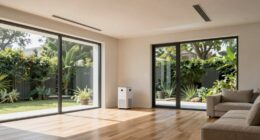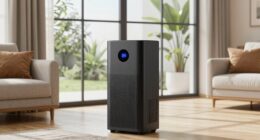
Air purifiers with high-quality HEPA filters can help reduce airborne COVID-19 particles indoors, especially when used correctly and maintained well. They trap respiratory droplets that may carry the virus, lowering the risk of inhalation. However, they work best alongside other measures like masks, good ventilation, and distancing. To maximize protection, proper placement and regular filter changes are essential. Keep exploring to discover more ways you can enhance your indoor safety.
Key Takeaways
- High-efficiency air purifiers with HEPA filters can significantly reduce airborne viral particles indoors.
- Properly sized and correctly placed purifiers improve their effectiveness against COVID-19 transmission.
- Air purifiers alone do not eliminate all risk; they should be combined with masks and good ventilation.
- Regular filter maintenance ensures optimal removal of virus-laden aerosols from indoor air.
- Devices with UV light features can add extra protection by inactivating viruses passing through filters.

Have you wondered if air purifiers can help protect you from COVID-19? The answer isn’t straightforward, but understanding how air purifiers work can give you clarity. COVID-19 primarily spreads through virus transmission via respiratory droplets when an infected person coughs, sneezes, or talks. These droplets can linger in the air, especially indoors, increasing the risk of inhalation. That’s where air purifiers come into play. They’re designed to filter out airborne particles, including viruses, before they reach you. But their effectiveness largely depends on the air filter efficiency and how well the device is suited for your space.
Air filter efficiency is critical because not all filters are created equal. High-efficiency filters, like HEPA filters, are capable of trapping at least 99.97% of particles as small as 0.3 microns, which includes the size range of respiratory aerosols carrying the virus. When you choose an air purifier with a HEPA filter, it considerably reduces the number of virus-laden particles circulating in the air. This can lower the overall viral load in your environment, decreasing the chances of virus transmission. However, it’s essential to ensure that your air purifier is appropriately rated for the size of your room. A small purifier in a large space won’t circulate and filter the air effectively, diminishing its protective potential.
It’s also worth noting that air purifiers alone don’t eliminate all risks. They should complement other preventive measures, such as wearing masks, maintaining good ventilation, and practicing physical distancing. The key lies in proper placement and operation of your device. Position the purifier in areas where you spend the most time and keep doors and windows open when possible to enhance airflow. Regularly changing or cleaning filters is equally important to maintain air filter efficiency. A clogged or dirty filter won’t trap particles effectively, which could allow virus particles to escape back into the environment. Additionally, choosing an air purifier with UV Light Technology can provide an extra layer of protection by killing bacteria and viruses that pass through the filter.

LEVOIT Air Purifiers for Bedroom Home Dorm, AHAM VERIFIED, 3-in-1 Filter Cleaner With Aroma Pad, Filters Smoke, Allergens, Pet Dander, Odor, Dust, Office, Desktop, Core Mini-P, White
𝗪𝗛𝗬 𝗖𝗛𝗢𝗢𝗦𝗘 𝗔𝗛𝗔𝗠 𝗩𝗘𝗥𝗜𝗙𝗜𝗗𝗘 𝗔𝗜𝗥 𝗣𝗨𝗥𝗜𝗙𝗜𝗘𝗥𝗦: AHAM (Association of Home Appliance Manufacturers) is an ANSI-accredited organization that sets...
As an affiliate, we earn on qualifying purchases.
Frequently Asked Questions
Can Air Purifiers Eliminate All COVID-19 Particles?
Air purifiers can’t eliminate all COVID-19 particles, but they considerably improve virus filtration and air quality. They reduce airborne virus concentration, decreasing your risk of exposure. To maximize protection, use a purifier with HEPA filters and ensure proper room coverage. Remember, air purifiers are part of a layered approach, so combine their use with masks, ventilation, and other safety measures for the best defense against COVID-19.
Are HEPA Filters Sufficient to Prevent COVID-19 Transmission?
Hepa filters alone can’t stop viral transmission, but they’re incredibly effective at reducing airborne COVID-19 particles. You might think they’re a magic shield, but in reality, their filter effectiveness is impressive yet not absolute. Combined with good ventilation and masks, they dramatically lower your risk. So, while they aren’t foolproof, HEPA filters are a crucial part of your defense, making your space much safer against the virus.
How Often Should Air Purifier Filters Be Replaced for COVID Safety?
You should replace your air purifier filters every 6 to 12 months for maximum covid safety, depending on usage and filter type. Regular filter replacement ensures the purifier maintains its effectiveness in capturing airborne particles, including viruses. Check your manufacturer’s guidelines for specific recommendations, and consider more frequent changes if you have a high occupancy or if the air quality deteriorates. Staying on top of filter replacement helps keep your environment safer.
Do Portable Air Purifiers Work Better Than Whole-Home Systems?
You might think whole-home systems are better, but portable air purifiers often work more effectively for improving indoor air quality quickly. They’re easier to maintain, allowing you to replace filters regularly for peak performance. Plus, they target specific areas, reducing airborne particles faster. While whole-home systems cover larger spaces, portable units give you flexibility and immediate benefits, making them a better choice if you want to enhance indoor air quality efficiently.
Can Air Purifiers Reduce the Risk of COVID-19 Outdoors?
Air purifiers don’t substantially reduce your risk of COVID-19 outdoors because outdoor air quality and virus transmission are much different than indoor environments. In open spaces, air circulates freely, diluting viral particles quickly. While purifiers can help indoors, they’re not effective outdoors where virus transmission depends on factors like crowd density and airflow. To stay safe, focus on outdoor distancing and avoiding crowded areas instead of relying on air purifiers.

KNKA Air Purifier for Home Bedroom Large Room Up to 1,695 Ft² in 1 Hr, HEPA Air Cleaner with Washable Pre-Filter, AQI Display, ECO Mode, Sleep Mode, Pet Mode for Pets, Dust, Pollen, APH4000
𝐇𝐢𝐠𝐡 𝐂𝐀𝐃𝐑 𝐕𝐚𝐥𝐮𝐞: This air purifier provides reliable performance with a Smoke/Dust/PM2.5 CADR of 226 CFM (384 m³/h)...
As an affiliate, we earn on qualifying purchases.
Conclusion
So, while air purifiers might seem like your COVID-19 superhero, don’t forget they’re not invincible. They can help reduce some particles, but relying solely on them is like bringing a spoon to a sword fight. Ironically, the best protection still comes from masks, handwashing, and social distancing — things you’d think are old news. So, enjoy your air purifier, but don’t forget the basic safety steps. After all, it’s your health, not just a fancy gadget.

Air Purifiers for Home Large Room up to 2200sq.ft, MOOKA Air purifier for Home Pets with Washable Filter, PM 2.5 Display Air Quality Sensor Air Cleaner for Bedroom, Dorm room, Pets, Office PR1 (White)
MORE AIR INTAKE & HIGH-EFFICIENCY: This is the 2024 latest MOOKA PR1 HEPA air purifiers for home. To...
As an affiliate, we earn on qualifying purchases.

GermGuardian 4-in-1 HEPA Air Purifier for Home, Large Rooms Up to 743 Sq. Ft. with HEPA Air Filter, UV-C Light & Odor Reduction, AC4825E, 22 Tower Gray"
TRUE HEPA 3-LAYER PROTECTION: HEPA filter captures 99.97% of smoke, dust, pollen, and pet dander as small as...
As an affiliate, we earn on qualifying purchases.