TL;DR

Get garden gear delivered free with Prime
- Fast, free delivery on millions of items
- Prime Video, Amazon Music and more included
- Member-only deals all year
A Gardening Know How report points to Dakota Johnson’s Los Angeles poolside garden as an example of using repeated terracotta pots for a calm, unified look. The design advice is to repeat a material, pot size and a small selection of plants, while choosing containers suited to the space and climate.
Dakota Johnson’s Los Angeles garden offers a simple container-garden approach: line a curved poolside retaining wall with repeated terracotta pots instead of mixing many shapes and materials. A Gardening Know How report, drawing on an Architectural Digest Open Door video, describes the arrangement as an example of how repetition can create a calm, cohesive outdoor space.
The report says at least 20 or 30 terracotta planters sit along the wall, a feature of a property originally designed in 1947 by Carl Mason. The pots are made from the same material and are mostly similar in size and shape. The report describes Johnson’s planting as repeating similar shrubs, including roses and azaleas.
Rather than treating every container as a separate display, the arrangement uses repetition to establish a visual rhythm. The report says terracotta’s natural tone and texture help unify the row, while changes in patina as pots age can keep the effect from looking overly uniform. These are the source’s design observations, not a measured assessment of the garden’s effects.
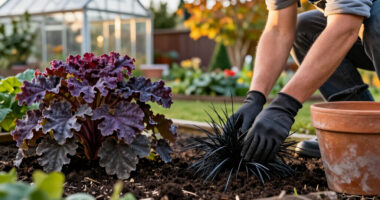
For patios and poolside areas, Gardening Know How advises choosing pots that fit the scale of the hard surface. It gives 12 inches in diameter as a suggested minimum for a container in such a setting, with larger pots as space allows. The article also recommends selecting plants for local light and conditions: it lists agave, aeonium, jade and trailing rosemary for sunny areas, and ferns, hostas or clipped box for shade.
A Repeated Look for Outdoor Pots
The example offers an accessible design choice for people who find mixed containers visually busy: repeat a pot style and a limited plant selection to make separate containers read as one arrangement. That can be useful on a long wall or broad patio, where small pots may appear lost against the surrounding surface.
The advice is adaptable, but it is not a guarantee that the same plants or containers will suit every home. Sun exposure, pool splash, available space and winter temperatures affect what will thrive and which materials will last. Readers can borrow the design principle while choosing plants and pots for their own conditions.
From Poolside Wall to Design Principle
The Gardening Know How article frames Johnson’s garden as a counterpoint to the common advice to mix container shapes, sizes and colors. It argues that cohesion can come from repetition, a principle also used in planting borders to create rhythm across a space.
The report identifies the curved retaining wall as part of a property originally designed in 1947 by Carl Mason. It does not provide a detailed planting plan, exact pot dimensions or a full account of how the garden is maintained. Its practical suggestions are general guidance inspired by the arrangement shown in the Architectural Digest video.
““Repetition is your friend.””
— Gardening Know How
Details the Report Does Not Give
The source does not specify the pots’ exact dimensions, the full plant list, the garden’s maintenance schedule or whether Johnson selected the arrangement herself. Its count of “20 or 30” pots is approximate. The report also offers no comparison or measurement showing how viewers respond to repeated containers; the calming effect is its design interpretation.
Plant recommendations depend on local conditions. The article does not identify the garden’s watering practices, soil mix or precise sun exposure, so its suggested species should not be treated as a complete planting prescription.
Applying the Idea at Home
For readers considering a similar layout, the report suggests starting with the space and climate: select containers large enough to hold their own against the patio or wall, then choose a material and a small group of plants suited to the light. In regions with hard frosts, traditional terracotta may need to be brought indoors, since absorbed water can freeze and crack the clay. Frost-resistant terracotta or double-walled resin with a terracotta finish are alternatives cited by the article.
The source reports no upcoming project or further announcement from Johnson. The next step is practical rather than news-driven: adapt the repeated-pot approach to the conditions of the site, including drainage, exposure and winter weather.
Key Questions
What is the container-garden idea in Dakota Johnson’s garden?
The Gardening Know How report describes a row of similar terracotta pots along the curved wall beside her Los Angeles pool, planted with repeated shrubs such as roses and azaleas.
Why does the report recommend repeating pots?
It says using the same material and similar sizes creates a cohesive visual rhythm, rather than making each container compete for attention. That is the article’s design assessment.
How large should patio or poolside containers be?
Gardening Know How suggests a container should be at least 12 inches in diameter in these settings, and says larger pots may suit larger spaces.
Can terracotta pots stay outside in freezing weather?
The report cautions that water absorbed by traditional terracotta can freeze and crack the pot. It recommends bringing pots indoors in hard-frost climates or considering frost-resistant terracotta or resin alternatives.
Source: rss
Halloween Picks
halloween
As an affiliate, we earn on qualifying purchases.