For an air monitor for VOCs and PM2.5, my best overall pick is the BREATHE Airmonitor Plus Gen 2 for buyers who want a focused indoor air quality monitor, while the Airthings View Plus stands out for adding radon tracking and the GoveeLife H5106 for smart alerts. The main tradeoff is between a device that tracks a wide range of readings and one that makes its core measurements easier to understand and act on. Some monitors add connectivity or data tools, while others prioritize a screen for quick room checks. VOC readings also vary by sensor and should be treated as indicators of changing conditions rather than exact identification of a chemical. Read on for how the 14 options compare and which one fits your home.

Get garden gear delivered free with Prime
- Fast, free delivery on millions of items
- Prime Video, Amazon Music and more included
- Member-only deals all year
Complete the kit


Key Takeaways
- BREATHE Airmonitor Plus Gen 2 is the lead pick for buyers focused on indoor air quality readings, while Airthings View Plus adds radon as a distinct reason to choose a more specialized monitor.
- GoveeLife H5106 pairs PM2.5 monitoring with smart features, making it a stronger fit for connected households than display-first models.
- The several 16-in-1 monitors share a broad-measurement pitch, so buyers should compare the specific VOC and particle sensors, display readability, and data access instead of relying on the number of readings.
- Temtop S1 and the amazon.com/dp/B0CLCL9HH4?tag=aeroguardians-20&ascsubtag=dc-450153″ target=”_blank” rel=”nofollow sponsored noopener”>Temtop 7-in-1 offer more focused paths for buyers who value portable checks or data export over a long list of measurements.
- AprilAire ZAWTHCPV and Amazon Smart Air Quality Monitor make the most sense when compatibility with an existing smart home matters as much as the monitor’s on-device display.
| 16-in-1 Indoor Air Quality Monitor with HD Color Screen |  | Best for Portable VOC and PM2.5 Checks | Measurements: PM1.0, PM2.5, PM10, CO2, TVOC, HCHO, temperature, and humidity | Sampling interval: 1.5 seconds | Display: HD color screen with color-coded readings | VIEW ON AMAZON | See Our Full Breakdown |
| GoveeLife Smart Air Quality Monitor with PM2.5 Sensor and LED Display (H5106) |  | Best for Connected PM2.5 Tracking | Model: H5106 | Measurements: PM2.5, temperature, and humidity | PM2.5 accuracy: ±15 µg/m³ from 0 to 100 µg/m³; ±15% from 100 to 1000 µg/m³ | VIEW ON AMAZON | See Our Full Breakdown |
| AprilAire ZAWTHCPV Smart Wi-Fi Indoor Air Quality Monitor |  | Best for AprilAire System Integration | Measurements: PM2.5, VOCs/TVOC, CO2, humidity, and temperature | Connectivity: Wi-Fi | App: AprilAire Healthy Air app required | VIEW ON AMAZON | See Our Full Breakdown |
| 16-in-1 Indoor Air Quality Monitor with Color Display |  | Best for Portable Checks with Audio Prompts | Model: AK16C | Measurements: PM1.0, PM2.5, PM10, TVOC, HCHO, temperature, and humidity | Update interval: 1.5 seconds | VIEW ON AMAZON | See Our Full Breakdown |
| Temtop S1 PM2.5 Air Quality Monitor with Indoor Thermometer | 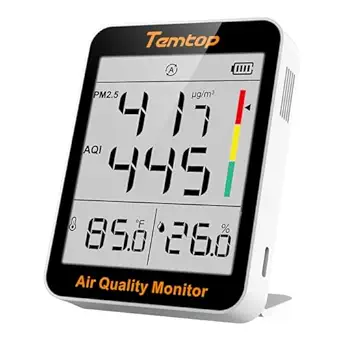 | Best for Long-Running PM2.5 Checks | Measurements: PM2.5, AQI, temperature, and humidity | Particle sensor: Miniature laser particle sensor | Temperature and humidity sensors: Digital temperature and humidity sensor | VIEW ON AMAZON | See Our Full Breakdown |
| LifeBasis 11-in-1 Indoor Air Quality Monitor |  | Best for Extended Cordless Monitoring | Monitoring indexes: AQI, CO₂, PM1.0, PM2.5, PM10, particles, HCHO, TVOC, temperature, and humidity | CO₂ sensor: NDIR infrared | Particle sensor: Laser | VIEW ON AMAZON | See Our Full Breakdown |
| 16-in-1 Indoor Air Quality Monitor with Real-Time Color Display | 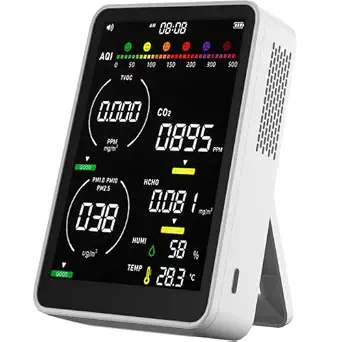 | Best for Simple, Frequent Readouts | Measurements: PM1.0, PM2.5, PM10, CO₂, TVOC, HCHO, temperature, and humidity | Sampling interval: 1.5 seconds | Battery runtime: 4–5 hours | VIEW ON AMAZON | See Our Full Breakdown |
| Sainlogic 16-in-1 Indoor Air Quality Monitor with 7.2-Inch Display |  | Best for a Large, Customizable Display | Monitored parameters: CO₂, PM1.0, PM2.5, PM10, AQI, HCHO, TVOC, temperature, and humidity | Display: 7.2-inch screen with 3 brightness levels | Alert thresholds: 7 user-defined thresholds | VIEW ON AMAZON | See Our Full Breakdown |
| Amazon Smart Air Quality Monitor |  | Best for Alexa Automations | Measurements: PM2.5, VOCs, carbon monoxide, humidity, and temperature | Smart home compatibility: Alexa | Alerts: Phone notifications and announcements on Echo devices | VIEW ON AMAZON | See Our Full Breakdown |
| Temtop 7-in-1 Air Quality Monitor with Data Export |  | Best for Exportable Trend Records | Measurements: PM2.5, PM10, HCHO, VOCs, humidity, temperature, and AQI | Sensors: Laser particle sensor and Dart electrochemical HCHO sensor | Data logging: Continuous logging with USB export to Excel; 12-hour trend histogram | VIEW ON AMAZON | See Our Full Breakdown |
| Airthings View Plus Battery-Powered Radon and Air Quality Monitor |  | Best for Broad Indoor Air Coverage | Sensors: Radon, PM2.5, CO₂, VOCs, humidity, temperature, and air pressure | Connectivity: Wi-Fi; requires internet access and the Airthings app | Power: Battery-powered | VIEW ON AMAZON | See Our Full Breakdown |
| BREATHE Airmonitor Plus Gen 2 Indoor Air Quality Monitor |  | Best for Data Export and Formaldehyde Tracking | Measurements: CO₂, PM1, PM2.5, PM10, TVOC, formaldehyde (HCHO), temperature, and humidity | CO₂ sensor: NDIR | Connectivity: 2.4 GHz Wi-Fi | VIEW ON AMAZON | See Our Full Breakdown |
| AirKnight AT1000 10-in-1 Indoor Air Quality Monitor |  | Best for a Large, Readable Display | Model: AT1000 | Measurements: CO₂, PM2.5, PM10, TVOC, HCHO, temperature, humidity, and AQI | Display: Large LCD screen | VIEW ON AMAZON | See Our Full Breakdown |
| ZEMEOLLO 10-in-1 Indoor Air Quality Monitor |  | Best for Longer Cordless Sessions | Measurements: CO₂, HCHO, TVOC, benzene, PM2.5, PM10, temperature, AQI, and PM0.3–1 detection listed | Accuracy: Claimed error margin under ±5% | Display: HD color screen with visual alerts | VIEW ON AMAZON | See Our Full Breakdown |
| air monitor for vocs and pm25 | Measurements | Display |
|---|---|---|
| 16-in-1 Indoor Air Quality Mon | PM1.0, PM2.5, PM10, CO2, TVOC, HCHO, temperature, and humidity | HD color screen with color-coded readings |
| GoveeLife Smart Air Quality Mo | PM2.5, temperature, and humidity | — |
| AprilAire ZAWTHCPV Smart Wi-Fi | PM2.5, VOCs/TVOC, CO2, humidity, and temperature | — |
| 16-in-1 Indoor Air Quality Mon | PM1.0, PM2.5, PM10, TVOC, HCHO, temperature, and humidity | HD color screen |
| Temtop S1 PM2.5 Air Quality Mo | PM2.5, AQI, temperature, and humidity | Shows temperature, humidity, AQI, and PM2.5 |
| LifeBasis 11-in-1 Indoor Air Q | — | Adjustable-brightness LCD |
| 16-in-1 Indoor Air Quality Mon | PM1.0, PM2.5, PM10, CO₂, TVOC, HCHO, temperature, and humidity | Real-time color display |
| Sainlogic 16-in-1 Indoor Air Q | — | 7.2-inch screen with 3 brightness levels |
| Amazon Smart Air Quality Monit | PM2.5, VOCs, carbon monoxide, humidity, and temperature | — |
| Temtop 7-in-1 Air Quality Moni | PM2.5, PM10, HCHO, VOCs, humidity, temperature, and AQI | IPS color display |
| Airthings View Plus Battery-Po | — | Customizable eInk screen |
| BREATHE Airmonitor Plus Gen 2 | CO₂, PM1, PM2.5, PM10, TVOC, formaldehyde (HCHO), temperature, and humidity | — |
| AirKnight AT1000 10-in-1 Indoo | CO₂, PM2.5, PM10, TVOC, HCHO, temperature, humidity, and AQI | Large LCD screen |
| ZEMEOLLO 10-in-1 Indoor Air Qu | CO₂, HCHO, TVOC, benzene, PM2.5, PM10, temperature, AQI, and PM0.3–1 detection listed | HD color screen with visual alerts |
More Details on Our Top Picks
16-in-1 Indoor Air Quality Monitor with HD Color Screen
For readers who want to check TVOC and PM2.5 together across several rooms, this portable monitor covers more ground than the GoveeLife H5106, which tracks PM2.5 but not VOCs. It also adds CO2, formaldehyde, other particle sizes, temperature, and humidity, with readings refreshed every 1.5 seconds on a color-coded screen. That breadth makes it useful for quick spot checks in different indoor spaces, while audio prompts can call attention to changing readings. The tradeoff is that the stated 4–5-hour battery life limits how long it can stay untethered. The product information also gives no sensor accuracy figures, so I would treat its readings as a guide to changes rather than a precision measurement.
Pros:- Measures TVOC and PM2.5 alongside CO2, HCHO, other particle sizes, temperature, and humidity
- Refreshes readings every 1.5 seconds on a color screen
- Portable design supports spot checks in different indoor spaces and vehicles
- Includes a USB Type-C cable and AC adapter
Cons:- Battery runtime is limited to a stated 4–5 hours per charge
- No numerical sensor accuracy figures are provided
Best for: People who want to compare VOC and particle readings in different rooms without keeping the monitor plugged in.
Not ideal for: Buyers who need all-day cordless monitoring or documented sensor accuracy.
- Measurements:PM1.0, PM2.5, PM10, CO2, TVOC, HCHO, temperature, and humidity
- Sampling interval:1.5 seconds
- Display:HD color screen with color-coded readings
- Battery runtime:4–5 hours
- Charging:USB Type-C
- Controls:Single-tap power and temperature-unit switching; double-tap audio prompt control
- Included items:Monitor, Type-C cable, AC adapter, and user manual
Our verdict“Choose this for portable, broad VOC and particle spot checks; skip it if you need long battery life or published accuracy data.”
GoveeLife Smart Air Quality Monitor with PM2.5 Sensor and LED Display (H5106)
The GoveeLife H5106 is a fit for buyers who want remote PM2.5 monitoring and saved trends, but it does not measure VOCs. That makes it less suited to this roundup’s VOC-and-particle brief than the AprilAire ZAWTHCPV, which tracks both, while the GoveeLife offers a detailed data export path of up to two years. Its Wi-Fi and Bluetooth connections support remote checks and compatible appliance automation; the two-second refresh is practical for observing changes without requiring a more expansive sensor set. A stated PM2.5 accuracy range gives buyers useful context, too. The main compromise is placement: this monitor has no battery and needs wired USB-C power. Its compact display is convenient, but the clock depends on 2.4 GHz Wi-Fi.
Pros:- Supports Bluetooth and 2.4 GHz Wi-Fi for remote monitoring
- Stores 13-day graphs and allows export of up to two years of data
- Can automate compatible GoveeLife appliances based on air quality
- Lists PM2.5, temperature, and humidity accuracy figures
Cons:- Does not measure VOCs or other listed pollutants
- Requires wired USB-C power and has no built-in battery
- Clock display requires a 2.4 GHz Wi-Fi connection
Best for: GoveeLife users who want remotely accessible PM2.5 trends and compatible appliance automation in a fixed location.
Not ideal for: Buyers who need VOC readings or want a battery-powered monitor they can move between rooms.
- Model:H5106
- Measurements:PM2.5, temperature, and humidity
- PM2.5 accuracy:±15 µg/m³ from 0 to 100 µg/m³; ±15% from 100 to 1000 µg/m³
- Response time:2 seconds
- Connectivity:Bluetooth and 2.4 GHz Wi-Fi
- Data storage:13-day graphs; export up to two years of data
- Power:Wired USB-C; no built-in battery
- Dimensions:5.31 × 1.57 × 2.47 inches
Our verdict“Pick the H5106 for connected PM2.5 tracking and data exports, but choose the AprilAire if VOC readings are a requirement.”
AprilAire ZAWTHCPV Smart Wi-Fi Indoor Air Quality Monitor
The AprilAire ZAWTHCPV brings PM2.5, VOCs, and CO2 together with temperature and humidity, then presents readings, trends, alerts, and guidance in its app. For a buyer focused on both VOCs and fine particles, that broader view makes it a closer match than the PM2.5-only GoveeLife H5106. Its AprilAire system integration can connect monitoring to compatible ventilation and filtration equipment, which is its clearest distinction in this group. That capability depends on a supported S86WMUPR or 8920W Wi-Fi thermostat, sold separately, so it makes the most sense for someone already using or planning a compatible setup. Buyers who simply want portable checks may find the 16-in-1 monitor more flexible; the AprilAire relies on its app and Wi-Fi instead.
Pros:- Measures PM2.5 and VOCs alongside CO2, temperature, and humidity
- App provides readings, trends, alerts, and guidance
- Color-coded status indicators have three light settings
- Can integrate with compatible AprilAire ventilation and filtration systems
Cons:- Requires the AprilAire Healthy Air app
- System integration requires a compatible thermostat sold separately
Best for: Homeowners using compatible AprilAire ventilation or filtration equipment who want VOC and PM2.5 readings with app alerts.
Not ideal for: Buyers who want an app-free portable monitor or do not want to depend on a compatible AprilAire thermostat for system integration.
- Measurements:PM2.5, VOCs/TVOC, CO2, humidity, and temperature
- Connectivity:Wi-Fi
- App:AprilAire Healthy Air app required
- Status indicators:Color-coded status with three light settings
- System integration:Compatible AprilAire systems; requires S86WMUPR or 8920W Wi-Fi Thermostat, sold separately
Our verdict“Choose the AprilAire if you want app-based VOC and PM2.5 monitoring linked to a compatible AprilAire system.”
16-in-1 Indoor Air Quality Monitor with Color Display
This AirWhisper model offers the same core appeal as the other portable 16-in-1 in this batch: TVOC and PM2.5 readings, several additional air measurements, and a screen that refreshes every 1.5 seconds. Its optional audio prompt gives it a useful distinction for someone who wants to notice changes without continually watching the display. Compared with the AprilAire ZAWTHCPV, it is easier to move between spaces and does not rely on an app, though AprilAire is the stronger fit for app trends and compatible home-system integration. The short 4–5-hour battery life makes this better for brief checks than continuous portable monitoring. As with the similar HD-screen 16-in-1, the supplied details omit accuracy figures, so buyers cannot judge precision from the published specs.
Pros:- Measures TVOC and PM2.5 along with other particle sizes, HCHO, temperature, and humidity
- Updates readings every 1.5 seconds on a color display
- Optional audio prompt can draw attention to readings
- Includes USB-C cable, AC adapter, and a 12-month warranty
Cons:- Battery life is stated at only 4–5 hours
- No numerical measurement accuracy figures are listed
Best for: People who want portable VOC and PM2.5 spot checks with an optional audible prompt and a simple screen.
Not ideal for: Buyers who need continuous battery-powered monitoring, documented accuracy, or connected trend tracking.
- Model:AK16C
- Measurements:PM1.0, PM2.5, PM10, TVOC, HCHO, temperature, and humidity
- Update interval:1.5 seconds
- Battery life:4–5 hours
- Charging:USB-C
- Display:HD color screen
- Item weight:14.9 ounces
- Warranty support:12 months
Our verdict“Pick this AirWhisper for short, portable checks where its audio prompt helps, and choose AprilAire for app-based trends and system integration.”
Temtop S1 PM2.5 Air Quality Monitor with Indoor Thermometer
Temtop’s S1 is the simplest choice here for buyers who mainly want PM2.5 and AQI readings alongside temperature and humidity. Its stated battery life of up to 60 days makes it easier to leave in a room or carry around than either portable 16-in-1 monitor, whose batteries are rated for just 4–5 hours. The narrower sensor set is the cost of that convenience: unlike the AprilAire ZAWTHCPV, the S1 does not measure VOCs, and it also omits CO2 and formaldehyde. A single display showing air and comfort readings keeps the focus straightforward, while the miniature laser particle sensor is specified without numerical accuracy data. I’d choose it for long-running particle checks, but not as a complete VOC-and-PM2.5 monitor.
Pros:- Measures PM2.5 and AQI alongside temperature and humidity
- Battery is rated for up to 60 days on a charge
- Shows air quality and comfort readings on one display
- Uses a miniature laser particle sensor
Cons:- Does not measure VOCs, CO2, or formaldehyde
- No numerical measurement accuracy specifications are provided
Best for: People who want a simple, long-running portable monitor for PM2.5 and indoor comfort readings.
Not ideal for: Buyers who need VOC measurements or a broader view that includes CO2 and formaldehyde.
- Measurements:PM2.5, AQI, temperature, and humidity
- Particle sensor:Miniature laser particle sensor
- Temperature and humidity sensors:Digital temperature and humidity sensor
- Battery life:Up to 60 days on a single charge
- Display:Shows temperature, humidity, AQI, and PM2.5
Our verdict“Choose the Temtop S1 for low-maintenance PM2.5 checks, but select the AprilAire if VOC monitoring is essential.”
LifeBasis 11-in-1 Indoor Air Quality Monitor
The LifeBasis earns this spot for buyers who want a broad VOC and particle snapshot without keeping the monitor plugged in all day. It tracks TVOC, PM2.5, and PM10 alongside CO₂ and HCHO, while its adjustable LCD and color-coded alerts make changes easier to notice at a glance. Its 11–12-hour battery life is longer than the 4–5 hours listed for the 16-in-1 Indoor Air Quality Monitor with Real-Time Color Display, so it suits moving between rooms or checking a space through much of the day. The tradeoff is that it still needs recharging, and an audible alert may be disruptive in a quiet bedroom or office. I’d choose it for flexible spot monitoring, not unattended, long-term logging.
Pros:- Measures TVOC and PM2.5 alongside PM1.0, PM10, HCHO, and CO₂
- Up to 11–12 hours of battery use gives it more cordless time than the Real-Time Color Display model
- Adjustable-brightness LCD and color-coded indicators make readings easier to check
- Visual and audible alerts signal elevated readings
Cons:- Requires recharging after up to 11–12 hours
- Audible alerts may interrupt sleep or focused work
Best for: People who want to carry one monitor between rooms and check VOCs and particles through much of the day
Not ideal for: Light sleepers or office users who need silent alerts, and anyone seeking continuous monitoring without recharging
- Monitoring indexes:AQI, CO₂, PM1.0, PM2.5, PM10, particles, HCHO, TVOC, temperature, and humidity
- CO₂ sensor:NDIR infrared
- Particle sensor:Laser
- Display:Adjustable-brightness LCD
- Alerts:Color-coded visual indicators and audible alert
- Battery capacity:2500 mAh
- Battery life:Up to 11–12 hours
- Charging port:USB Type-C
Our verdict“Choose the LifeBasis if you want broad VOC and particle readings with a longer cordless run than the Real-Time Color Display monitor.”
16-in-1 Indoor Air Quality Monitor with Real-Time Color Display
This monitor suits buyers who want to see frequently refreshed PM2.5 and TVOC readings without navigating app menus. Its color display updates every 1.5 seconds, and one-button controls keep routine checks straightforward; double tapping can turn off the audio prompt. Compared with the LifeBasis 11-in-1, it offers a quicker stated sampling interval and simpler operation, but its 4–5-hour runtime gives it less cordless flexibility. The included USB-C cable and AC adapter help when it stays near an outlet, while portable use is better for short checks at home, in an office, or in a vehicle. I’d pick it for quick visual monitoring and skip it if you need a full day of battery use or data logging.
Pros:- Measures PM2.5 and TVOC alongside PM1.0, PM10, CO₂, and HCHO
- Readings update every 1.5 seconds on a color display
- One-button operation and a shortcut to silence audio prompts
- Includes USB-C charging cable and AC power adapter
Cons:- Battery runtime is limited to 4–5 hours per charge
- No data logging or export feature is listed
Best for: People who want a simple color-screen monitor for short checks in a home, office, or vehicle
Not ideal for: Buyers who need all-day cordless monitoring or a long-term record of changing readings
- Measurements:PM1.0, PM2.5, PM10, CO₂, TVOC, HCHO, temperature, and humidity
- Sampling interval:1.5 seconds
- Battery runtime:4–5 hours
- Charging port:USB-C
- Controls:One-button power and °C/°F switching; double tap to turn off audio prompt
- Display:Real-time color display
- Included:Monitor, USB-C charging cable, AC power adapter, and user manual
- Warranty support:12 months
Our verdict“Pick this model for quick, straightforward VOC and particle checks near a power source, rather than extended battery use.”
Sainlogic 16-in-1 Indoor Air Quality Monitor with 7.2-Inch Display
The Sainlogic is the clearest choice here when several people need to read PM2.5 and TVOC levels across a room. Its 7.2-inch screen has three brightness settings, and seven user-defined alert thresholds let buyers tailor warnings to their preferences. Readings refresh every 1–2 seconds, much like the Real-Time Color Display monitor, but Sainlogic pairs that quick feedback with a larger screen and up to eight hours of cordless use—longer than that model’s stated 4–5 hours. Its limitation is a lack of Wi-Fi or app connectivity: readings require someone to be near the unit, and placement is manual. I’d choose it for visible, local monitoring; the Temtop 7-in-1 is a better fit for buyers who want logged data they can export.
Pros:- Large 7.2-inch display makes readings easier to see across a room
- Seven user-defined alert thresholds support tailored warnings
- Measures TVOC and PM2.5 alongside CO₂, HCHO, other particles, and climate readings
- Up to eight hours of cordless use, longer than the Real-Time Color Display model’s stated runtime
Cons:- No Wi-Fi or app connectivity for remote checks
- Requires manual placement and battery recharging after up to eight hours
Best for: Households or small offices that want multiple people to see readings and customize local alerts
Not ideal for: People who want remote phone access, automatic records, or app-connected monitoring
- Monitored parameters:CO₂, PM1.0, PM2.5, PM10, AQI, HCHO, TVOC, temperature, and humidity
- Display:7.2-inch screen with 3 brightness levels
- Alert thresholds:7 user-defined thresholds
- Sampling interval:1.5 seconds
- Reading refresh:Every 1–2 seconds
- Battery:2500 mAh rechargeable
- Wireless runtime:Up to 8 hours
- Connectivity:No Wi-Fi or app required
Our verdict“Choose Sainlogic if a large, customizable local display matters more than app access or exported air-quality history.”
Amazon Smart Air Quality Monitor
The Amazon Smart Air Quality Monitor makes the most sense for an Alexa-centered home where PM2.5 and VOC readings can prompt a practical response. It tracks both, plus carbon monoxide, humidity, and temperature, and sends app notifications or announcements through Echo devices. Buyers can also use readings to trigger routines for compatible Alexa devices. That automation is the main distinction from the portable LifeBasis 11-in-1, which covers more particle sizes and HCHO but has no listed smart-home routine feature. Amazon’s monitor depends on the Alexa app for setup and detailed information, and climate-control routines require compatible devices. I’d choose it for connected alerts and hands-off routines, but it is a poor match for someone who wants a standalone screen or cordless checks around the house.
Pros:- Measures PM2.5 and VOCs alongside carbon monoxide, humidity, and temperature
- Provides phone notifications and announcements on Echo devices
- Can trigger routines for compatible Alexa devices
- Plug-in setup supports a fixed monitoring location
Cons:- Requires the Alexa app for setup and detailed readings
- Climate-control routines depend on compatible Alexa devices
- Does not offer the broader particle-size and HCHO coverage listed for the LifeBasis 11-in-1
Best for: Alexa users who want PM2.5 and VOC alerts to trigger routines on compatible home devices
Not ideal for: People who want a standalone display, portable battery operation, or setup without the Alexa app
- Measurements:PM2.5, VOCs, carbon monoxide, humidity, and temperature
- Smart home compatibility:Alexa
- Alerts:Phone notifications and announcements on Echo devices
- Setup:Plug in and connect through the Alexa app
- Automation:Routines for compatible Alexa devices
- Power:Plug-in
Our verdict“Choose this monitor if Alexa routines and connected alerts matter more than a portable unit or a stand-alone display.”
Temtop 7-in-1 Air Quality Monitor with Data Export
The Temtop stands apart for buyers who want to move beyond a live PM2.5 and VOC snapshot and keep a record of changing conditions. Its 12-hour trend histogram gives a short on-device view, while USB export to Excel supports closer analysis without an app or subscription. A Dart electrochemical HCHO sensor and laser particle sensor add detail for people tracking formaldehyde and particles. Compared with the Amazon Smart Air Quality Monitor, Temtop offers data export rather than Alexa alerts and routines; compared with the LifeBasis 11-in-1, it has fewer listed measurements but a defined logging workflow. Its battery lasts 6–8 hours, though it can run continuously on USB power. Alcohol, perfumes, sprays, and strong cleaners may affect readings, so placement and nearby products matter.
Pros:- Exports continuous logs to Excel by USB without an app or subscription
- 12-hour trend histogram helps show recent changes
- Laser particle sensor and Dart electrochemical HCHO sensor are specified
- Can run continuously when connected to power
Cons:- Battery supports only 6–8 hours of portable use
- Does not detect carbon monoxide
- Alcohol, perfumes, sprays, and strong cleaning agents may affect readings
Best for: People who want to export air-quality trends for review, especially when comparing readings over time
Not ideal for: Alexa users seeking automated device control, or buyers who need carbon monoxide leak detection
- Measurements:PM2.5, PM10, HCHO, VOCs, humidity, temperature, and AQI
- Sensors:Laser particle sensor and Dart electrochemical HCHO sensor
- Data logging:Continuous logging with USB export to Excel; 12-hour trend histogram
- Battery life:6–8 hours
- Power supply:3.7 V DC
- Display:IPS color display
- Dimensions:6.97 × 1.26 × 2.56 inches
- Weight:14.4 ounces
Our verdict“Choose the Temtop if exportable PM and VOC trends matter more than smart-home automation or carbon monoxide readings.”
Airthings View Plus Battery-Powered Radon and Air Quality Monitor
I’d choose the Airthings View Plus when VOC and PM2.5 readings are part of a wider home air picture. It tracks both alongside radon and CO₂, plus humidity, temperature, and air pressure, while the customizable eInk screen keeps selected readings visible without relying on a phone. Compared with the BREATHE Airmonitor Plus Gen 2, its standout distinction is radon monitoring and a battery-powered setup; BREATHE adds formaldehyde measurement and CSV export. The View Plus can also link with other Airthings monitors for room-to-room coverage. Its tradeoff is dependence on an account, app, internet, and cloud data storage, so it suits buyers comfortable with connected monitoring more than those seeking an offline, self-contained device.
Pros:- Tracks VOCs and PM2.5 alongside radon, CO₂, humidity, temperature, and air pressure
- Battery-powered design allows placement without a power cable
- Customizable eInk display keeps selected readings visible
- Supports multi-room monitoring with other Airthings monitors
Cons:- Requires an Airthings account, app, and internet access
- Air quality data is saved in the cloud
Best for: Households that want VOC and PM2.5 readings alongside radon and CO₂, with cable-free placement and app-based trends.
Not ideal for: Buyers who want local-only data or do not want to depend on an app, account, and internet connection.
- Sensors:Radon, PM2.5, CO₂, VOCs, humidity, temperature, and air pressure
- Connectivity:Wi-Fi; requires internet access and the Airthings app
- Power:Battery-powered
- Display:Customizable eInk screen
- Operating temperature:4–40°C (39–104°F)
- Sensor type:Electrochemical
- Warranty:Optional registration extends the standard warranty to five years
Our verdict“Choose the View Plus if you want VOC and PM2.5 monitoring as part of a broader, app-connected system that also tracks radon.”
BREATHE Airmonitor Plus Gen 2 Indoor Air Quality Monitor
For VOC and PM2.5 monitoring with records a buyer can take elsewhere, I’d put the BREATHE Airmonitor Plus Gen 2 ahead of simpler screen-focused options. It measures PM1, PM2.5, PM10, TVOC, and formaldehyde, and its app offers alerts, graphs covering up to 90 days, and CSV export. That export makes it more useful for people comparing readings over time than the AirKnight AT1000, whose listed strengths center on its LCD and portability. BREATHE also uses an NDIR CO₂ sensor and can operate on USB-C power or its rechargeable battery. The battery lasts up to six hours, though, so I’d treat portable use as a short-term convenience. App features also require 2.4 GHz Wi-Fi.
Pros:- Measures PM1, PM2.5, PM10, TVOC, and formaldehyde
- App provides alerts and up to 90 days of history
- CSV export supports analysis outside the app
- Can operate from its rechargeable battery or USB-C power
Cons:- Portable battery life is limited to up to six hours
- App connectivity requires 2.4 GHz Wi-Fi
Best for: Homeowners or building managers who want VOC and particle trends, formaldehyde readings, and CSV files for their own analysis.
Not ideal for: People who need all-day cordless monitoring or cannot connect the device to a 2.4 GHz Wi-Fi network.
- Measurements:CO₂, PM1, PM2.5, PM10, TVOC, formaldehyde (HCHO), temperature, and humidity
- CO₂ sensor:NDIR
- Connectivity:2.4 GHz Wi-Fi
- Battery life:Up to 6 hours
- App history:Up to 90 days
- Data export:CSV
- Power:Rechargeable; USB-C operation
- Warranty:2 years
Our verdict“Pick BREATHE if you value exportable VOC and particulate history and can keep it plugged in for longer monitoring sessions.”
AirKnight AT1000 10-in-1 Indoor Air Quality Monitor
The AirKnight AT1000 makes its readings easy to check at a glance with a large LCD screen and plug-and-play operation. For this roundup’s VOC and PM2.5 focus, it covers both while also listing PM10, CO₂, formaldehyde, temperature, humidity, and AQI. Its rechargeable 3000 mAh battery gives it a portable role that contrasts with the Airthings View Plus, which emphasizes connected trends and multi-room Airthings integration. AirKnight’s appeal is simpler: move it between a home office, classroom, or car and read the display directly. The tradeoff is that the product information gives no measurement accuracy or sensor calibration details, making it harder to judge how much confidence to place in readings. I’d favor it for visibility and mobility over data validation.
Pros:- Lists both TVOC and PM2.5 among its measurements
- Large LCD screen makes readings easier to see across a room
- Rechargeable battery supports portable use
- Plug-and-play operation avoids a listed app setup requirement
Cons:- No measurement accuracy details are provided
- No sensor calibration information is provided
Best for: People who want a portable monitor with a large, directly readable screen for checking VOC and PM2.5 in different spaces.
Not ideal for: Buyers who need documented sensor accuracy, calibration information, or app-based historical analysis.
- Model:AT1000
- Measurements:CO₂, PM2.5, PM10, TVOC, HCHO, temperature, humidity, and AQI
- Display:Large LCD screen
- Battery:3000 mAh rechargeable lithium-polymer
- Operation:Plug and play
Our verdict“Choose the AT1000 for portable, at-a-glance readings, provided the missing accuracy and calibration details are acceptable to you.”
ZEMEOLLO 10-in-1 Indoor Air Quality Monitor
If I wanted to move a monitor between rooms without frequent charging, the ZEMEOLLO 10-in-1 would be the portable pick here: its listed battery life is up to 20 hours, compared with the BREATHE Airmonitor Plus Gen 2 at up to six. It lists TVOC, PM2.5, PM10, formaldehyde, and benzene, with a color screen that signals threshold alerts and one-button operation. That makes it straightforward for quick checks across several spaces. There are limits to the claims, though: the description does not name the full set of ten measurements, and its under-±5% error margin and battery-life figure are claims without independent verification in the supplied information. I’d choose it for cordless convenience, not as the most documented option.
Pros:- Lists TVOC, PM2.5, PM10, formaldehyde, and benzene monitoring
- Color screen displays readings and visual threshold alerts
- Claimed battery life of up to 20 hours supports longer cordless sessions
- One-button operation and selectable Celsius or Fahrenheit simplify use
Cons:- The product description does not specify the full set of ten measurements
- Accuracy and battery-life claims are not independently verified in the provided information
Best for: People who want to carry a simple monitor between rooms and prioritize long claimed battery life with visible alerts.
Not ideal for: Buyers who need independently verified accuracy or a clearly itemized list of all included measurements.
- Measurements:CO₂, HCHO, TVOC, benzene, PM2.5, PM10, temperature, AQI, and PM0.3–1 detection listed
- Accuracy:Claimed error margin under ±5%
- Display:HD color screen with visual alerts
- Battery:2000 mAh rechargeable lithium polymer
- Battery life:Up to 20 hours
- Weight:7 ounces
- Temperature units:Celsius and Fahrenheit
- Package dimensions:5.39 x 4.06 x 1.85 inches
Our verdict“Choose ZEMEOLLO if long cordless use and simple visual alerts matter more to you than fully documented performance.”

How We Picked
I ranked these monitors around the job implied by the search: tracking VOCs and PM2.5 indoors in a way a household can use. I gave more weight to clear reporting of those readings, accessible display or app information, and practical ways to notice changes than to a high count of advertised measurements. For this category, a long sensor list only helps when the readings are understandable and relevant to the rooms and decisions a buyer cares about.
I also weighed setup, connectivity, portability, data access, and the value of additional measurements. The BREATHE and Airthings models rise for distinct use cases, while GoveeLife is a compelling smart-home option; focused Temtop models suit buyers with narrower needs. The many 16-in-1 and 10-in-1 units may offer breadth and prominent displays, but their order depends on whether that breadth translates into useful VOC and particle monitoring. Buyers should check each listing for the exact sensor types and supported features before choosing.
Factors to Consider When Choosing Air Monitor For Vocs And Pm25
Before choosing a monitor, decide what you need the readings to help you do. A device can show changes in indoor conditions, but it may not identify the source of a VOC reading or tell you whether a particular exposure is safe. These questions help separate useful measurements from features that look impressive on a spec sheet.
Check What the VOC Reading Represents
“VOC” can describe a broad class of compounds, and consumer monitors may report a combined or index-style reading rather than identify individual chemicals. That makes a trend more useful than treating one number as a lab-grade measurement. Ask whether the device names its sensor type, explains its scale, and gives guidance for interpreting changes. A jump after painting or cleaning can prompt ventilation and source checks, but it does not tell you exactly which compound caused it. If you need identification or formal exposure assessment, a home monitor is not a substitute for specialized testing.
Match PM2.5 Monitoring to Your Room
PM2.5 is fine particulate matter, and a monitor’s usefulness depends on where and how you place it. A reading near a cooking area may differ from one in a bedroom, so think about the room whose air you most want to understand. Avoid placing the unit directly beside a vent, open window, or appliance unless that is the condition you are deliberately checking. If you want to compare rooms, a portable device can be more practical than a monitor intended to stay in one place. Check whether the screen makes changes easy to see without opening an app.
Choose Breadth Only When You Will Use It
Multi-measurement models can track temperature, humidity, and other conditions alongside VOCs and particles, which may help explain why readings change. But a bigger sensor count does not automatically mean better VOC or PM2.5 performance. Decide which extra measurements will affect your actions, such as adjusting ventilation or investigating a damp room. If you mainly want particle trends, a focused monitor may be easier to interpret and maintain. Compare the named sensors and reporting methods, not just the headline number of functions.
Decide How You Want to See and Use Data
A built-in display works well for quick checks by anyone in the household, while an app can support alerts, history, and remote viewing. Data export matters when you want to compare conditions across time or share a record with a professional. Smart-home compatibility can connect readings with routines, but it adds setup and account requirements. Before buying, check whether core readings remain available if Wi-Fi drops or you do not want to use an app. Choose the simplest interface that supports the decisions you expect to make.
Account for Power, Placement, and Upkeep
A battery-powered monitor is easier to move between rooms, while a plugged-in unit can stay in a chosen location without charging interruptions. Consider whether you need continuous tracking or occasional spot checks, since those uses favor different designs. Look for the maker’s instructions on sensor warm-up, cleaning, calibration, and replacement parts. A monitor that is hard to place or requires upkeep you will skip can produce less useful records over time. Also check whether its screen remains readable in the lighting where it will sit.
Know When Paying More Makes Sense
Extra spend is most defensible when it buys a capability tied to your concern, such as radon measurement, usable history, or integration with equipment you already own. A premium label or larger display alone does not prove the core VOC and PM2.5 readings are more useful. For broad household awareness, a straightforward monitor may cover the need without advanced data tools. Buyers tracking a suspected pattern may benefit more from export or alerts than from additional sensor categories. Write down the decision you want the monitor to support, then pay for the features that help answer it.
Frequently Asked Questions
Can one monitor tell me whether a VOC reading is dangerous?
Most consumer monitors provide an indicator or estimate for a broad group of VOCs rather than identifying each chemical and its concentration with laboratory precision. A changing reading can help you notice that indoor conditions have shifted, especially after activities such as painting, cooking, or using cleaning products. Follow the device maker’s instructions and look for the likely source before treating the number as a safety verdict. If you have a specific exposure concern or symptoms, consult a qualified professional or appropriate testing service. The monitor is most useful as a prompt for investigation and ventilation.
Should I choose a 16-in-1 monitor over a focused PM2.5 device?
Choose a multi-reading device if its additional measurements answer questions you actually have, such as whether humidity changes alongside air quality. The number of listed functions alone does not show that its VOC or PM2.5 measurements are more accurate or easier to use. A focused device can be a better fit for occasional particle checks because it may present fewer readings to interpret. Compare sensor descriptions, data presentation, and placement needs before deciding. If VOC tracking is central, confirm how that particular model reports VOCs.
Is an app connection worth choosing over a screen?
An app is useful when you want notifications, remote checks, or a history of readings, while a screen makes a quick local check simpler. Some buyers benefit from both, but a connection can bring setup steps and dependence on Wi-Fi or an account. Check which readings remain visible on the device if the network is unavailable. If several people will check the monitor, a clear display may be easier than relying on one person’s phone. Let your preferred way of acting on changes guide the choice.
Do I need radon measurement alongside VOCs and PM2.5?
Radon is a separate concern from VOCs and fine particles, so a combined monitor can be useful if you want to track it as part of a broader indoor air picture. That added function matters most when radon monitoring is already on your list, not simply because more readings sound better. Check the device’s radon measurement approach and any maker guidance on placement and monitoring duration. If you need a formal radon assessment, confirm whether the monitor’s results meet the requirements for your situation. Without a radon-specific need, focus on how well the device serves your VOC and PM2.5 priorities.
How many monitors do I need to compare rooms?
One portable monitor can help you take readings in different rooms, though it will not capture conditions in all of them at the same time. Keep placement and timing reasonably consistent so that comparisons are more meaningful. Multiple units can show simultaneous differences, but only if their readings and setup are comparable. Start with the room tied to your main concern, then move the device or add another if the comparison changes a household decision. Do not treat small differences between consumer devices as definitive without checking their specifications and guidance.
Conclusion
For most buyers focused on VOCs and PM2.5, I’d start with the BREATHE Airmonitor Plus Gen 2 as the best overall fit in this group. Choose the GoveeLife H5106 as the smart-home value pick when connected alerts matter, and the Airthings View Plus as the premium choice when radon tracking is part of the brief. Beginners who want a familiar screen or a simple setup can compare the Amazon Smart Air Quality Monitor with the display-led 16-in-1 options, checking which readings and controls are easiest to understand. For portable particle checks or downloadable records, the Temtop S1 and Temtop 7-in-1 address more specific needs. The right choice is the one whose VOC and PM2.5 readings you can interpret and use consistently.