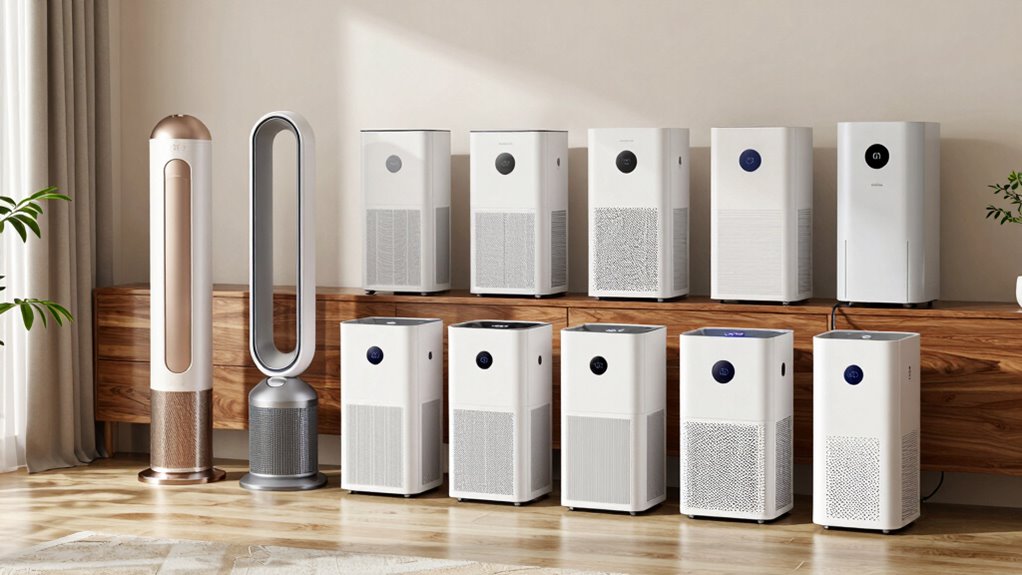
For chemical sensitivity, I would look beyond a HEPA label: HEPA filters capture particles, while meaningful odor and gas reduction depends on the amount and type of activated carbon or other sorbent media. My best overall pick is the Austin Air it Room, whose VOC carbon wrap makes it the most directly focused option in this group for gas filtration. The Levoit Core 600S-P stands out for covering large spaces, while the Levoit Core 300-P is a simpler choice for a smaller room. The main tradeoff is between a purifier with more dedicated gas media and a higher-airflow, smart-feature model that may be stronger on particles than chemicals. Read on for the full comparison, buying criteria, and guidance on choosing by room and filtration needs.

Get garden gear delivered free with Prime
- Fast, free delivery on millions of items
- Prime Video, Amazon Music and more included
- Member-only deals all year
Complete the kit


Key Takeaways
- Austin Air it Room is the most chemical-focused pick here because its product description specifically identifies a VOC carbon wrap; the lineup does not provide comparable carbon-media details for every model.
- Large-room coverage does not establish VOC performance. The Levoit Core 600S-P and Blueair Blue Pure 311i Max advertise broad room coverage, but buyers seeking gas reduction should verify sorbent type and quantity.
- The Levoit Core 300-P suits a smaller-room, simpler setup; its compact positioning makes it easier to place than the large-coverage models, though it is not the strongest fit for open areas.
- Several models emphasize smart controls and particle filtration, including the Levoit Vital 200S-P and Dhyala purifier, so their convenience features should not be mistaken for proof of strong chemical removal.
- The two KNKA APH4000 listings appear in different colors and list different coverage figures. Confirm the exact model and specifications before choosing between them.
| KNKA APH4000 Air Purifier, White |  | Best for Quiet, Measured Particle Cleaning | Model: APH4000 | Color: White | Filtration: Dual three-stage filters: washable pre-filter, high-efficiency filter, activated carbon | VIEW ON AMAZON | See Our Full Breakdown |
| Dhyala Air Purifier for Home Bedroom Large Room up to 3000 sq ft, HEPA with Washable Double-Sided Filters, Smart WiFi, AQI Display, Air Cleaner for Pets, Dust, Pollen, 15dB Sleep Mode, Fragrance Box |  | Best for Smart Controls and Large Spaces | Coverage area: Up to 3,000 ft² | CADR: 265 CFM | Filtration: Three-stage: washable pre-filter, HEPA, activated carbon; dual filters | VIEW ON AMAZON | See Our Full Breakdown |
| LEVOIT Vital 200S-P Smart Air Purifier for Large Rooms up to 1875 sq ft |  | Best for Particle Performance Transparency | Coverage area: Up to 1,875 ft² | CADR smoke: 250 CFM | CADR dust: 254 CFM | VIEW ON AMAZON | See Our Full Breakdown |
| PuroAir 240 HEPA Air Purifier for Home, Pets & Bedroom – 1,000 sq ft Coverage |  | Best for Straightforward Carbon and HEPA Filtration | Coverage area: Up to 1,000 ft² in one hour | Filtration: Three layers: pre-filter, HEPA, activated carbon | Claimed filtration efficiency: Up to 99.9% of pollutants | VIEW ON AMAZON | See Our Full Breakdown |
| Austin Air it Room Air Purifier with VOC Carbon Wrap, Model C100CC1 |  | Best Compact Pick for VOC-Focused Filtration | Model: C100CC1 | Filtration: VOC carbon wrap | Particle capture: As small as 0.1 microns | VIEW ON AMAZON | See Our Full Breakdown |
| Levoit Core 600S-P Smart Air Purifier for Large Rooms up to 2,933 sq ft |  | Best Overall for Large Open Spaces | Model: Core 600S-P | Coverage area: Up to 2,933 sq ft | CADR: 391 CFM | VIEW ON AMAZON | See Our Full Breakdown |
| Levoit Core 300-P Air Purifier |  | Best Compact Bedroom Pick | Model: Core 300-P | Motor power: 56 W | Smoke CADR: 143 CFM | VIEW ON AMAZON | See Our Full Breakdown |
| PuroAir 400 HEPA Air Purifier for Large Rooms |  | Best Explicit Carbon Filtration | Coverage: Up to 2,000 sq ft in one hour | Filtration: Pre-filter, HEPA filter, and activated carbon | Pollutant filtration claim: Up to 99.9% | VIEW ON AMAZON | See Our Full Breakdown |
| Coway Mighty AP-1512HH(W) Air Purifier, White |  | Best for Maintenance Feedback | Model: AP-1512HH(W) Mighty | Color: White | Coverage: Up to 1,748 sq ft in 60 minutes | VIEW ON AMAZON | See Our Full Breakdown |
| Blueair Blue Pure 311i Max Air Purifier for Home up to 2,107 Ft² |  | Best Smart, Quiet Pick | Coverage area: Up to 2,107 sq ft | Filtration: HEPASilent dual filtration | Particle capture: 99.97% down to 0.1 microns | VIEW ON AMAZON | See Our Full Breakdown |
| VOOPNU Air Purifier for Home, 360° Filtration, White |  | Best Compact Pick | Coverage: Up to 1,076 ft² | Dimensions: 6.69 x 6.69 x 9.84 inches | Filtration: Three-layer filtration; stated to capture 99.97% of airborne pollutants | VIEW ON AMAZON | See Our Full Breakdown |
| KNKA APH4000 Air Purifier for Home Bedroom, Up to 1,695 Ft² Coverage, Black |  | Best for Larger Rooms | Model: APH4000 | Coverage area: Up to 1,695 ft² once per hour | Smoke/Dust/PM2.5 CADR: 226 CFM (384 m³/h) | VIEW ON AMAZON | See Our Full Breakdown |
| air purifier for chemical sensitivity | Filtration | Model | Coverage area |
|---|---|---|---|
| KNKA APH4000 Air Purifier | Dual three-stage filters: washable pre-filter, high-efficiency filter, activated carbon | APH4000 | — |
| Dhyala Air Purifier for Home B | Three-stage: washable pre-filter, HEPA, activated carbon; dual filters | — | Up to 3,000 ft² |
| LEVOIT Vital 200S-P Smart Air | — | — | Up to 1,875 ft² |
| PuroAir 240 HEPA Air Purifier | Three layers: pre-filter, HEPA, activated carbon | — | Up to 1,000 ft² in one hour |
| Austin Air it Room Air Purifie | VOC carbon wrap | C100CC1 | — |
| Levoit Core 600S-P Smart Air P | 3-stage; 99.97% efficiency for 0.1–0.3 μm particles | Core 600S-P | Up to 2,933 sq ft |
| Levoit Core 300-P Air Purifier | — | Core 300-P | — |
| PuroAir 400 HEPA Air Purifier | Pre-filter, HEPA filter, and activated carbon | — | — |
| Coway Mighty AP-1512HH(W) Air | Four-stage: washable pre-filter, deodorization filter, bipolar device, and HEPA filter | AP-1512HH(W) Mighty | — |
| Blueair Blue Pure 311i Max Air | HEPASilent dual filtration | — | Up to 2,107 sq ft |
| VOOPNU Air Purifier for Home | Three-layer filtration; stated to capture 99.97% of airborne pollutants | — | — |
| KNKA APH4000 Air Purifier for | — | APH4000 | Up to 1,695 ft² once per hour |
More Details on Our Top Picks
KNKA APH4000 Air Purifier, White
For chemical sensitivity, the activated carbon stage gives the KNKA APH4000 some relevance to odors and gases, while its stated CADR values make particle performance easier to compare. Its strongest fit is a bedroom or other space where quiet operation matters: Sleep Mode is listed at 22–24 dB, and the air-quality display helps track particle readings. Compared with the Dhyala, it has less elaborate app and voice control, but avoids a built-in fragrance feature that may be unwelcome to scent-sensitive buyers. The main tradeoff is scale: the 1,695 ft² figure means one air refresh per hour, while the recommended faster cleaning rate is 4.8 refreshes per hour in rooms up to 350 ft². Its carbon stage is not described by weight or gas-specific performance, so I would not treat it as proof of strong VOC removal.
Pros:- Activated carbon stage is included for odor-related filtration
- Stated smoke/dust/PM2.5 and pollen CADR values aid comparison
- Sleep Mode is listed at 22–24 dB
- Washable pre-filters and a real-time air-quality display
Cons:- The 1,695 ft² coverage figure corresponds to only one air refresh per hour
- Faster 4.8-refresh-per-hour coverage is limited to 350 ft²
- Filter replacement is listed every 3–6 months, and carbon capacity is unspecified
Best for: Scent-sensitive bedroom users who want quiet particle filtration, an air-quality display, and a stated faster-cleaning room size.
Not ideal for: Buyers who need documented high-capacity VOC removal or frequent air cleaning across a large open-plan room.
- Model:APH4000
- Color:White
- Filtration:Dual three-stage filters: washable pre-filter, high-efficiency filter, activated carbon
- Coverage:Up to 1,695 ft² at 1 air refresh per hour; up to 350 ft² at 4.8 refreshes per hour
- Smoke/dust/PM2.5 CADR:226 CFM (384 m³/h)
- Pollen CADR:244 CFM (415 m³/h)
- Modes and speeds:PET, ECO, Sleep, Auto; 4 fan speeds
- Sleep Mode noise:22–24 dB
- Filter replacement interval:Every 3–6 months
Our verdict“Choose the KNKA for quiet particle cleaning in a modest room, but look for gas-specific carbon data if VOC reduction is your priority.”
Dhyala Air Purifier for Home Bedroom Large Room up to 3000 sq ft, HEPA with Washable Double-Sided Filters, Smart WiFi, AQI Display, Air Cleaner for Pets, Dust, Pollen, 15dB Sleep Mode, Fragrance Box
The Dhyala combines a 265 CFM CADR with a dual-sided intake and app and voice controls, making it the most connected option here for managing particle filtration across a large area. That broad coverage claim needs context: as with other large-room figures, it does not specify the cleaning rate, so it is hard to compare directly with the LEVOIT Vital 200S-P, which supplies separate CADR figures for smoke, dust, and pollen. For chemical sensitivity, the washable pre-filters help catch larger debris, while activated carbon is listed for gases and odors; no carbon quantity or chemical-specific test data is provided. The built-in fragrance box is a poor fit for people who react to added scents, even if left unused. Washable pre-filters do not eliminate the ongoing cost of replacing the remaining filters.
Pros:- Dual-sided intake and 265 CFM CADR are suited to substantial particle loads
- Washable pre-filters can be reused
- App, Alexa, and Google Assistant control with PM2.5 display and auto mode
- Child lock and tip-over shutoff are useful household safety features
Cons:- Fragrance box and pads may be unsuitable for scent-sensitive users
- Coverage claim does not state an air-change rate
- Replacement filters remain an ongoing cost, with no carbon capacity provided
Best for: Large-home buyers who want app or voice control, particle monitoring, and can leave the fragrance pads unused.
Not ideal for: People highly sensitive to added scents or buyers seeking documented, chemical-specific VOC reduction.
- Coverage area:Up to 3,000 ft²
- CADR:265 CFM
- Filtration:Three-stage: washable pre-filter, HEPA, activated carbon; dual filters
- Smart controls:WiFi app, Alexa, and Google Assistant
- Air-quality sensor:PM2.5 sensor with real-time AQI display
- Fan speeds and timer:4 speeds; 1–12 hours
- Sleep Mode noise:15 dB
- Fragrance feature:Aromatherapy box with 3 pads
- Safety and warranty:Child lock, tip-over shutoff at 45°, anti-chew 1.83 m cord; 24-month warranty
Our verdict“Pick the Dhyala for connected particle control across a large home if you can avoid its fragrance feature and do not need verified VOC removal data.”
LEVOIT Vital 200S-P Smart Air Purifier for Large Rooms up to 1875 sq ft
The Vital 200S-P earns its place through AHAM VERIFIDE status and separate CADR figures for smoke, dust, and pollen, giving buyers clearer particle-performance evidence than the Dhyala’s single CADR and broad coverage claim. Its traditional and U-shaped inlets are designed to take in pet hair and dander, which can help keep particle capture practical in busy pet homes. For chemical sensitivity, though, the supplied details do not identify an activated-carbon stage or provide gas-removal data. That makes it a more defensible pick for pollen, dust, and smoke particles than for VOCs. The PuroAir 240 explicitly lists activated carbon and VOC filtration, although its own gas-performance detail is limited. The Vital’s large-room capacity also comes with a substantial footprint and replacement-filter upkeep.
Pros:- AHAM VERIFIDE designation
- Separate CADR figures for smoke, dust, and pollen
- U-shaped inlet is designed to capture pet hair and dander
- Smart features support convenient operation
Cons:- Supplied specifications do not identify an activated-carbon stage or gas-removal performance
- Large size may be awkward in smaller rooms or apartments
- Replacement filters add ongoing upkeep
Best for: Pet-owning households prioritizing independently verified particle performance in a large room over documented gas filtration.
Not ideal for: Buyers whose main concern is VOCs, odors, or chemical gases, since the supplied product data does not specify carbon filtration.
- Coverage area:Up to 1,875 ft²
- CADR smoke:250 CFM
- CADR dust:254 CFM
- CADR pollen:289 CFM
- Certification:AHAM VERIFIDE
- Smart features:Yes
- Air inlet:Traditional inlet plus U-shaped inlet
Our verdict“Choose the Vital 200S-P for verified, well-specified particle cleaning in a pet household, not as a proven VOC-focused purifier.”
PuroAir 240 HEPA Air Purifier for Home, Pets & Bedroom – 1,000 sq ft Coverage
The PuroAir 240 is one of the clearer matches here for buyers who want both HEPA particle filtration and activated carbon named in the same filter system. The product description also mentions VOCs, odors, smoke, and common household particles, giving it a more direct chemical-sensitivity rationale than the LEVOIT Vital 200S-P, whose supplied specifications focus on particle CADR. A smart particle sensor can raise fan output when it detects particle pollution, but that does not establish detection or removal of chemical gases. The stated 1,000 ft² capacity is based on one hour of operation, so it suits steady background cleaning better than rapid turnover in a large room. Carbon amount and VOC-specific test results are not supplied, leaving the extent of gas filtration uncertain.
Pros:- Three-layer system includes pre-filter, HEPA, and activated carbon
- Product data specifically lists VOCs among targeted pollutants
- Particle sensor automatically adjusts power
- Quiet sleep mode and two-year warranty are specified
Cons:- 1,000 ft² coverage is based on one hour of operation
- No carbon quantity or VOC-specific test results are provided
- Particle sensor does not establish chemical-gas detection
Best for: Buyers seeking a simple purifier with named HEPA and activated-carbon stages for a medium-to-large room and ongoing particle monitoring.
Not ideal for: People who need quantified VOC removal, gas sensing, or a stated faster air-change rate for a large space.
- Coverage area:Up to 1,000 ft² in one hour
- Filtration:Three layers: pre-filter, HEPA, activated carbon
- Claimed filtration efficiency:Up to 99.9% of pollutants
- Sensor:Smart particle sensor with automatic power adjustment
- Modes:Sleep mode
- Certifications:CARB, ETL, ISO, UL
- Warranty:2 years
Our verdict“The PuroAir 240 is a straightforward choice for combined particle and odor filtration when you accept that its VOC performance is not quantified.”
Austin Air it Room Air Purifier with VOC Carbon Wrap, Model C100CC1
The Austin Air it is the only product in this group whose supplied description leads with a VOC carbon wrap, so it has the most direct stated focus on gases and chemicals. That makes it more relevant to chemical sensitivity than the particle-focused LEVOIT Vital 200S-P, whose listed data emphasizes CADR for smoke, dust, and pollen. The Austin also claims capture of particles as small as 0.1 microns and uses a steel body, but the description omits coverage area, carbon quantity, and filter replacement details. Those gaps make it hard to judge how much room it can handle or how long its carbon stage may remain useful. Its compact, quiet design may suit a bedroom or office, but buyers needing a known cleaning rate should favor a model with published room and CADR data.
Pros:- VOC carbon wrap is directly relevant to chemical and odor concerns
- Claims particle capture down to 0.1 microns
- Steel construction
- Quiet operation is described for bedroom and office use
Cons:- No coverage area or CADR is provided
- Carbon quantity and filter replacement interval are unspecified
- No chemical-specific removal test results are supplied
Best for: A buyer prioritizing an explicitly named VOC carbon wrap for a bedroom, office, or other compact space.
Not ideal for: People who need published room coverage, CADR, filter-life guidance, or quantified chemical-removal performance.
- Model:C100CC1
- Filtration:VOC carbon wrap
- Particle capture:As small as 0.1 microns
- Construction:Steel
- Operation:Quiet operation
- Listed use cases:Bedrooms, offices, large rooms, and travel
Our verdict“Consider the Austin Air it when VOC-focused carbon filtration matters most and you can accept limited capacity and maintenance data.”
Levoit Core 600S-P Smart Air Purifier for Large Rooms up to 2,933 sq ft
For chemical sensitivity, the Core 600S-P offers substantial particle-cleaning capacity, but its supplied description does not specify activated carbon filtration, so I would not treat it as a dedicated solution for chemical gases or odors. Its 391 CFM CADR and AHAM verification make it a stronger documented choice for moving air through a large open space than the compact Core 300-P. Auto Mode can adjust fan speed as air quality changes, reducing the need to manage settings manually. The tradeoff is that room coverage figures alone do not establish how well it removes VOCs; filter type matters, and HEPA-grade Sleep Mode performance requires Levoit’s Original Filter. I’d choose it for broad particle control, while buyers focused on chemical adsorption should compare it with the PuroAir 400’s explicitly listed activated carbon layer.
Pros:- 391 CFM CADR supports substantial airflow in large spaces.
- AHAM VERIFIDE certification provides independently tested performance data.
- Auto Mode adjusts fan speed based on air quality.
- Fine-particle filtration is specified at 99.97% for particles from 0.1 to 0.3 microns.
Cons:- The supplied specifications do not identify an activated carbon filter for chemical adsorption.
- HEPA-grade Sleep Mode performance requires the Levoit Original Filter.
- The stated maximum coverage does not describe cleaning frequency or VOC removal.
Best for: People in large open-plan homes who need independently verified, high-capacity particle filtration and can confirm the replacement filter suits their needs.
Not ideal for: Buyers primarily seeking documented VOC or chemical adsorption, since the supplied product details do not specify an activated carbon stage.
- Model:Core 600S-P
- Coverage area:Up to 2,933 sq ft
- CADR:391 CFM
- Filtration:3-stage; 99.97% efficiency for 0.1–0.3 μm particles
- Certification:AHAM VERIFIDE
- Modes:Auto Mode and Sleep Mode
- Operating temperature:14°–104°F / -10°–40°C
Our verdict“Choose the Core 600S-P for verified, high-capacity particle cleaning in a large open space, but look elsewhere if chemical adsorption is your main need.”
Levoit Core 300-P Air Purifier
The Core 300-P makes more sense for a bedroom or smaller room than the much larger Core 600S-P: its stated coverage supports frequent cleaning in 222 sq ft, and Sleep Mode runs at 24 dB. That quiet operation and a display you can turn off may make it easier to keep running overnight. Its particle filtration is clearly specified, and the AHAM verified listing adds useful performance context. For chemical sensitivity, though, the supplied data does not identify an activated carbon layer, so its strengths are better grounded in particle control than VOC removal. Compared with the PuroAir 400, which explicitly lists activated carbon, the Core 300-P is the more compact, simpler bedroom option but the less clearly documented choice for odor and chemical adsorption. It is also designed for 120V use and calls for official replacement filters.
Pros:- Sleep Mode operates at a specified 24 dB.
- Room coverage is specified at 222 sq ft refreshed 4.8 times per hour.
- Display can be turned off, and timers offer 2-, 4-, 6-, or 8-hour settings.
- AHAM verified, FCC certified, ETL listed, and CARB compliant.
Cons:- The supplied filtration details do not identify activated carbon for chemical adsorption.
- Designed for 120V use in the United States.
- Manufacturer recommends official Levoit replacement filters.
Best for: US buyers furnishing a bedroom or small home office who prioritize quiet particle filtration and a dark, uncomplicated display.
Not ideal for: People who need documented VOC adsorption, large-room airflow, or a purifier compatible with voltages beyond 120V.
- Model:Core 300-P
- Motor power:56 W
- Smoke CADR:143 CFM
- Dust CADR:153 CFM
- Pollen CADR:167 CFM
- Filtration efficiency:99.97% for 0.1–0.3 μm particles
- Sleep Mode noise:24 dB
- Coverage:222 sq ft refreshed 4.8 times per hour; 1,073 sq ft once per hour
- Power and certifications:120V; AHAM verified, FCC certified, ETL listed, CARB compliant
Our verdict“Pick the Core 300-P for quiet, certified particle cleaning in a US bedroom, not as a documented VOC-focused purifier.”
PuroAir 400 HEPA Air Purifier for Large Rooms
Among these five options, the PuroAir 400 is one of the clearest matches for shoppers who want chemical and odor filtration called out in the product details: its three layers include activated carbon alongside a pre-filter and HEPA filter. That does not quantify how much gas it can adsorb or how long the carbon remains effective, so I would not infer performance beyond the stated feature. Its 2,000 sq ft claim is based on one air change per hour, a slower cleaning pace than many buyers may expect for sensitive spaces. The Coway Mighty also lists a deodorization filter, while the Levoit Core 600S-P gives a stronger stated CADR; the PuroAir’s distinction is the explicit carbon stage paired with a sensor and sleep mode. It suits buyers who value that filtration mix and accept the coverage caveat.
Pros:- Three-layer filtration explicitly includes activated carbon as well as HEPA.
- Air quality sensor adjusts power when pollution is detected.
- Sleep mode is included.
- CARB, ETL, ISO, and UL certifications are listed.
Cons:- The 2,000 sq ft coverage claim is based on cleaning the room once per hour.
- No quantified VOC removal rate or carbon capacity is provided in the supplied details.
- The stated filtration claims rely on independent lab testing.
Best for: Households seeking a large-room purifier whose listed filter stack explicitly includes activated carbon for odors and VOCs, alongside particle filtration.
Not ideal for: Buyers who need a quantified VOC removal rate, frequent air changes across a large room, or detailed carbon-filter capacity data.
- Coverage:Up to 2,000 sq ft in one hour
- Filtration:Pre-filter, HEPA filter, and activated carbon
- Pollutant filtration claim:Up to 99.9%
- Particle filtration description:Particles described as up to 700 times smaller than a human hair
- Sensor:Air quality sensor
- Mode:Sleep mode
- Warranty:2 years
- Certifications:CARB, ETL, ISO, and UL
Our verdict“Choose the PuroAir 400 when an explicitly listed carbon stage matters more than a fast, clearly quantified large-room cleaning rate.”
Coway Mighty AP-1512HH(W) Air Purifier, White
The Coway Mighty balances a named deodorization filter with a washable pre-filter and real-time air-quality monitoring, making upkeep and changing conditions easier to follow. Its HEPA stage is specified to reduce 99.97% of 0.3-micron particles; the deodorization filter gives it a more direct odor-control rationale than the Levoit Core 300-P, whose supplied filter details focus on particles. For chemical sensitivity, however, the listing does not give the deodorization filter’s material, capacity, or VOC removal rate, so I would treat that as a feature to investigate rather than a guarantee. The claimed 1,748 sq ft coverage is at one air change per hour, and the bipolar device adds another treatment stage that may not suit every buyer. Its washable pre-filter and filter indicator help with routine care, while the LED may need manual dimming at night.
Pros:- Four-stage system includes a deodorization filter and HEPA filter.
- Auto mode monitors air quality and adjusts fan speed.
- Washable pre-filter and replacement indicator make routine maintenance easier to track.
- Three-year warranty is specified.
Cons:- The deodorization filter’s material and VOC removal capacity are not specified in the supplied data.
- Coverage of 1,748 sq ft is based on one air change per hour.
- The air-quality LED may need to be turned off manually at night.
Best for: Buyers who want a washable pre-filter, filter-change reminders, and automatic air-quality response in a room where odor filtration is also a priority.
Not ideal for: People seeking detailed evidence of VOC adsorption capacity or those who want a purifier with no bipolar treatment stage.
- Model:AP-1512HH(W) Mighty
- Color:White
- Coverage:Up to 1,748 sq ft in 60 minutes
- Filtration:Four-stage: washable pre-filter, deodorization filter, bipolar device, and HEPA filter
- HEPA efficiency:99.97% of 0.3-micron particles
- Modes:Auto, Eco, and Timer
- Indicators:Air-quality LED and filter-replacement indicator
- Warranty:3 years
Our verdict“The Coway Mighty suits buyers who value maintenance feedback and a deodorization stage, provided they verify its chemical-filtration details for their needs.”
Blueair Blue Pure 311i Max Air Purifier for Home up to 2,107 Ft²
The Blue Pure 311i Max pairs fast stated particle cleaning with app control and a quiet operating range, which makes it a convenient fit for bedrooms or shared living areas. It lists 439 sq ft cleaned in 12.5 minutes and up to 2,107 sq ft in one hour, giving buyers more useful pace information than a single maximum-area figure. Its HEPASilent dual filtration is specified to capture 99.97% of particles down to 0.1 microns, but the supplied details do not name an activated carbon stage or quantify VOC removal. That leaves the PuroAir 400 with a clearer listed case for chemical adsorption, while Blueair offers app scheduling, sensors, and quieter low-speed operation. I’d favor Blueair when particle control and convenient monitoring lead; buyers focused on gases should investigate the filter composition before choosing it.
Pros:- HEPASilent filtration is specified to capture 99.97% of particles down to 0.1 microns.
- Coverage claims include both 439 sq ft in 12.5 minutes and 2,107 sq ft in one hour.
- 23–50 dB operating range supports quiet use at lower settings.
- App control, air-quality sensors, scheduling, and filter-life tracking are listed.
Cons:- The supplied details do not specify activated carbon or a VOC removal rate.
- Replacement filters add an ongoing cost.
- Smart features require app setup and a compatible device.
Best for: People who want app scheduling, automatic sensing, and quiet particle filtration for a bedroom or medium-to-large shared space.
Not ideal for: Shoppers whose primary goal is documented VOC or chemical adsorption, since the supplied specifications do not identify an activated carbon stage.
- Coverage area:Up to 2,107 sq ft
- Filtration:HEPASilent dual filtration
- Particle capture:99.97% down to 0.1 microns
- Noise level:23–50 dB
- Connectivity:Blueair mobile app
- Sensors:Built-in automatic air-quality sensors
- Air intake:360°
- Certification:QuietMark certified
Our verdict“Pick the Blue Pure 311i Max for quiet, app-managed particle cleaning, and verify its filter chemistry first if VOC removal is your priority.”
VOOPNU Air Purifier for Home, 360° Filtration, White
The VOOPNU is the most space-conscious choice here: its roughly 10-inch height and 360° intake suit a bedside table or a small room where a larger unit would be intrusive. Its three-layer filter is described as capturing 99.97% of airborne pollutants, but the supplied details do not specify the filter’s activated-carbon quantity or VOC test performance. For chemical sensitivity, that makes it a less substantiated odor and vapor option than the Austin Air it Room, which specifically lists a VOC carbon wrap. The VOOPNU’s 22 dB minimum noise may appeal to light sleepers, while the essential-oil tray is an optional scent feature some sensitive buyers may prefer to leave unused. The manufacturer recommends continuous operation and genuine replacement filters, so factor ongoing use and filter availability into the choice.
Its large stated coverage claim is attractive, but the provided data gives no CADR to help compare room-clearing performance. I’d choose it for compactness and quiet particle filtration, not as the strongest documented answer for chemical odors.
Pros:- Compact 6.69 x 6.69 x 9.84-inch footprint
- 360° air intake draws air from around the unit
- Listed minimum noise level of 22 dB
- Three-layer filtration is stated to capture 99.97% of airborne pollutants
Cons:- No CADR or room air-change rate is provided to substantiate its coverage claim
- Continuous operation is recommended for best results
- Manufacturer recommends genuine replacement filters, limiting flexibility
Best for: Sleepers with a small bedroom who want a compact, quiet purifier for airborne particles and are comfortable running it continuously.
Not ideal for: People whose main concern is chemical odors or VOCs, since the supplied product data does not quantify activated-carbon capacity or VOC performance.
- Coverage:Up to 1,076 ft²
- Dimensions:6.69 x 6.69 x 9.84 inches
- Filtration:Three-layer filtration; stated to capture 99.97% of airborne pollutants
- Air intake:360°
- Noise level:As low as 22 dB
- Additional feature:Essential oil tray
- Certifications:DOE, ETL, FCC, CARB, CE, RoHS
Our verdict“Choose the VOOPNU for quiet, compact particle filtration in a bedroom, but look to a model with documented carbon or VOC performance for chemical odors.”
KNKA APH4000 Air Purifier for Home Bedroom, Up to 1,695 Ft² Coverage, Black
The KNKA APH4000 has the clearest performance figures of these two picks: AHAM verification and a 226 CFM smoke, dust, and PM2.5 CADR give buyers more to compare than the VOOPNU’s coverage claim alone. Its dual intakes and washable pre-filter also suit households dealing with frequent dust or pet debris, while the activated-carbon layer offers some odor filtration. The listing does not give carbon quantity or specific VOC reduction results, though, so I would not treat it as a dedicated chemical-removal unit; the Austin Air it Room is a more directly targeted option based on its VOC carbon wrap.
Although its headline coverage reaches 1,695 square feet, the supplied description says purification efficiency falls by about 45% in larger rooms. It refreshes a 350-square-foot space 4.8 times per hour, making that smaller-room figure more useful for buyers prioritizing faster turnover. Sleep Mode runs at 22–24 dB, but genuine filters need replacement every three to six months, adding upkeep.
Pros:- AHAM-verified CADR figures provide a useful basis for particle-cleaning comparisons
- Dual intakes and washable pre-filter support homes with pets and visible dust
- Real-time AQI display and Auto, PET, and ECO modes add operating feedback and flexibility
- Sleep Mode is listed at 22–24 dB
Cons:- Purification efficiency is reported to drop about 45% in larger rooms
- Activated-carbon quantity and specific VOC reduction performance are not provided
- Genuine replacement filters are recommended every three to six months
Best for: People furnishing a medium-sized bedroom or living area who want independently verified particle-cleaning figures, AQI feedback, and pet-focused modes.
Not ideal for: Buyers targeting chemical-sensitive reactions to VOCs or strong odors who need quantified gas-removal performance or a specified carbon capacity.
- Model:APH4000
- Coverage area:Up to 1,695 ft² once per hour
- Smoke/Dust/PM2.5 CADR:226 CFM (384 m³/h)
- Pollen CADR:244 CFM (415 m³/h)
- Certification:AHAM Verified
- Filter system:Three-stage: washable pre-filter, high-efficiency filter, activated carbon
- Noise level:22–24 dB in Sleep Mode
- Modes:Sleep, Auto, PET, ECO
- Filter replacement interval:Every 3–6 months
Our verdict“Pick the KNKA for measured particle performance and useful controls in a medium-sized room, while chemical odor concerns call for better documented gas filtration.”

How We Picked
I ranked these purifiers by how clearly their listed features address chemical sensitivity, giving weight to identified VOC or carbon media ahead of room-size claims, app controls, or general HEPA language. I also considered whether the stated coverage and form factor make sense for the room a buyer intends to treat, along with ease-of-use cues such as smart controls and sleep modes. A purifier can capture airborne particles without removing gases, so I treated particle filtration and chemical filtration as separate needs.
The Austin Air it Room ranks first because its VOC carbon wrap gives the clearest stated connection to gas filtration in this lineup. The large Levoit and Blueair models follow as candidates for buyers who need broad particle-cleaning coverage, while compact or feature-led choices rank better for smaller rooms and simpler setups. Product descriptions do not establish contaminant-specific removal rates, carbon capacity, or independent performance for every model, so I do not treat advertised coverage alone as evidence of chemical protection.
| air purifier for chemical sensitivity | Model | Coverage area |
|---|---|---|
| KNKA APH4000 Air Purifier | APH4000 | — |
| Dhyala Air Purifier for Home B | — | Up to 3,000 ft² |
| LEVOIT Vital 200S-P Smart Air | — | Up to 1,875 ft² |
| PuroAir 240 HEPA Air Purifier | — | Up to 1,000 ft² in one hour |
| Austin Air it Room Air Purifie | C100CC1 | — |
| Levoit Core 600S-P Smart Air P | Core 600S-P | Up to 2,933 sq ft |
| Levoit Core 300-P Air Purifier | Core 300-P | — |
| PuroAir 400 HEPA Air Purifier | — | — |
| Coway Mighty AP-1512HH(W) Air | AP-1512HH(W) Mighty | — |
| Blueair Blue Pure 311i Max Air | — | Up to 2,107 sq ft |
| VOOPNU Air Purifier for Home | — | — |
| KNKA APH4000 Air Purifier for | APH4000 | Up to 1,695 ft² once per hour |
Factors to Consider When Choosing Air Purifier For Chemical Sensitivity
Choosing a purifier for chemical sensitivity starts with identifying what you want it to reduce and how the room is used. Room coverage and gas filtration answer different questions: one is about how much air the unit can circulate, the other about what its media can capture. These checks can help you avoid buying a particle-focused unit when odors or VOCs are your main concern.
Check the Sorbent Media, Not Just the HEPA Label
HEPA filtration targets airborne particles such as dust and pollen; it does not by itself tell you how well a purifier handles gases or odors. For chemical concerns, check whether the manufacturer identifies activated carbon or another gas-adsorbing material. Ask about the media’s quantity and whether it is a substantial filter bed or a thin layer, since the material’s capacity affects how much gas it can hold. A broad phrase such as “odor reduction” gives less information than a clear description of the media. If the product page does not state the media or its capacity, treat gas performance as uncertain rather than assuming HEPA covers it. The Austin Air’s named VOC carbon wrap is a more specific signal than general particle-filter claims elsewhere in this roundup.
Match Coverage to Your Actual Room
Coverage figures can refer to different air-change rates, so two products advertising similar square footage may not clean at the same pace. Compare the stated rate and test conditions when they are available, and measure the room rather than relying on a whole-home impression. Open layouts, high ceilings, and doors that stay open make a single-room estimate less useful. A large unit can circulate air across a bigger area, but it still needs a suitable filter for the contaminant you care about. For a bedroom or office with a closed door, a smaller model may be easier to place and run. Avoid buying solely on the largest advertised area if the manufacturer does not explain the conditions behind it.
Plan for Filter Replacement and Ongoing Use
Gas-adsorbing media has finite capacity, and a filter that is saturated may stop reducing odors effectively even if the fan still runs. Before choosing, find the replacement schedule, the exact compatible filter, and whether the maker gives a change indicator or only a time estimate. A washable pre-filter can catch larger debris, but washing it does not restore the capacity of carbon media deeper in the filter. Consider how often the purifier will run and how easy it is to obtain replacement parts. A model with a high fan speed that is too loud for regular use may spend more time turned off. Long-term usability depends on maintenance as much as on the initial feature list.
Separate Source Control From Air Cleaning
A purifier can reduce some airborne contaminants, but it cannot stop a chemical source from releasing more into the room. When possible, identify and remove or isolate the source, increase outdoor ventilation when conditions allow, and keep newly applied products or materials out of occupied spaces. Do not use fragrance boxes or scent features as a substitute for odor removal; added fragrance can introduce another airborne compound. If sensitivity is tied to a particular chemical, seek product-specific test data for that compound rather than relying on a general VOC claim. This distinction matters because filtering and source control work on different parts of the problem. A purifier is one layer of room management, not a guarantee that a space will be symptom-free.
Decide Which Convenience Features Matter
Wi-Fi, air-quality displays, automatic modes, and sleep settings can make a purifier easier to manage, but they do not establish that its filter removes gases. An AQI display may track particles or a limited set of sensors rather than the chemical you are concerned about. Check what the sensor measures before treating an automatic reading as a full picture of indoor air. For a bedroom, quiet operation at a usable cleaning speed may matter more than remote control. For a shared space, a clear display or scheduling feature may help with routine operation. Choose controls that support consistent use, while judging filtration on the media and relevant performance data.
Frequently Asked Questions
Is a HEPA purifier enough for chemical sensitivity?
Not necessarily. HEPA filtration is designed to capture particles, while many chemicals and odors are gases that call for suitable sorbent media, such as activated carbon. Check the product’s stated media and look for information about its quantity and intended contaminants. In this roundup, the Austin Air it Room explicitly lists a VOC carbon wrap, while a HEPA label alone on another model does not establish comparable gas reduction. If particles and gases are both concerns, assess each filtration stage separately.
Should I choose the biggest room-coverage rating?
Choose coverage that fits the room and the cleaning rate you need, rather than treating the largest area figure as a quality score. Manufacturers may state coverage at different air-change rates, and an open floor plan can behave differently from a closed bedroom of the same area. Large coverage can be useful for particle circulation, as with the Levoit Core 600S-P, but it says little about VOC removal without details on gas media. Check the assumptions behind the rating and whether the unit can run at a comfortable speed. For chemical concerns, match both room size and filter type.
How can I tell whether carbon filtration is substantial enough?
Look for a specific description of the sorbent material, its quantity or bed depth, and the chemicals or odors the manufacturer says it targets. A small carbon-coated sheet may have less capacity than a dedicated media bed, but labels alone are not enough to compare performance. Also check whether the maker provides replacement guidance and contaminant-specific test information. If these details are absent, ask the manufacturer rather than assuming that “carbon” means strong VOC control. The Austin Air’s explicit VOC carbon-wrap description makes its purpose clearer, though buyers should still seek performance data for their own target compounds.
Can I use a purifier instead of removing the source of an odor?
A purifier may reduce some airborne material, but a continuing source can keep adding contaminants to the room and use up filter capacity. When practical, remove or isolate the source and ventilate the space under suitable outdoor conditions. Use filtration as an additional measure, not as proof that an ongoing emission is harmless or fully controlled. Added fragrance can mask an odor without removing the chemical, so avoid scent features if they trigger symptoms. If a particular compound is suspected, seek targeted advice and product data rather than relying on smell alone.
Which type of purifier makes sense for a bedroom?
For a bedroom, prioritize a model that fits the room, can run at a comfortable noise level, and has replacement filters you can maintain. The Levoit Core 300-P is positioned as a compact, straightforward choice, while a large-room model may make more sense in a spacious bedroom or adjoining area. Check whether the stated quiet mode still provides useful circulation and whether its filter includes gas media if odors or VOCs are the main concern. Smart controls can help with routines but do not replace appropriate filtration. Avoid relying on a fragrance feature to freshen the room.
Conclusion
For the best overall chemical-focused fit, I would start with the Austin Air it Room because it specifically identifies a VOC carbon wrap. For large-space particle coverage, the Levoit Core 600S-P is a stronger fit than the compact Levoit Core 300-P, though buyers should verify gas-media details before expecting VOC reduction. The best value in this lineup depends on the room and filter needs: the Core 300-P is the simpler smaller-room option, while the large KNKA models require careful checking of which listing and coverage figure apply. For beginners, I would favor a straightforward model sized to one room and prioritize easy filter replacement over app features. If chemical sensitivity is tied to a specific compound, choose based on documented performance for that compound and source control, not coverage claims alone.
Fall yard work Picks
leaf blowers
As an affiliate, we earn on qualifying purchases.