For allergy-focused monitoring, I would start with the Temtop 7-in-1 Air Quality Monitor with Data Export: its particle readings and saved data can help you compare changes over time. The GoveeLife Smart Air Quality Monitor is a simpler fit if PM2.5 alerts and app access matter most, while the BREATHE Airmonitor Plus Gen 2 suits buyers who want a more connected monitoring setup. The main tradeoff is between focused particle tracking and broad sensor counts, since extra readings do not automatically make a monitor better at identifying allergy triggers. I also weigh display clarity, data access, and how much setup or interpretation each unit asks of you. Read on for the full comparison and guidance on matching a monitor to your home.

Get garden gear delivered free with Prime
- Fast, free delivery on millions of items
- Prime Video, Amazon Music and more included
- Member-only deals all year
Complete the kit


Key Takeaways
- Particle data matters more than a long sensor list. For allergy-related changes, PM2.5 tracking is more directly useful than a high count of sensors whose readings may not identify pollen or a specific allergen.
- Temtop’s data export gives it a practical edge for tracking patterns. It is a stronger fit for comparing readings across days than a monitor chosen mainly for a large display.
- GoveeLife favors simple PM2.5 monitoring and app access. It trades the broad readout of the many-sensor models for a more focused setup.
- The amazon.com/dp/B0FCDCWKJV?tag=aeroguardians-20&ascsubtag=dc-450180″ target=”_blank” rel=”nofollow sponsored noopener”>16-in-1 models emphasize at-a-glance breadth. Their large displays can make several readings easier to see, but more measurements also mean more numbers to interpret.
- Amazon Smart Air Quality Monitor and BREATHE Airmonitor Plus Gen 2 take different connected approaches. Buyers should compare their preferred app or smart home setup and sensor needs before choosing either.
| Temtop 7-in-1 Air Quality Monitor with Data Export |  | Best for Tracking Trends | Measurements: PM2.5, PM10, formaldehyde, VOCs, temperature, humidity, AQI | Sensors: Laser particle sensor; Dart electrochemical HCHO sensor | Data logging: Up to 3 months; USB export to Excel | VIEW ON AMAZON | See Our Full Breakdown |
| LifeBasis 11-in-1 Indoor Air Quality Monitor |  | Best for Beginners | Measurements: AQI, CO2, PM1.0, PM2.5, PM10, particles, HCHO, TVOC, temperature, humidity | Sensors: NDIR infrared CO2, laser particle, semiconductor, photoelectric, temperature, humidity | Alerts: Visual color indicators and audible alert | VIEW ON AMAZON | See Our Full Breakdown |
| 16-in-1 Indoor Air Quality Monitor with 7-Inch Display |  | Best for Roomside Readability | Display: 7-inch LED | Monitored parameters: CO2, PM2.5, PM1.0, PM10, HCHO, TVOC, temperature, humidity, AQI, time | AQI alerts: 7 buzzer types | VIEW ON AMAZON | See Our Full Breakdown |
| Zemeollo 10-in-1 Indoor Air Quality Monitor |  | Best for Longer Cordless Checks | Measurements: CO2, HCHO, TVOC, benzene, PM2.5, PM10, PM0.3–1, temperature, AQI | Accuracy: Error margin under ±5% | Display: Color LED screen | VIEW ON AMAZON | See Our Full Breakdown |
| YNAK 16-in-1 Indoor Air Quality Monitor with 5.5-Inch Display | 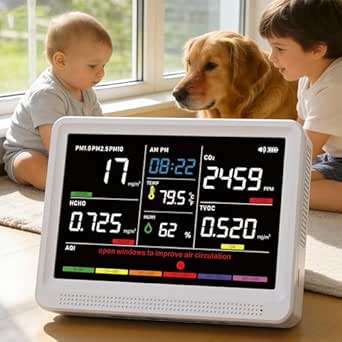 | Best for a Compact Shared Display | Monitored parameters: CO2, PM2.5, PM1.0, PM10, HCHO, TVOC, temperature, humidity, AQI, time | Display: 5.5-inch LED; 3 brightness settings | Battery capacity: 2500 mAh | VIEW ON AMAZON | See Our Full Breakdown |
| ZEMEOLLO 10-in-1 Indoor Air Quality Monitor |  | Best for Portable Pollutant Checks | Measurements: CO₂, formaldehyde, TVOC, benzene, PM2.5, PM10 | Stated accuracy: Error margin less than ±5% | Display: Color LED screen | VIEW ON AMAZON | See Our Full Breakdown |
| 16-in-1 Indoor Air Quality Monitor with Real-Time Color Display |  | Best for Quick, Cordless Spot Checks | Measured indicators: PM1.0, PM2.5, PM10, TVOC, HCHO, temperature, humidity | Sampling interval: 1.5 seconds | Display: HD color screen with color-coded readings | VIEW ON AMAZON | See Our Full Breakdown |
| GoveeLife Smart Air Quality Monitor with PM2.5 Sensor and LED Display |  | Best for Connected Particle Tracking | Measurements: PM2.5, temperature, humidity | PM2.5 accuracy: ±15 µg/m³ from 0 to 100 µg/m³; ±15% from 100 to 1000 µg/m³ | Temperature accuracy: ±0.54°F | VIEW ON AMAZON | See Our Full Breakdown |
| 16-in-1 Indoor Air Quality Monitor with PM2.5, CO2, TVOC, HCHO, Temperature and Humidity |  | Best for Wall-Mounted Room Checks | Measurements: PM1, PM2.5, PM10, CO₂, TVOC, HCHO, AQI, temperature, humidity, time | Display: Color screen | Alerts: AQI buzzer alerts | VIEW ON AMAZON | See Our Full Breakdown |
| Sainlogic 16-in-1 Indoor Air Quality Monitor with 7.2-Inch Display |  | Best for Easy-to-Read Local Monitoring | Measurements: CO₂, PM1.0, PM2.5, PM10, AQI, HCHO, TVOC, temperature, humidity | Display: 7.2-inch screen with three brightness levels | Alerts: 7 user-defined thresholds; tri-color LED indicators | VIEW ON AMAZON | See Our Full Breakdown |
| Lecoolife 10-in-1 Indoor Air Quality Monitor with Large Color Display |  | Best for At-a-Glance Checks | Brand: Lecoolife | Model: AK27 | Measurements: PM1.0, PM2.5, PM10, HCHO, TVOC, temperature, humidity, AQI, and time | VIEW ON AMAZON | See Our Full Breakdown |
| Amazon Smart Air Quality Monitor |  | Best for Alexa Automation | Measurements: PM2.5, VOCs, carbon monoxide, humidity, and temperature | Alerts: Phone notifications and announcements on Echo devices | Smart home integration: Alexa routines and compatible devices | VIEW ON AMAZON | See Our Full Breakdown |
| BREATHE Airmonitor Plus Gen 2 Indoor Air Quality Monitor |  | Best for Tracking Trends | Brand: BREATHE | Model: BTL40001 | Measurements: CO₂, PM1, PM2.5, PM10, TVOC, formaldehyde (HCHO), temperature, and humidity | VIEW ON AMAZON | See Our Full Breakdown |
| air quality monitor for allergie | Measurements | Display | Battery life |
|---|---|---|---|
| Temtop 7-in-1 Air Quality Moni | PM2.5, PM10, formaldehyde, VOCs, temperature, humidity, AQI | — | 6–8 hours |
| LifeBasis 11-in-1 Indoor Air Q | AQI, CO2, PM1.0, PM2.5, PM10, particles, HCHO, TVOC, temperature, humidity | LCD with adjustable brightness | Up to 11–12 hours |
| 16-in-1 Indoor Air Quality Mon | — | 7-inch LED | — |
| Zemeollo 10-in-1 Indoor Air Qu | CO2, HCHO, TVOC, benzene, PM2.5, PM10, PM0.3–1, temperature, AQI | Color LED screen | Up to 20 hours |
| YNAK 16-in-1 Indoor Air Qualit | — | 5.5-inch LED; 3 brightness settings | — |
| ZEMEOLLO 10-in-1 Indoor Air Qu | CO₂, formaldehyde, TVOC, benzene, PM2.5, PM10 | Color LED screen | Up to 20 hours |
| 16-in-1 Indoor Air Quality Mon | — | HD color screen with color-coded readings | 4–5 hours |
| GoveeLife Smart Air Quality Mo | PM2.5, temperature, humidity | — | — |
| 16-in-1 Indoor Air Quality Mon | PM1, PM2.5, PM10, CO₂, TVOC, HCHO, AQI, temperature, humidity, time | Color screen | About 7 hours |
| Sainlogic 16-in-1 Indoor Air Q | CO₂, PM1.0, PM2.5, PM10, AQI, HCHO, TVOC, temperature, humidity | 7.2-inch screen with three brightness levels | — |
| Lecoolife 10-in-1 Indoor Air Q | PM1.0, PM2.5, PM10, HCHO, TVOC, temperature, humidity, AQI, and time | Large color display | — |
| Amazon Smart Air Quality Monit | PM2.5, VOCs, carbon monoxide, humidity, and temperature | — | — |
| BREATHE Airmonitor Plus Gen 2 | CO₂, PM1, PM2.5, PM10, TVOC, formaldehyde (HCHO), temperature, and humidity | — | Up to 6 hours |
More Details on Our Top Picks
Temtop 7-in-1 Air Quality Monitor with Data Export
The Temtop is my pick for allergy-conscious buyers who want to connect changing particle readings with conditions around the home. It tracks PM2.5 and PM10 alongside formaldehyde and VOCs, then saves up to three months of readings for Excel review. That history can help reveal whether a room’s air changes at particular times, while the 12-hour histogram gives a quicker view on the device. Compared with the LifeBasis 11-in-1, the Temtop offers simpler logging without relying on an app, but it does not measure CO2 and has a shorter portable battery life. Its 6–8 hours of cordless use suits spot checks more than all-day monitoring. It also does not detect carbon monoxide or gas leaks, so it cannot replace dedicated safety alarms.
Pros:- Measures both PM2.5 and PM10, useful particle indicators for allergy-related air checks
- Stores up to three months of readings for USB export to Excel
- Shows a 12-hour trend histogram and AQI on a color display
- Can run from its battery for spot checks or from a Type-C cable for continuous monitoring
Cons:- Portable battery lasts only 6–8 hours
- Does not measure CO2 or detect gas and carbon monoxide leaks
Best for: Allergy sufferers who want to compare particle readings over time and export records for their own analysis
Not ideal for: Buyers who need CO2 readings, all-day cordless monitoring, or gas and carbon monoxide leak detection
- Measurements:PM2.5, PM10, formaldehyde, VOCs, temperature, humidity, AQI
- Sensors:Laser particle sensor; Dart electrochemical HCHO sensor
- Data logging:Up to 3 months; USB export to Excel
- Trend display:12-hour histogram
- Battery life:6–8 hours
- Power:3.7 V DC; Type-C cable for continuous monitoring
- Dimensions and weight:6.97 × 1.26 × 2.56 inches; 14.4 ounces
Our verdict“Choose the Temtop if exported particle trends matter more to you than CO2 readings or long cordless runtime.”
LifeBasis 11-in-1 Indoor Air Quality Monitor
The LifeBasis makes a broad set of readings easier to act on by pairing its display with color indicators and audible alerts. For someone checking whether particles or other readings have risen, the alerts can draw attention without requiring constant screen watching. It also measures PM1.0, PM2.5, PM10, and CO2, giving it broader coverage than the Temtop, which adds data export but omits CO2. The adjustable LCD brightness helps when the monitor sits in a bedroom or living space. Its 2500 mAh battery runs for up to 11–12 hours, longer than the Temtop’s portable use, though still short of a full day away from USB power. The product data does not list historical logging, so buyers seeking long-term trend exports should favor the Temtop instead.
Pros:- Measures PM1.0, PM2.5, PM10, and CO2 alongside HCHO and TVOC
- Uses visual indicators and audible alerts for elevated readings
- Adjustable LCD brightness suits different rooms and lighting conditions
- USB-C charging and up to 11–12 hours of battery operation
Cons:- Battery runtime is limited to about 11–12 hours per charge
- No data logging or export feature is listed in the supplied product details
Best for: First-time buyers who want particle and CO2 readings with visible and audible prompts in a portable monitor
Not ideal for: People who need multi-month data exports or cordless monitoring that lasts through a full day
- Measurements:AQI, CO2, PM1.0, PM2.5, PM10, particles, HCHO, TVOC, temperature, humidity
- Sensors:NDIR infrared CO2, laser particle, semiconductor, photoelectric, temperature, humidity
- Alerts:Visual color indicators and audible alert
- Display:LCD with adjustable brightness
- Battery capacity:2500 mAh
- Charging port:USB-C
- Battery life:Up to 11–12 hours
Our verdict“Choose the LifeBasis if you want a straightforward alerting monitor with broader readings than the Temtop and do not need exported history.”
16-in-1 Indoor Air Quality Monitor with 7-Inch Display
This model is aimed at people who want to read several air measurements from across a room. Its 7-inch LED display gives CO2, particulate readings, HCHO, TVOC, temperature, humidity, AQI, and time prominent space, while three brightness settings help adapt the screen to its location. Seven types of AQI alert buzzers can signal changes, and the mute option is useful if sounds would disturb a bedroom or shared space. Compared with the YNAK 16-in-1, this monitor has the larger listed display, while the YNAK provides battery capacity and cordless runtime details that are absent here. That makes the YNAK easier to assess for portable use. The supplied description also warns that touching sensors or exposing them to strong odors can affect accuracy, so careful placement matters.
Pros:- Large 7-inch display presents multiple readings at once
- Three brightness settings allow adjustment for different rooms
- Seven AQI alert buzzer types provide notification options
- Mute button can prevent alerts from disturbing quiet spaces
Cons:- Product details do not specify battery capacity or cordless runtime
- Touching the sensors or exposure to strong odors may affect sensor accuracy
Best for: Households that want a large, glanceable display for monitoring readings in a shared room
Not ideal for: Buyers who need documented battery runtime or plan to move the monitor around frequently
- Display:7-inch LED
- Monitored parameters:CO2, PM2.5, PM1.0, PM10, HCHO, TVOC, temperature, humidity, AQI, time
- AQI alerts:7 buzzer types
- Display brightness:3 settings
- Time format:12-hour or 24-hour
- Sensor accuracy:0.001 units, as stated
Our verdict“Choose this model over the smaller YNAK if a large roomside display matters more than documented portability.”
Zemeollo 10-in-1 Indoor Air Quality Monitor
The Zemeollo stands out for buyers who want to carry a monitor between rooms or into a car without frequent recharging. Its stated up to 20-hour battery life exceeds the LifeBasis and YNAK runtimes, and it checks PM2.5, PM10, and PM0.3–1 alongside CO2, HCHO, TVOC, and benzene. The color LED screen and alerts make elevated readings easier to spot at a glance. However, the description does not provide specific detection ranges, which makes it harder to judge what the stated ±5% error margin means across different measurements. Unlike the Temtop, it also lists no data export or logging. I’d treat it as a portable screening tool rather than a way to build a detailed record of allergy-related particle patterns.
Pros:- Up to 20 hours of stated battery life, longer than the LifeBasis and YNAK
- Measures PM2.5, PM10, and PM0.3–1 as well as CO2 and several gases
- Color screen and alerts highlight readings above safety thresholds
- One-button operation supports quick checks in different locations
Cons:- Specific detection ranges are not provided
- No app, wireless connection, or data logging is listed
Best for: People who want to move a monitor among rooms, a vehicle, or other spaces during extended cordless checks
Not ideal for: Buyers who need specified detection ranges, historical exports, or a detailed record of changing readings
- Measurements:CO2, HCHO, TVOC, benzene, PM2.5, PM10, PM0.3–1, temperature, AQI
- Accuracy:Error margin under ±5%
- Display:Color LED screen
- Battery capacity:2000 mAh
- Battery life:Up to 20 hours
- Charging:USB charging cable
- Temperature units:Celsius and Fahrenheit
Our verdict“Choose the Zemeollo for longer cordless screening across locations, but pick the Temtop if you need exported reading history.”
YNAK 16-in-1 Indoor Air Quality Monitor with 5.5-Inch Display
The YNAK combines a 5.5-inch display with a broad set of readings, including CO2, PM1.0, PM2.5, PM10, HCHO, TVOC, temperature, humidity, and AQI. That makes it a practical centerpiece for a bedroom or living area where someone wants to check particles without relying on a phone. Its three brightness settings and muteable audible alerts give some control over screen and sound. Compared with the larger-display 16-in-1 model, the YNAK takes a less imposing screen footprint and provides a stated 10-hour cordless runtime. The tradeoff is shorter battery life than the Zemeollo’s 20 hours and less screen area than its 7-inch rival. The supplied details also warn that strong odors or touching the sensors can affect accuracy, so careful placement is advisable.
Pros:- Tracks PM1.0, PM2.5, PM10, CO2, and other indoor readings
- 5.5-inch display offers more viewing area than a small handheld screen
- Three brightness settings and muteable alerts support quieter room use
- Includes USB-C cable and adapter, with up to 10 hours of cordless operation
Cons:- Cordless runtime is shorter than the Zemeollo’s stated 20 hours
- Touching sensors or exposure to strong odors may affect accuracy
Best for: Households wanting a readable, multi-reading monitor for one room with occasional cordless placement
Not ideal for: People who need a large display for across-room viewing or more than 10 hours of cordless use
- Monitored parameters:CO2, PM2.5, PM1.0, PM10, HCHO, TVOC, temperature, humidity, AQI, time
- Display:5.5-inch LED; 3 brightness settings
- Battery capacity:2500 mAh
- Cordless battery life:Up to 10 hours
- Temperature accuracy:±1 to ±3 °F
- Humidity accuracy:±2% to ±3% RH
- Temperature and time formats:°F and °C; 12-hour or 24-hour
- Included accessories:Charging adapter, USB-C cable, user manual
Our verdict“Choose the YNAK if you want broad readings on a substantial display for one room and can work within its 10-hour battery limit.”
ZEMEOLLO 10-in-1 Indoor Air Quality Monitor
For allergy-conscious buyers who want to check several kinds of indoor pollution around the home, the ZEMEOLLO monitor covers PM2.5 and PM10 alongside CO₂, formaldehyde, TVOC, and benzene. That broader list can help identify changes worth investigating, though its readings are a screening aid rather than a diagnosis of allergy triggers. Compared with the GoveeLife Smart Air Quality Monitor, it adds gas measurements and can run without a power cord, while GoveeLife offers Wi-Fi graphs and remote viewing. The ZEMEOLLO’s up to 20-hour battery also outlasts the short-lived battery in the 16-in-1 portable monitor, making it easier to move between rooms. One caveat: the product’s ten-in-one label is not clearly reconciled with the six listed pollutants. Choose it for portable breadth, but treat unclear measurement counts cautiously.
Pros:- Measures PM2.5 and PM10 plus CO₂, formaldehyde, TVOC, and benzene
- Up to 20 hours of stated battery life supports checks in different rooms
- Color screen highlights readings that exceed thresholds
- Compact 7-ounce design
Cons:- The listed pollutants do not explain all ten advertised functions
- No app connectivity or remote data history is specified
Best for: People who want to move a rechargeable monitor between rooms while checking particle and gas readings
Not ideal for: Buyers who need verified clarity about every advertised measurement or want remote app-based tracking
- Measurements:CO₂, formaldehyde, TVOC, benzene, PM2.5, PM10
- Stated accuracy:Error margin less than ±5%
- Display:Color LED screen
- Battery:2000mAh rechargeable lithium polymer
- Battery life:Up to 20 hours
- Weight:7 ounces
- Temperature units:Celsius and Fahrenheit
Our verdict“Pick the ZEMEOLLO if portable checks across several particle and gas readings matter more than app-based tracking or a clearly itemized feature count.”
16-in-1 Indoor Air Quality Monitor with Real-Time Color Display
This monitor suits someone who wants an easy-to-read snapshot of particles and selected gases without learning an app. Its one-button operation and color-coded screen keep the process simple, while readings refresh every 1.5 seconds. For allergy-related checks, PM1.0, PM2.5, and PM10 are the most directly relevant listed measures; temperature and humidity add room context. Compared with the Sainlogic 16-in-1, it is less suited to leaving in one place all day: its battery lasts only 4–5 hours, though it includes a power adapter and USB-C cable. The description also says it is a reference monitor, not a smoke or carbon monoxide alarm. Its short runtime makes it best for brief room-to-room checks, not continuous monitoring during a full day.
Pros:- Tracks PM1.0, PM2.5, PM10, TVOC, and formaldehyde
- Color-coded display refreshes readings every 1.5 seconds
- One-button operation and adjustable audio prompts
- USB-C cable and AC adapter are included
Cons:- Battery lasts only 4–5 hours
- Reference monitor is not a smoke or carbon monoxide alarm
Best for: Renters or allergy sufferers who want simple, short-duration readings in several rooms and can recharge between checks
Not ideal for: People who need all-day cordless monitoring or want a life-safety alarm for smoke or carbon monoxide
- Measured indicators:PM1.0, PM2.5, PM10, TVOC, HCHO, temperature, humidity
- Sampling interval:1.5 seconds
- Display:HD color screen with color-coded readings
- Battery life:4–5 hours
- Charging port:USB-C
- Operation:One-button power; °C/°F switching; double tap turns audio prompt off
- Warranty:12 months
- Safety note:Reference monitor; not a smoke or carbon monoxide alarm
Our verdict“Choose this model for straightforward, temporary spot checks, but choose the Sainlogic if you need a larger display and longer cordless sessions.”
GoveeLife Smart Air Quality Monitor with PM2.5 Sensor and LED Display
The GoveeLife is the most focused choice here for following PM2.5 over time. It pairs particle readings with temperature and humidity, then sends data over Bluetooth or 2.4 GHz Wi-Fi for remote checks and graphs. That makes it more useful for spotting patterns than the portable ZEMEOLLO, which lists more pollutant types but does not specify app history. For allergy concerns, PM2.5 can help flag fine particles, but this monitor does not measure PM10, pollen, or specific allergens, so it cannot identify what caused a reaction. Its wired USB-C power works well for a fixed room station and compatible GoveeLife appliance automation, but limits moving it around. Choose it if connected trends matter more than breadth or portability.
Pros:- Remote monitoring over Bluetooth or 2.4 GHz Wi-Fi
- Stores 13-day graphs and supports export of up to two years of data
- Two-second response time with a four-level air quality indicator
- Can automate compatible GoveeLife appliances
Cons:- Requires constant wired USB-C power
- Measures PM2.5, temperature, and humidity only
- 2.4 GHz Wi-Fi is required to display the time
Best for: Smart-home users who want to track PM2.5 trends remotely in a room with a convenient USB-C power source
Not ideal for: People who need a portable battery-powered monitor or readings for gases, PM10, or specific allergens
- Measurements:PM2.5, temperature, humidity
- PM2.5 accuracy:±15 µg/m³ from 0 to 100 µg/m³; ±15% from 100 to 1000 µg/m³
- Temperature accuracy:±0.54°F
- Humidity accuracy:±3% RH
- Response time:2 seconds
- Connectivity:Bluetooth and 2.4 GHz Wi-Fi
- Data storage:13-day graphs; export up to 2 years of data
- Power:Wired USB-C; no built-in battery
Our verdict“Pick GoveeLife for connected PM2.5 trend tracking at a fixed location; choose a portable multi-pollutant monitor if you need broader readings.”
16-in-1 Indoor Air Quality Monitor with PM2.5, CO2, TVOC, HCHO, Temperature and Humidity
With readings for PM1, PM2.5, PM10, CO₂, TVOC, formaldehyde, temperature, humidity, and AQI, this monitor puts a broad snapshot on one color screen. Its buzzer alerts can make changes harder to miss than the GoveeLife’s visual indicator, though the GoveeLife monitor is the stronger fit for anyone who wants remote graphs. A wall-hanging hole gives this model a practical place in a bedroom or living area, and its seven-hour battery allows some placement flexibility. The listing is inconsistent about whether it is 16-in-1 or 13-in-1, so I would not rely on the advertised count; the named readings are the clearer guide. It makes sense for buyers who value visible local alerts, but recharging after about seven hours interrupts longer cordless use.
Pros:- Lists particle, CO₂, TVOC, formaldehyde, temperature, and humidity readings
- AQI buzzer alerts draw attention to changing readings
- Color display presents readings locally
- Wall-hanging hole supports a fixed room location
Cons:- Description conflicts on the 16-in-1 versus 13-in-1 measurement count
- About seven hours of battery life requires regular recharging
- No remote monitoring or data export is specified
Best for: Households that want a locally visible, wall-hung monitor with buzzer alerts in a bedroom or shared room
Not ideal for: People who want reliable app history, all-day cordless operation, or a clearly documented advertised measurement count
- Measurements:PM1, PM2.5, PM10, CO₂, TVOC, HCHO, AQI, temperature, humidity, time
- Display:Color screen
- Alerts:AQI buzzer alerts
- Battery capacity:2000 mAh
- Battery life:About 7 hours
- Charging:USB Type-C
- Mounting:Wall-hanging hole
- Color:Grey
Our verdict“Choose this model for wall-mounted readings and audible AQI alerts, while buyers who want trend graphs should look at GoveeLife.”
Sainlogic 16-in-1 Indoor Air Quality Monitor with 7.2-Inch Display
The Sainlogic stands out for a large 7.2-inch display and configurable alerts, making it easier to check a room from across the space without opening an app. Its list includes PM1.0, PM2.5, PM10, CO₂, formaldehyde, TVOC, AQI, temperature, and humidity, which gives allergy-conscious households more context than the narrower GoveeLife monitor. Sainlogic also works without Wi-Fi, while GoveeLife is the better pick for remote graphs and data export. The tradeoff is that Sainlogic keeps readings on the device: there is no app history or remote check-in. Its battery supports up to eight hours away from an outlet, and seven customizable thresholds let buyers tune alerts, but those sessions still require charging for continued use.
Pros:- Large 7.2-inch display with three brightness levels
- Tracks particle measures alongside CO₂, HCHO, TVOC, AQI, temperature, and humidity
- Seven user-defined thresholds and tri-color LED indicators
- Up to eight hours of cordless use with no app or Wi-Fi setup
Cons:- No app or Wi-Fi connectivity for remote monitoring
- Battery lasts up to eight hours per charge
- Temperature accuracy is specified as ±1°F to ±3°F
Best for: Households that want large, glanceable local readings and adjustable alerts without setting up Wi-Fi or an app
Not ideal for: People who need remote monitoring, saved trend graphs, or uninterrupted monitoring beyond the battery runtime
- Measurements:CO₂, PM1.0, PM2.5, PM10, AQI, HCHO, TVOC, temperature, humidity
- Display:7.2-inch screen with three brightness levels
- Alerts:7 user-defined thresholds; tri-color LED indicators
- Sampling interval:1.5 seconds
- Temperature range and accuracy:14°F to 122°F; ±1°F to ±3°F
- Humidity range and accuracy:0% to 99% RH; ±2% RH to ±3% RH
- Battery:2500mAh rechargeable; up to 8 hours
- Connectivity:No app or Wi-Fi required
Our verdict“Choose Sainlogic for a large local display and customizable alerts; choose GoveeLife if remote graphs matter more than screen size.”
Lecoolife 10-in-1 Indoor Air Quality Monitor with Large Color Display
The Lecoolife AK27 suits allergy-conscious households that want a quick read on both particles and several indoor pollutants. It tracks PM1.0, PM2.5, PM10, HCHO, and TVOC, alongside temperature and humidity, so you can spot changes in dust-sized particles or conditions that may affect comfort. Its large color display and AQI alerts make readings easier to scan across a room than app-centered options such as the Amazon Smart Air Quality Monitor. The tradeoff is that Lecoolife lists no connectivity or data logging, so it cannot provide remote alerts or a history to compare room conditions over time. The product data also gives no accuracy or calibration details; I would treat its readings as a guide to changes, not a diagnostic measurement.
Pros:- Measures PM1.0, PM2.5, and PM10 alongside HCHO and TVOC
- Large color display makes readings easy to check from across a room
- Color-coded AQI indicators and alerts draw attention to changes
- Includes temperature and humidity readings for added room context
Cons:- No app, connectivity, or data logging is specified
- Accuracy and sensor calibration details are not provided
Best for: Households that want a visible, standalone screen for checking particle and pollutant readings in a frequently used room
Not ideal for: Buyers who need phone access, historical trends, or published sensor accuracy and calibration details
- Brand:Lecoolife
- Model:AK27
- Measurements:PM1.0, PM2.5, PM10, HCHO, TVOC, temperature, humidity, AQI, and time
- Display:Large color display
- AQI indicator:Color-coded indicators with alerts
- Use:Indoor
Our verdict“Choose Lecoolife if you want a standalone, easy-to-read screen covering particles and several indoor pollutants without relying on an app.”
Amazon Smart Air Quality Monitor
The Amazon Smart Air Quality Monitor is the clearest fit for an Alexa home where an air change should prompt an action, such as running a compatible device through a routine. It tracks PM2.5, VOCs, and carbon monoxide, plus humidity and temperature, and can send phone notifications or Echo announcements when air quality drops. That makes it more connected than the standalone Lecoolife AK27, whose large screen favors quick local checks over smart home control. The allergy-specific limitation is its narrower particle coverage: the supplied details mention PM2.5, but not PM1.0 or PM10. You also need the Alexa app for setup and fuller readings, and routines depend on compatible Alexa devices. It makes most sense when those existing connections are useful, rather than as a feature-rich particle monitor on its own.
Pros:- Tracks PM2.5, VOCs, carbon monoxide, humidity, and temperature
- Sends phone notifications and announcements on Echo devices
- Can trigger Alexa routines with compatible smart home devices
- Shows air quality through a color-coded LED and Alexa app
Cons:- The listed particle measurement is limited to PM2.5
- Setup and detailed readings require the Alexa app
- Automations depend on compatible Alexa devices
Best for: Alexa households that want PM2.5 and indoor-condition alerts to trigger compatible smart devices or Echo announcements
Not ideal for: People seeking PM1.0 and PM10 readings, a standalone detailed display, or an air monitor independent of the Alexa app
- Measurements:PM2.5, VOCs, carbon monoxide, humidity, and temperature
- Alerts:Phone notifications and announcements on Echo devices
- Smart home integration:Alexa routines and compatible devices
- Setup:Plug in and connect through the Alexa app
- Air quality display:Color-coded LED and app score
Our verdict“Pick this monitor if you already use Alexa and want air quality changes to feed into alerts or compatible smart home routines.”
BREATHE Airmonitor Plus Gen 2 Indoor Air Quality Monitor
For allergy-conscious buyers who want to compare readings over time, the BREATHE Airmonitor Plus Gen 2 brings together a broad set of measurements and useful recordkeeping. It tracks PM1, PM2.5, PM10, TVOC, and formaldehyde, as well as CO₂, temperature, and humidity; its app adds alerts, remote readings, up to 90 days of history, and CSV export. Those records offer more context than the Amazon Smart Air Quality Monitor details, which emphasize Alexa alerts and routines rather than an exportable history. BREATHE is also portable, but its battery runs for up to six hours, so it is better suited to moving between rooms than all-day cordless monitoring. Remote access and history require 2.4 GHz Wi-Fi, while USB-C supports continuous use at a chosen location.
Pros:- Tracks PM1, PM2.5, PM10, TVOC, formaldehyde, CO₂, temperature, and humidity
- App provides alerts, remote readings, and up to 90 days of history
- CSV export supports keeping or examining measurement records
- Rechargeable battery allows short-term use away from USB-C power
Cons:- Portable battery life is limited to up to six hours
- App connectivity requires 2.4 GHz Wi-Fi
- Remote readings and history depend on using the app
Best for: Allergy-conscious households that want to compare particle and pollutant readings between rooms or across a 90-day period
Not ideal for: Buyers who want long-duration cordless monitoring or prefer not to use a Wi-Fi-connected app
- Brand:BREATHE
- Model:BTL40001
- Measurements:CO₂, PM1, PM2.5, PM10, TVOC, formaldehyde (HCHO), temperature, and humidity
- CO₂ sensor:NDIR
- Connectivity:2.4 GHz Wi-Fi
- Battery life:Up to 6 hours
- App history and export:Up to 90 days; CSV data export
- Power:Rechargeable battery; USB-C power for continuous use
- Warranty:2 years
Our verdict“Choose BREATHE if you want broad measurements and app-based history to track how readings change between rooms or over time.”

How We Picked
I ranked these monitors by how well their stated features support practical allergy-related decisions: following particulate readings, noticing changes in indoor conditions, and reviewing information in a form a household can use. I gave more weight to relevant particle monitoring and useful data access than to the headline number of sensors, since a longer sensor list does not by itself identify allergens or predict symptoms. Readability, app or export options, and the amount of interpretation required also shaped each product’s role.
The order reflects those differences. Temtop leads for its combination of particle-focused monitoring and data export; GoveeLife is a simpler choice for PM2.5 readings with app access. Large-screen 16-in-1 options suit buyers who want many measurements visible at once, while the Amazon and BREATHE models are better judged by how their connected features fit a buyer’s existing habits. I treat these devices as indoor air monitors, not diagnostic tools: a reading can reveal a pattern or prompt further investigation, but it cannot confirm an allergy or identify a specific allergen.
Factors to Consider When Choosing Air Quality Monitor For Allergies
Before choosing a monitor, decide what information would change what you do at home. The right device depends on whether you want to track particles, spot stale or humid conditions, review patterns over time, or simply see a few readings from across the room.
Match the particle sensor to the question you have
For allergy concerns, first check which particle measurements a monitor reports and how it presents them. PM2.5 can help show changes in fine particles, but it does not tell you whether those particles are pollen, dust, smoke, or another source. A device that reports particle readings should not be treated as a pollen counter unless it explicitly measures pollen. If your concern is seasonal pollen entering through windows, placement and a record of changing conditions may be more useful than adding unrelated sensors. A common mistake is to buy by sensor count alone, then expect the display to name a trigger. Choose the particle information that supports the action you can take, such as checking filtration or ventilation habits.
Decide whether trends or live readings matter more
A live display answers what the monitor reads now; stored data helps you compare different days, rooms, or household routines. If you are trying to connect symptoms with cooking, cleaning, open windows, or filter use, a history or export feature can make patterns easier to review. Without saved readings, you may need to check the screen consistently and keep your own notes. On the other hand, buyers who only want a quick status check may not benefit from a complicated data workflow. Verify whether records stay in an app, can be exported, and cover the period you need. The useful choice is the one whose data you will actually revisit.
Choose a display and app you will keep using
A large screen can make several readings visible from across a room, but it also takes more space and can crowd the information. Smaller displays or app-first monitors may fit a bedside table or shelf more easily, though they ask you to look closer or reach for a phone. Think about who needs to read it: a shared household may benefit from a simple display, while one person reviewing trends may prefer an app. Color indicators are quick to scan, but they can hide the measured value or imply a simple good-or-bad judgment. Check that the monitor shows units and clear labels. Ease of reading is a daily-use feature, not a cosmetic extra.
Buy only the extra sensors that answer a separate need
Carbon dioxide, humidity, temperature, and gas-related readings describe different aspects of indoor conditions; they do not all measure allergens. Humidity can be relevant to comfort and moisture management, while carbon dioxide can help flag ventilation patterns. Those readings can add context, but they cannot establish why someone has symptoms. A broad multi-sensor unit can be worthwhile when you want one screen for several household questions. If your goal is specifically to watch fine particles, a focused monitor may be easier to interpret. Avoid paying attention only to the number of measurements listed; check what each reading represents and whether you have a use for it.
Plan placement before interpreting changes
One monitor describes the air near its own location, so a reading in a hallway may not reflect conditions beside a bed or near a cooking area. Put it where people spend time and follow the maker’s placement guidance, keeping it away from direct drafts or obvious local sources unless you are investigating those sources. Moving the device between rooms can help compare spaces, but readings taken at different times are not a controlled comparison. Keep placement reasonably consistent when tracking a pattern. If a reading changes, note nearby activities and ventilation before drawing conclusions. A monitor is most useful as one part of a practical household check, alongside cleaning, filtration, and medical advice when needed.
Balance setup, maintenance, and connectivity
Before buying, check how the device is powered, whether it needs a phone account or network connection, and what functions remain available without an app. Connected features can make alerts and history convenient, but they add setup steps and depend on software support. A standalone screen may be easier for a household that wants immediate readings without opening an app. Also check the manufacturer’s guidance for sensor care, calibration, and expected service life, since maintenance affects whether readings remain useful. If several people will use the monitor, confirm that sharing access is straightforward. A modest feature set that fits your routine can be more helpful than a device with functions you rarely open.
Frequently Asked Questions
Can an indoor air quality monitor tell me which allergen is causing symptoms?
Usually, no. Particle readings can show that airborne particle levels changed, but they generally do not identify whether the particles are pollen, dust, pet dander, or another material. Use the monitor to note patterns alongside activities, outdoor conditions, and room use rather than treating a reading as a diagnosis. If you need to identify a specific allergen, discuss testing with a qualified health professional. A monitor can add context to that conversation, but it cannot replace it.
Should I choose a PM2.5 monitor or a model with many sensors?
Choose based on the question you want the device to answer. A PM2.5-focused unit makes particle tracking more direct, while extra readings such as humidity or carbon dioxide may help you understand broader indoor conditions. A larger sensor count does not mean the monitor detects more allergy triggers. If you are unsure which readings you will use, favor clear particle measurements and readable data over a longer feature list. Add broader sensing when you have a separate reason to track those conditions.
Where should I place a monitor to get useful allergy-related readings?
Place it in a room where you spend meaningful time, following the manufacturer’s directions for height, airflow, and distance from walls or vents. A bedroom may be a useful starting point if overnight conditions are your concern, while a living area may suit households focused on daytime exposure. Avoid placing it right beside a purifier, open window, stove, or humidifier unless you are specifically checking that local source. Keep the position stable when comparing readings across days. A single monitor cannot represent every room at once.
Is data history worth prioritizing if I only want to reduce allergy triggers?
History can help if you want to compare readings with routines such as vacuuming, opening windows, or running filtration. It is less necessary if you only need a quick current reading and already know what changes you plan to make. Saved data does not identify the source of a particle change, so pair it with notes about what was happening in the room. Export options can help if you want to keep records outside an app, but they add little value if you will not review them. Decide whether you prefer an automatic record or a simple screen before paying for data features.
Do I need a smart home monitor, or is a standalone display enough?
A standalone display is enough for many buyers who want to glance at conditions in a room. Smart features can suit people who prefer phone alerts, app history, or integration with devices they already use. Those features may require network setup and continued app support, so check what readings remain available if connectivity changes. For a shared home, a visible screen can be easier for everyone than relying on one person’s phone. Pick the format that matches how you will check and act on the readings.
Conclusion
For the strongest mix of allergy-relevant particle monitoring and reviewable data, my best overall pick is the Temtop 7-in-1 Air Quality Monitor with Data Export. The GoveeLife Smart Air Quality Monitor is my best value-style fit for focused PM2.5 monitoring when app access matters more than a broad sensor suite. For beginners, GoveeLife is the simpler starting point; those who want a larger at-a-glance readout can compare the 16-in-1 display models. The BREATHE Airmonitor Plus Gen 2 is my premium-leaning connected pick for buyers who want a more involved monitoring setup, while Amazon’s monitor suits people already drawn to its smart home approach. If your specific need is reviewing changes over time, favor Temtop’s export; if it is seeing many readings in one place, choose a large-display model. Whichever you select, treat its readings as household clues rather than an allergen diagnosis.
Halloween Picks

Haunted Hill Farm 2-Ft. Zombie Raccoon Halloween Animatronic

Pumpkin Halloween Fog Machine with 12-Color LED Lights, Bluetooth Speaker, and Remote

Fun Costumes 5.5ft Mary the Unhappily Ever After Bride Animatronic Halloween Decoration
As an affiliate, we earn on qualifying purchases.