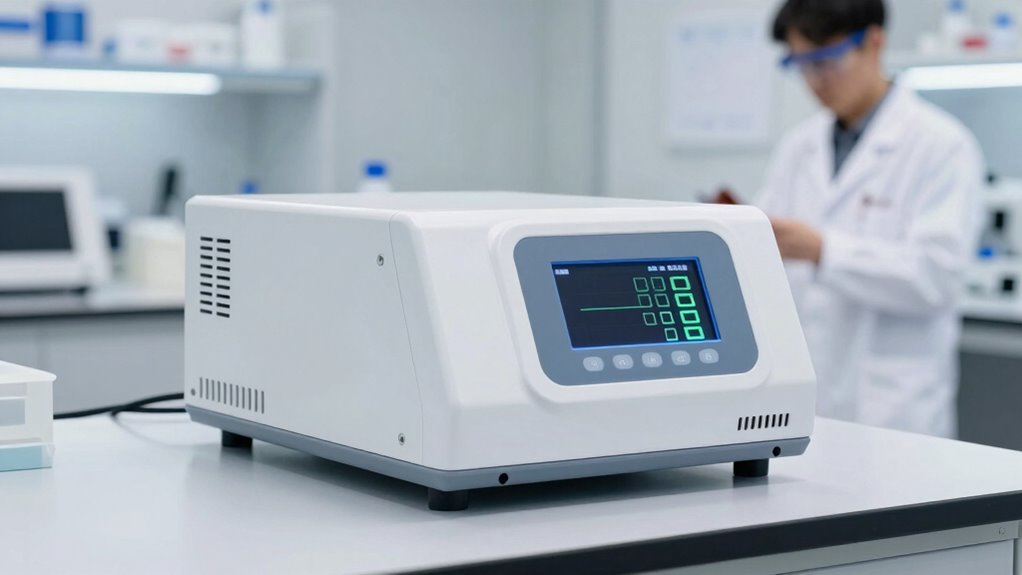
You need a particle counter when maintaining strict cleanliness standards is vital, like in pharmaceuticals, electronics, or healthcare. Use it to monitor air quality during regular checks, post-cleaning validation, or audits to guarantee compliance and prevent contamination. However, if your environment is a typical office or lacks sensitive processes, a particle counter may not be necessary. To decide the right timing for your situation, discover more about when and how to use these essential tools.
Key Takeaways
- Use particle counters in cleanrooms, manufacturing, or healthcare environments to monitor airborne contamination levels.
- They are unnecessary in general office spaces or environments without strict cleanliness standards.
- Employ particle counters during routine checks, post-cleaning validation, or regulatory audits to ensure compliance.
- Avoid using them if visual inspections and cleaning procedures suffice for maintaining air quality.
- Proper use reduces contamination risks, ensures compliance, and provides documented proof of environmental cleanliness.
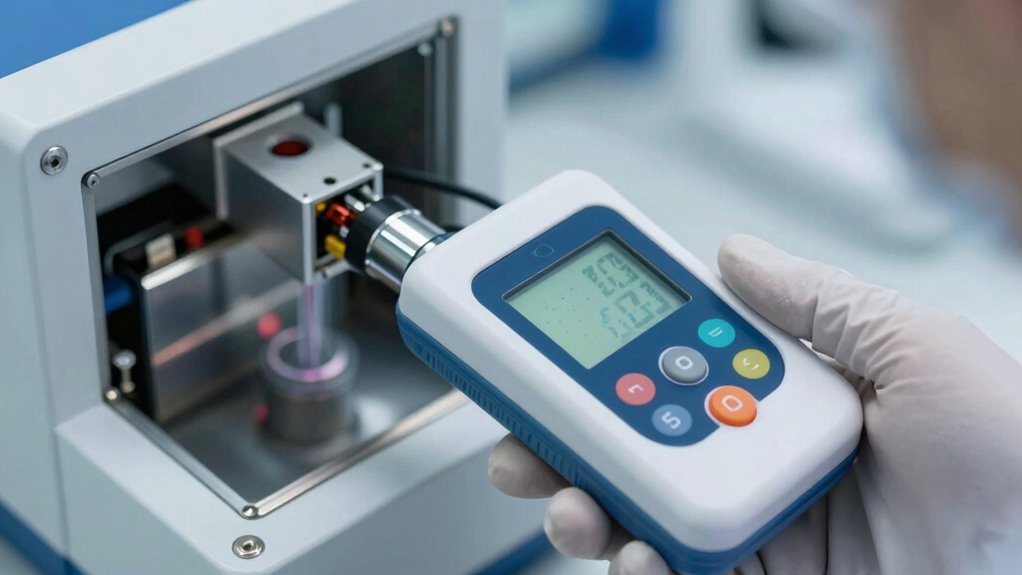
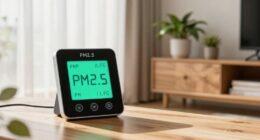
Have you ever wondered how industries keep their environments clean and safe? It’s a question that’s especially relevant in fields like pharmaceuticals, electronics, and healthcare, where maintaining strict cleanliness standards isn’t just about appearance—it’s about safety and compliance. That’s where particle counters come into play. These devices are essential tools for ensuring that cleanroom standards are met and maintained. They provide real-time data on airborne particles, which is critical for air quality monitoring. When particle levels exceed acceptable limits, it signals potential contamination risks, prompting immediate corrective actions. Without these counters, it’d be nearly impossible to verify that a cleanroom remains within the prescribed particle count thresholds, risking product safety and regulatory violations.
Particle counters are designed to detect and measure particles down to very small sizes, often as minute as 0.3 micrometers. They give you a quantitative snapshot of your environment’s cleanliness, allowing you to track trends over time and respond promptly when particle levels rise. This capability is essential because cleanroom standards are rigorous and vary depending on the industry. In pharmaceutical manufacturing, for example, strict limits are imposed on airborne particles to prevent contamination of sensitive drugs. Air quality monitoring with particle counters ensures these standards are consistently met, reducing the risk of costly recalls or regulatory penalties. In electronics, even tiny dust particles can ruin delicate components, so monitoring air quality with precision instruments becomes a non-negotiable part of quality control. Additionally, understanding airborne particle sizes helps industries select the appropriate counter models for their specific needs.
Particle counters measure tiny particles, ensuring strict industry standards and preventing costly contamination in sensitive environments.
Knowing when to use a particle counter is straightforward: whenever you need to verify the cleanliness of an environment that must meet specific standards. Regular monitoring during manufacturing, cleanroom assembly, or post-cleaning validation helps maintain control over airborne contamination. Particle counters also come in handy during audits or inspections, providing documented proof that your environment adheres to industry regulations. However, there are times when these devices aren’t necessary. For example, in general office spaces or areas with no strict cleanliness requirements, investing in a particle counter might be overkill. Similarly, if your environment doesn’t involve sensitive processes or products, visual inspections and routine cleaning could suffice.
In essence, a particle counter becomes a essential tool when your industry demands tight control over air quality and particle levels. It’s an investment in safety, compliance, and peace of mind. By diligently monitoring air quality and adhering to cleanroom standards, you ensure your environment remains safe for both products and personnel. When used appropriately, particle counters help you stay ahead of potential contamination issues, maintaining the integrity of your processes and the trust of your clients. So, if your industry’s success hinges on cleanliness, a particle counter isn’t just a gadget—it’s a fundamental part of your quality assurance toolkit.
Frequently Asked Questions
What Is the Typical Lifespan of a Particle Counter?
A particle counter typically lasts around 3 to 5 years, depending on sensor durability and usage conditions. You should expect more frequent replacement if it operates in harsh environments or sees heavy use. Regular calibration and maintenance can extend its lifespan, but ultimately, monitoring its performance helps determine when a replacement is necessary. Staying attentive guarantees accurate readings and maximizes the device’s longevity.
How Often Should Particle Counters Be Calibrated?
Imagine a scientist fine-tuning a delicate instrument; that’s how you should view calibrating your particle counter. Industry standards recommend calibrating it at least every six months, but your calibration schedule depends on usage and environment. Regular calibration ensures accuracy, preventing false readings or overlooked contamination. Don’t wait for errors—stay proactive, keep your equipment reliable, and follow these standards to maintain precise particle measurement and peak performance.
Can Particle Counters Detect Chemical Pollutants?
Particle counters primarily detect airborne particles, not chemical pollutants. They measure particle size and concentration, helping you assess air quality based on particulates. While they excel in pollutant measurement related to particles, they can’t directly identify chemical detection or chemical composition. If you’re targeting specific chemical pollutants, you’ll need specialized sensors or gas analyzers. Use particle counters for particulate matter, but rely on different instruments for chemical pollutant detection.
Are Portable Particle Counters as Accurate as Stationary Ones?
While portable particle counters may not quite match the precision of stationary ones, they still excel in dust measurement for most practical purposes. You’ll find that portable devices offer impressive accuracy for on-the-go assessments, though stationary counters typically provide more consistent data in controlled environments. So, if you’re flexible with a slight trade-off, portable counters can serve you well, especially when mobility and convenience matter most.
What Maintenance Is Required for Particle Counters?
You need to perform regular maintenance on your particle counter by replacing filters as recommended by the manufacturer to guarantee accurate readings. Additionally, follow proper calibration procedures periodically to maintain precision. Keep the device clean and store it in a suitable environment when not in use. Regular check-ups help prevent errors, extend the instrument’s lifespan, and ensure you get reliable data every time you operate it.
Conclusion
Knowing when to use a particle counter helps you guarantee cleanliness, maintain safety, and meet standards. When precision matters, a particle counter guides your decisions; when simplicity suffices, it’s unnecessary. Recognizing these moments allows you to act wisely, to assess accurately, and to decide confidently. By understanding when to rely on a particle counter and when to forego it, you empower yourself to manage environments effectively, efficiently, and with assurance.