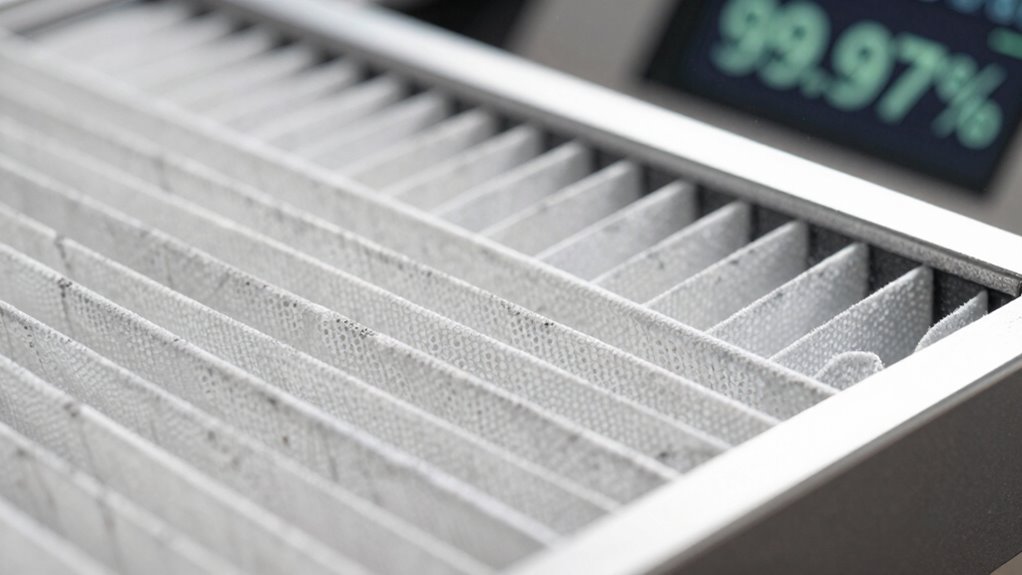
Chasing a filtration efficiency of 99.97% might seem impressive, but it’s important to understand what that number really means. It indicates the filter’s ability to trap 99.97% of particles tested during lab conditions, usually around 0.3 microns. However, real-world factors like installation, airflow, and maintenance can affect actual performance. To make smarter choices, explore how these ratings relate to your specific needs and the conditions you face.
Key Takeaways
- A 99.97% efficiency indicates the filter’s performance during lab tests against specific particles, not real-world conditions.
- Efficiency ratings like 99.97% are based on testing against 0.3-micron particles, known as MPPS.
- High efficiency does not guarantee optimal performance if installation, maintenance, or airflow are compromised.
- Filter material quality and design influence actual effectiveness, balancing particle capture and airflow.
- Focus on the filter’s suitability for your specific needs and proper maintenance rather than solely chasing high efficiency numbers.
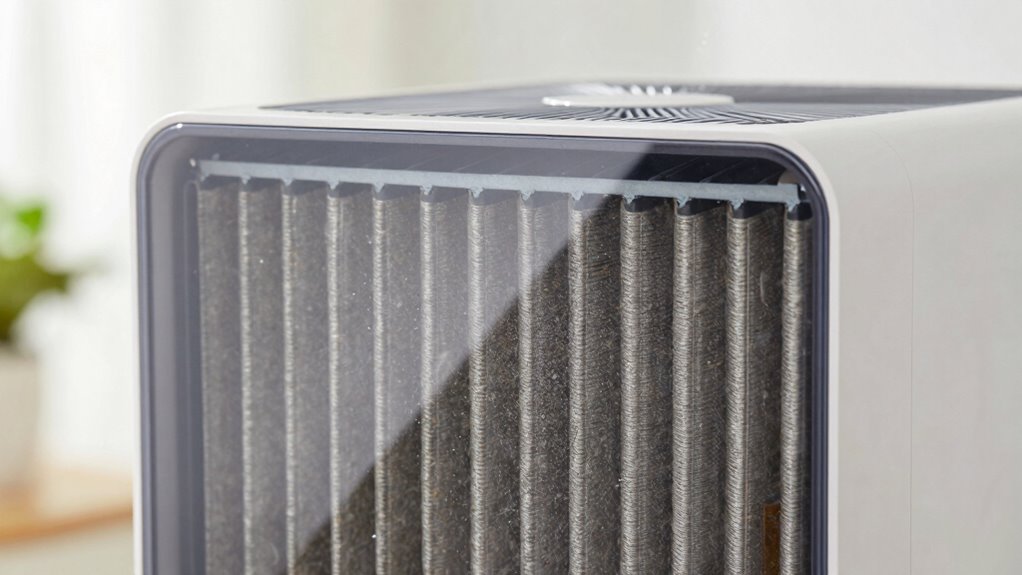
Have you ever wondered how effective different filters really are? When it comes to protecting your indoor air quality, understanding filtration efficiency numbers is essential. These numbers often sound impressive—like the famous 99.97%—but what do they truly mean? At the core, filtration efficiency measures how well a filter can trap airborne particles, which include dust, pollen, pet dander, bacteria, and even some viruses. It all comes down to the interaction between these airborne particles and the filter material. The filter material is designed with tiny fibers that create a maze, capturing particles as air flows through. But the numbers assigned to a filter’s efficiency don’t just happen out of thin air; they reflect specific testing standards that simulate real-world conditions.
Filtration efficiency measures how well filters trap airborne particles like dust, pollen, and bacteria.
When a filter claims to be 99.97% efficient, it’s usually tested against particles of a certain size—most notably, 0.3 microns, which are notoriously difficult to filter. This size is considered the most penetrating particle size (MPPS), meaning if a filter can trap 99.97% of these, it’s very effective at capturing other, larger airborne particles as well. But it’s essential to remember that these efficiency ratings are based on controlled laboratory tests, not everyday use. Real-world factors like filter installation, airflow rates, and the cleanliness of the filter material can influence actual performance.
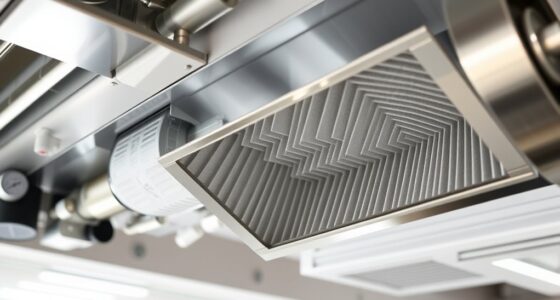
The effectiveness of a filter is directly tied to its filter material. High-quality filter media incorporate advanced fibers and layers designed to maximize particle retention without restricting airflow excessively. Some filters use electrostatic charges to attract airborne particles, boosting efficiency without adding to airflow resistance. Others rely on dense fiber arrangements—like HEPA filters—to physically trap particles at a microscopic level. The key is understanding that higher efficiency ratings often mean denser filter materials, which can sometimes reduce airflow if not properly designed. That’s why selecting a filter with the right balance of filtration and airflow is essential for your comfort and health.
Additionally, understanding the filter media composition can help you choose filters that deliver both high efficiency and good airflow, ensuring better indoor air quality without sacrificing comfort. Ultimately, numbers like 99.97% provide a useful benchmark but shouldn’t be the sole factor in your decision. Instead, pay attention to the type of airborne particles you’re most concerned about and choose a filter material optimized for those. Remember, no filter is perfect, and maintenance, such as timely replacement, plays a significant role in ensuring ongoing effectiveness. So, rather than chasing after “99.97%”, focus on understanding what the efficiency ratings mean in context and selecting a filter that matches your specific needs. That way, you can genuinely improve your indoor air quality without getting lost in misleading numbers.
Frequently Asked Questions
How Do Filtration Efficiency Numbers Vary Across Different Particle Sizes?
You’ll notice that filtration efficiency varies widely with particle size. Smaller particles, like viruses and fine dust, are harder to filter, so performance often drops for very tiny particles. Larger particles, on the other hand, are easier to trap, leading to higher filtration performance. This means a filter’s efficiency number can shift depending on the particle size, so don’t rely solely on a single efficiency rating without considering particle size distribution.
What Is the Significance of Filtration Efficiency in Real-World Air Quality?
Filtration efficiency directly impacts your indoor air quality by effectively removing allergens and pollutants, leading to fresher, healthier air. Higher efficiency filters not only improve allergen removal but also extend filter longevity, reducing replacements and costs. When choosing filters, look beyond just efficiency percentages; consider how well they perform across different particle sizes and their ability to maintain air purity over time, ensuring a safer, more comfortable environment for you.
How Do Filter Materials Influence Filtration Efficiency Ratings?
Filter materials directly impact filtration efficiency ratings through their fiber composition and manufacturing processes. You’ll notice that the choice of fibers—like fiberglass, synthetic, or natural materials—determines how well particles are captured. Advanced manufacturing techniques, such as electrostatic charging or layering, enhance performance. When selecting filters, consider these factors because better fiber quality and innovative processes lead to higher efficiency, providing cleaner air for your space.
Can Filtration Efficiency Decrease Over Time or With Use?
Yes, filtration efficiency can decrease over time as your filter’s particle adhesion weakens and its filter lifespan shortens. When particles build up, the filter becomes less effective at trapping new contaminants. Regularly replacing or maintaining filters ensures they continue performing at peak levels. Don’t wait until you notice reduced airflow or increased dust; proactive upkeep keeps your filtration system working efficiently.
Are Higher Efficiency Ratings Always Better for Everyday Indoor Air?
Higher efficiency ratings, like those meeting HEPA standards, generally improve indoor air quality, but they aren’t always better for everyday use. If your space has high air exchange rates, a lower-efficiency filter may suffice. Also, extremely high-efficiency filters can reduce airflow, making your system work harder. Consider your indoor environment, airflow needs, and maintenance to find the right balance between filtration efficiency and overall air quality.
Conclusion
So, next time you see a filtration efficiency number like 99.97%, remember it’s not the whole story. Like a lighthouse guiding ships through fog, these numbers only illuminate part of the picture. They’re helpful, but don’t let them blind you to what truly matters—how well a filter performs in real life. Keep questioning, stay informed, and don’t chase illusions—because sometimes, the brightest numbers hide the faintest truths.