Laser particle counters measure particulate matter by directing a focused laser beam through a sample area. As particles pass through the laser, they scatter light in different directions. Sensitive detectors capture this scattered light, and the device analyzes the pattern and intensity to determine each particle’s size and concentration. This real-time process offers precise, instant data on airborne particles, helping you understand air quality better—and there’s more to discover if you explore further.
Key Takeaways
- Laser particle counters use focused laser beams to detect particles passing through the light path.
- Particles scatter light in different directions, which is captured by sensors for analysis.
- The pattern and intensity of scattered light determine particle size and concentration.
- Smaller particles scatter less light, while larger particles produce more significant scattering signals.
- Data is displayed digitally, showing real-time particle size distribution and concentration levels.
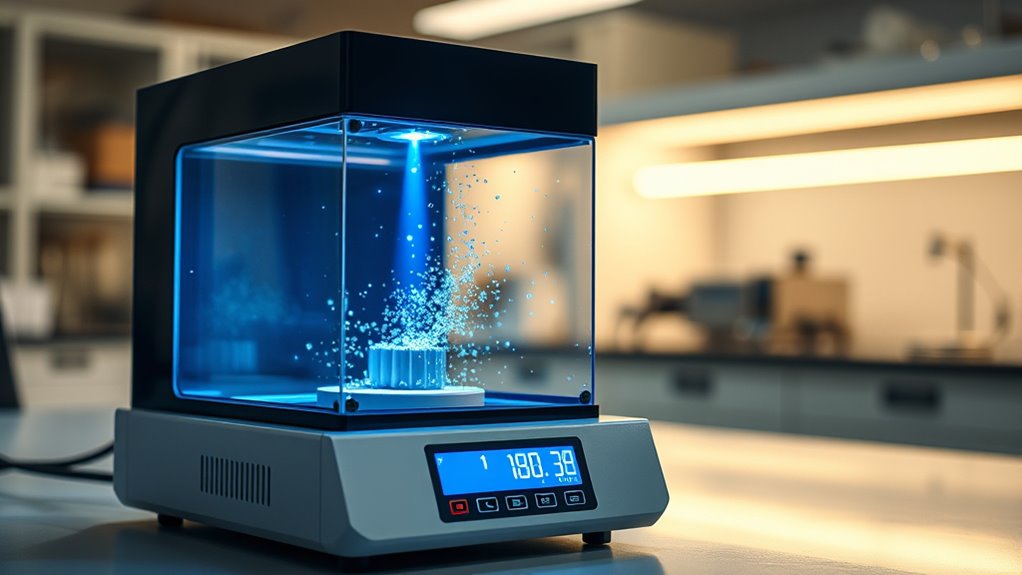
Laser particle counters are essential tools for accurately measuring particulate matter in various environments. These devices use advanced technology to detect and quantify tiny particles suspended in the air, providing crucial data for health, safety, and environmental monitoring. When you operate a laser particle counter, the core detection method involves optical detection. As particles pass through a focused laser beam inside the device, they scatter light in different directions depending on their size and composition. This scattered light is captured by sensitive sensors, allowing the instrument to analyze each particle’s characteristics in real time.
The process of particle size analysis is fundamental to the accuracy and usefulness of laser particle counters. By measuring the pattern and intensity of the scattered light, the device can determine the size of each particle. Smaller particles scatter less light, while larger ones produce more prominent signals. This allows the counter to classify particles into various size ranges, often down to nanometers or micrometers, depending on the model. Particle size analysis isn’t just about counting particles; it provides detailed information about their distribution, which is critical for understanding potential health risks or compliance with air quality standards.
You’ll find that laser particle counters excel at providing rapid, real-time data. Unlike traditional gravimetric methods that require collecting samples and analyzing them in a lab, these counters give immediate feedback. This real-time capability makes them invaluable in environments where conditions can change quickly, such as manufacturing plants, cleanrooms, or outdoor air monitoring. The optical detection method is highly sensitive, enabling you to detect even very small particles, which are often the most hazardous when inhaled. Additionally, understanding lifestyle factors can influence the interpretation of particle data, especially in indoor environments affected by human activity.
When using a laser particle counter, you’ll appreciate how straightforward it is to interpret the data. Most devices come with digital displays and software that chart particle concentrations across different size ranges. This detailed particle size analysis helps you identify sources of pollution, evaluate filtration efficiency, or monitor air quality over time. Because the method relies on light scattering, it’s also non-invasive and doesn’t alter or destroy the particles being measured, ensuring accurate, representative readings.
Frequently Asked Questions
How Often Should Laser Particle Counters Be Calibrated?
You should calibrate your laser particle counter at least once a year as part of your maintenance schedule. However, calibration frequency may need to increase if you notice inconsistent readings or after any repairs or relocations. Regular calibration ensures accurate particulate matter measurements, helping you maintain reliable data. Make sure to follow the manufacturer’s guidelines and document each calibration to keep your device in peak condition.
What Environmental Factors Affect Measurement Accuracy?
Environmental factors like humidity interference and airflow effects can impact your laser particle counter’s measurement accuracy. High humidity levels may cause particles to clump together or interfere with sensor readings, while strong airflow can disrupt the detection process, leading to inconsistent results. To guarantee reliable measurements, keep the environment stable, control humidity levels, and minimize airflow disruptions during testing.
Can Laser Particle Counters Distinguish Between Different Particle Types?
Did you know that laser particle counters can identify over 99% of particles by size? They do this through particle differentiation, which allows for particle identification based on how particles scatter laser light. While they mainly measure size, some advanced models can distinguish between different particle types by analyzing light scattering patterns, giving you valuable insights into air quality. This capability enhances monitoring precision and helps target specific pollution sources.
What Is the Typical Lifespan of a Laser Particle Counter?
Your laser particle counter typically lasts about 5 to 10 years, depending on device maintenance and usage conditions. Regular calibration, cleaning, and proper handling extend its operational lifespan. Keep an eye on components like the laser source and electronics, and replace parts as needed. Proper maintenance guarantees consistent performance, helping you get accurate particulate measurements over the device’s full lifespan.
Are Laser Particle Counters Safe for Continuous Indoor Use?
Think of laser particle counters as vigilant guardians of indoor air quality—they’re safe for continuous use. They excel at particle detection without releasing harmful emissions, ensuring your environment stays healthy. As long as you follow manufacturer guidelines, these devices provide real-time insights without risking safety. So, yes, you can trust them for sustained indoor monitoring, helping you maintain a cleaner, safer space while safeguarding your health.
Conclusion
Now that you know how laser particle counters work, you’ll realize they’re like the superheroes of air quality! They zap tiny particles with laser beams so powerful, they could probably spot a speck of dust from space. With these devices, you’re armed with supercharged technology that can uncover even the sneakiest pollutants hiding in your air. So, next time you breathe, thank these tiny laser heroes for making your environment safer—your lungs will thank you!