
TL;DR

Get garden gear delivered free — and shop member deals
- Fast, free delivery on millions of items
- Access to Prime Big Deal Days deals on October 6–7
- Prime Video, Amazon Music and more included
University of Florida researchers are studying whether pain self-management and ergonomic changes can help nursery and landscape workers manage back pain. Early findings reported by lead researcher Kim Dunleavy show improvements in pain and perceived task difficulty, but the source does not provide participant numbers or detailed results.
Researchers at the University of Florida are studying whether pain self-management and ergonomic changes can help nursery and landscape workers address back pain while continuing their jobs. Preliminary findings show improvements in pain and perceived work task difficulty, lead researcher Kim Dunleavy said, though detailed results and the study’s scale have not been provided in the source report.
The study is being conducted by the Southeastern Coastal Center for Agricultural Health and Safety, with researchers from UF’s College of Public Health and Health Professions and Department of Family, Youth and Community Sciences. It focuses on interventions suited to horticulture work, where physical demands and changing workloads can make standard workplace approaches difficult to apply.
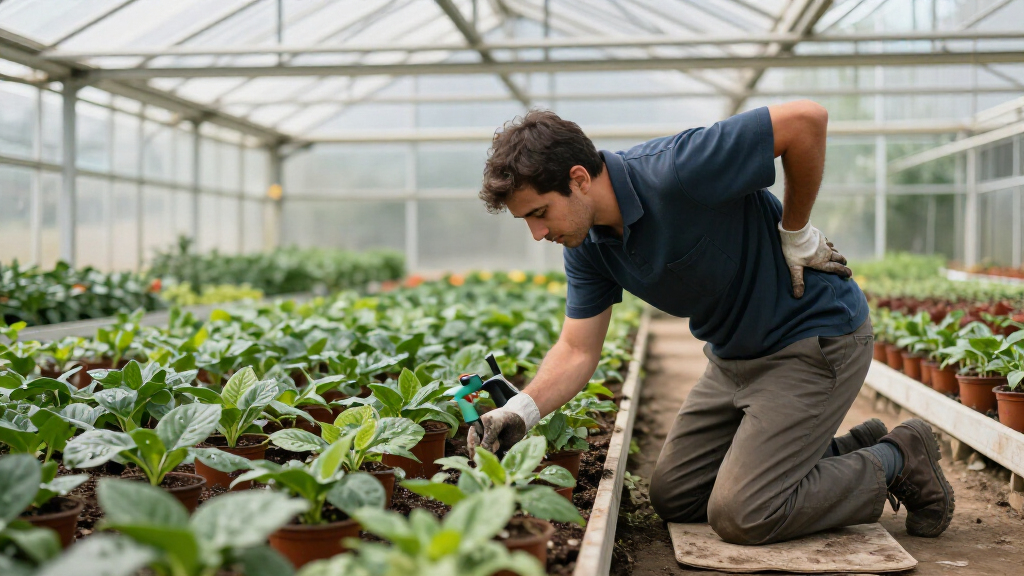
In the first phase, researchers spoke with stakeholders from the nursery and landscape industry, including workers, supervisors and insurance consultants. Those participants described back pain as common and said many workers continue working despite it. Workers cited lifting heavy plants, carrying materials, digging and spending time in bent or awkward positions as tasks that can strain the body over time.
Interviewees also described seasonal and weather-related changes in workload. They said useful interventions would need to account for those conditions and fit daily work. Participants pointed to a need for more workplace awareness of pain and clearer injury-prevention guidance; Dunleavy said formal training in that area is often limited. The study is assessing whether self-management strategies and ergonomic modifications can offer practical support.
Back Pain Affects Workers and Employers
Back pain can affect workers’ ability to do physically demanding jobs and earn income, while employers may face reduced productivity, injury costs and the loss of experienced staff. Dunleavy said these effects can reach beyond the individual worker and create consequences for horticulture businesses.
The issue also has a health dimension. Dunleavy said back pain can lead people to rely on prescription pain medicines, including opioids and muscle relaxers, or nonprescription medicines such as acetaminophen and anti-inflammatory drugs. She cited potential negative health side effects, but the source report does not quantify medication use among study participants or say that the study measured medication outcomes.
Participants said preventing injuries may not require major changes to workplace practices, but interventions would need to be tailored to the industry. If the approaches prove useful, they could give workers and employers options for addressing pain earlier and reducing the chance that short-term workarounds contribute to longer-term problems. The reported preliminary improvements offer an early indication, not a final assessment of effectiveness.
How the Study Reached Its Early Findings
The researchers began by gathering perspectives from workers and industry stakeholders. That first phase helped identify the physical tasks and work conditions that participants associate with back pain, along with the practical limits any intervention would need to respect. The source report does not specify when recruitment began, how many people took part, or how participants were selected.
After those early interviews, the study tested pain self-management and ergonomic modifications. Dunleavy described the initial results as encouraging, reporting improvements in pain and work task difficulty. The source does not give numerical measurements, explain how those changes were evaluated, or say how long participants were followed.
The report appeared in Greenhouse Grower and points readers to a fuller article on the University of Florida Institute of Food and Agricultural Sciences website. It does not provide a journal citation or say whether the study has undergone peer review. The available information supports describing the results as preliminary findings from an ongoing investigation.
““Not only is back pain debilitating for workers who rely on their bodies for income, reduced productivity, losing experienced workers, and overall costs for injury have major consequences for companies.””
— Kim Dunleavy, lead researcher and clinical professor in UF’s Department of Physical Therapy
Study Scale and Results Remain Unreported
The source report does not state how many workers participated, what specific self-management methods or ergonomic changes were tested, or how large the early improvements were. It also does not give a comparison group, measurement period or statistical analysis. Those details are needed to judge how strong the findings are and whether the interventions caused the reported changes.
It is also unclear whether the study has finished, when full results may be available, or whether researchers plan to publish them in a scientific journal. The reported improvements are preliminary and should not be read as proof that a particular approach will work for all nursery and landscape workers.
Full Findings Could Clarify Effectiveness
The study is intended to determine whether pain self-management and ergonomic modifications are effective for addressing back pain in horticulture. Researchers’ next reported milestone would be fuller findings that explain the interventions, participant group, methods and results. The source does not announce a release date or describe a publication schedule.
Workers and employers seeking more detail can consult the full article on the UF/IFAS website, as directed by the Greenhouse Grower report. Until researchers provide more complete results, the scope and durability of the preliminary improvements remain unknown.
Key Questions
What is the University of Florida study investigating?
It is examining whether pain self-management and ergonomic modifications can help horticulture workers address back pain.
Who is included in the study?
The first phase involved stakeholders from the nursery and landscape industry, including workers, supervisors and insurance consultants. The source does not give the number of participants.
What have researchers reported so far?
Lead researcher Kim Dunleavy reported preliminary improvements in pain and work task difficulty. Detailed measurements and the size of the changes were not included in the source report.
When will the full results be available?
The source does not provide a timeline for full results or say whether the study is complete. It directs readers to a fuller article on the UF/IFAS website.
Source: rss
Fall Picks
fall essentials
As an affiliate, we earn on qualifying purchases.