TL;DR
Solar-powered garden lights use a small photovoltaic panel to convert daylight into electricity, store that electricity in a rechargeable battery, and power LEDs after dark. Choose a light for its job, check its sun exposure, brightness, runtime, battery options, and IP rating, then keep its panel clean and clear. A decorative stake light can mark a path, but it usually cannot replace dependable security lighting.
A path can look inviting at dusk and disappear into darkness an hour later. Solar-powered garden lights promise an easy fix: no trenching for cable, no outdoor socket, and no switch to remember. But a light tucked under a leafy shrub may barely glow, while the same model in an open, sunny spot can shine through the evening.

Get garden gear delivered free with Prime
- Fast, free delivery on millions of items
- Prime Video, Amazon Music and more included
- Member-only deals all year
These lights collect daylight, store energy in a rechargeable battery, and use it to power an LED after dark. This guide explains how that works and what you should check before buying: sunlight, brightness, runtime, battery replacement, and weather protection. You’ll also get practical steps for setting up a new light and troubleshooting one that has stopped working.
Think of the panel as a small daily fuel collector. Its output changes with the season, shade, dirt, and weather, so the most useful light for your garden is the one suited to its location and job. A few checks can help you avoid buying bright-looking lights that leave your steps in shadow.
An integrated solar panel needs daylight where the entire fixture sits; a separate panel can help light a shaded area if its cable reaches a sunnier spot.
Use lumen output as a comparison guide, then match the beam and brightness to the job: path markers, task lighting, and security lighting need different covera…
Treat runtime as an estimate that changes with charging conditions, brightness settings, weather, and battery age.
Check the IP rating and installation guidance for the conditions at your site, especially around sprinklers, heavy rain, and standing water.
Look up the battery chemistry, replacement options, warranty, and spare parts before buying, and use only the specified rechargeable battery.
How Solar Lights Turn Daylight Into Evening Light
Solar-powered garden lights use a small photovoltaic panel to convert daylight into electricity, store that electricity in a rechargeable battery, and power an LED after dark. A sensor usually detects falling light and switches the fixture on automatically. At dawn, or when the battery runs low, the light switches off.
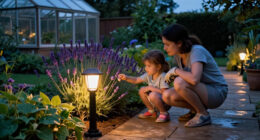
That simple cycle has three parts: the panel collects energy, the battery holds it, and the LED uses it. For instance, a stake light beside a sunny walkway gathers charge during the afternoon, then casts a soft pool of light across the paving when evening arrives. The panel does not need blazing sunshine to work, but shade and short winter days can leave less energy in reserve.
Some lights combine the panel and lamp in one unit. Others connect a separate panel to the lamp with a cable, so you can put the light in a shady spot and point the panel toward the sun. Check the cable length before you buy: a panel sitting just beyond the shade line won’t help if the cable can’t reach it.
The phrase “that electricity is” often describes what happens after the panel generates power: the rechargeable battery stores it for later use. That detail matters because a clear panel does not guarantee a full night of light. The battery’s condition, the lamp’s output, and the hours of daylight all shape the result.
Products Worth Considering

Bose SoundLink Max Portable Bluetooth Speaker, Black

Dyson Cyclone V10 Origin Cordless Vacuum

Dyson V15 Detect Cordless Vacuum
As an affiliate, we earn on qualifying purchases.
Choose Brightness That Fits the Job
Solar-powered garden lights suit different jobs, so choose brightness for what you need to see: a low-output glow can mark a path, while task lighting calls for a stronger fixture. Check the stated lumens as a guide, but remember that the beam shape, optics, and battery condition also affect how bright the light looks outdoors.
For example, a row of modest stake lights can help guests spot a winding garden path without turning the lawn into a car park. A light near a grill or workbench has a different job: you need enough illumination to see what you’re handling. Beam direction matters, too. A narrow beam can pick out a stone feature, while a wider beam spreads light over a larger area.
Small decorative models are generally not substitutes for dependable security lighting. Some larger, motion-sensing models may give useful illumination, but their performance depends on panel size, battery capacity, sensor range, and placement. If you need light near a gate, compare coverage and sensor details as well as lumen figures; a bright lamp pointed toward the fence won’t do much for the steps beside it.
Separate the look you want from the task you need the light to perform. Warm light can make a patio feel relaxed; a more focused beam may help you see a latch or read a label. If the product offers selectable brightness, try a lower setting for decoration and reserve a brighter mode for moments when you need it.
Check the Sun Before You Buy
Solar-powered garden lights need several hours of useful daylight to charge well, and the available sun can vary from one spot to another in the same garden. Trees, walls, winter shade, dirt, and snow can all reduce how much energy reaches the panel. Match the fixture to the light its panel will receive, rather than assuming every outdoor spot will charge it equally.
A sunny border beside a low wall might keep a path light running late into the evening, while a model beneath a dense conifer may fade early. If you are unsure, watch the planned panel location through a typical day. Pay attention to moving shadows, especially in the afternoon, when a fence or neighboring building could block the sun.
Use this quick setup process for a new light:
- Pick the job and location. Decide whether you want a path marker, decorative accent, or task light.
- Check the panel’s sun. Look for several hours of useful daylight and follow the product’s charging guidance.
- Set up the unit. Put an integrated panel in a sunny position, or aim a separate panel toward the best available light.
- Switch it on and check its mode. Confirm the on/off switch and any brightness or timer settings.
- Watch it for several evenings. Note when it turns on and how long it stays lit across different weather.
Cloudy weather does not mean a light can’t charge, but it may collect less energy and run for fewer hours. One dim evening after a storm is a poor verdict; several days of observation give you a better sense of how the actual position performs.
Read Runtime and Weather Claims With Care
Advertised runtime describes an estimate under stated or favorable charging conditions; it cannot promise the same number of hours every night in your garden. A fully charged battery, a bright summer day, and a low brightness setting may produce a very different result from a shaded panel on a short winter day.
Imagine a light that stays on until midnight in June but fades soon after dusk in December. Short days, low sun angles, cloud cover, and cold conditions can change the charging picture, while a high brightness setting draws more power. As the battery ages, it may also hold less charge, so a once-reliable runtime can shorten.
Weather protection needs a similar reality check. An IP rating describes resistance to dust or water under specified tests; it does not mean every fixture can survive flooding, constant irrigation, or every climate. Read what the rating covers and follow the installation instructions, particularly if the light sits near a sprinkler or in a dip where water gathers.
“All-weather” is a broad marketing claim. A stated IP rating, clear installation guidance, and a suitable location tell you more about a light’s weather protection.
For instance, a light installed on a well-drained border may cope with ordinary rain but still fail if it stands in a puddle after a downpour. Keep the panel clear of dirt, leaves, and snow, and check seals and connections if the lamp starts acting strangely after wet weather.
Make Battery Life and Repairs Part of Your Choice
A replaceable rechargeable battery can extend a solar light’s useful life, while a sealed unit may need replacement when its battery fails. Many products use lithium-ion or nickel-metal hydride batteries, but the correct replacement depends on the product. Check the manual or label for the required size, chemistry, capacity, and manufacturer guidance.
For example, a patio light may have a clean panel and working LED but stop shining because its battery has worn down. If the battery is accessible and the manufacturer lists a suitable replacement, you may be able to restore the lamp without discarding the whole fixture. A sealed model offers fewer repair options, so look at parts availability and warranty before you buy.
When a light stops working, start with the easy checks: confirm its switch is on, clean the panel, remove shade if you can, and check the sensor or selected mode. Follow the manual before opening the fixture. If its battery is replaceable, use the specified rechargeable type; a non-rechargeable battery is not a safe substitute in a circuit designed for recharging.
Material quality matters because panels, batteries, LEDs, housings, and seals age at different rates. A repairable design can reduce waste, but a replaceable battery only helps if the right part is available and you can install it safely. Solar charging avoids routine mains electricity use, yet manufacturing and battery disposal still have environmental impacts. Look at the warranty and spare-parts information alongside the green claims.
Use This Buying Checklist to Compare Models
A good buying decision starts with the spot and the job: check where the panel will sit, how much light you need, and what you can repair if the battery wears out. A product page may promise all-night illumination, but its lumens, runtime estimate, battery details, and IP rating give you more useful points to compare.
For instance, you might be choosing between an integrated stake light for a sunny path and a separate-panel model for a shaded patio corner. The first may be simpler to install; the second gives you more choice about panel placement. If you need to light a gate for security, look at the motion sensor’s stated range and the lamp’s coverage instead of relying on a decorative light’s appearance in a product photo.
| Check | Why it matters |
|---|---|
| Intended use | Pathfinding, decoration, task lighting, and security need different light output and coverage. |
| Sunlight and panel type | Shade can cut charging; a separate panel may help if its cable reaches a sunny spot. |
| Lumens and runtime | These offer comparison points, but actual brightness and hours depend on conditions and battery age. |
| Battery and repairs | Check the rechargeable battery type, replaceability, warranty, and spare-parts availability. |
| IP rating and materials | Review stated dust and water resistance, construction, and the installation instructions. |
Compare products on the details that match your garden. A low-output lamp can be a sensible, pleasant path marker; it is a poor purchase if you expect it to illuminate a whole patio. Clear specifications and available replacement parts make it easier to judge whether the light fits your needs beyond its first few weeks.
Frequently Asked Questions
Do solar garden lights work in winter or cloudy weather?
Usually, but short days, low sun angles, cloud cover, shade, and snow can reduce charging and runtime. Keep the panel clear, position it toward available sun, and compare several evenings rather than judging from one cloudy day.
How many hours of sun do solar garden lights need?
It depends on the panel, battery, light output, and the product’s guidance. Many models recommend several hours of direct sunlight for a full charge, so check the instructions and assess the actual light at the planned panel location.
Can I replace the battery in a solar garden light?
Often, but some models have sealed batteries. Check the manual or product label for the specified rechargeable battery’s size, chemistry, and capacity. Do not use a non-rechargeable battery as a substitute.
Are solar garden lights bright enough for security?
Some larger motion-sensing models can provide useful illumination, but small decorative stake lights are generally better for decoration or wayfinding. Compare lumen output, coverage, sensor range, and battery capacity for the area you need to light.
Can I put the solar panel away from the light?
Only if the model has a separate panel and the cable reaches the planned sunny spot. Integrated-panel lights need the whole fixture in a position that receives useful daylight.
Why did my solar garden lights stop working?
Common causes include a dirty or shaded panel, a switch left off, a battery that needs charging or replacement, a sensor setting, water ingress, or a loose connection. Check the manual, clean the panel, confirm the settings, and inspect the battery if it is replaceable.
Conclusion
Choose a solar light for the place it will sit and the job it needs to do. Check panel exposure, brightness, realistic runtime, weather rating, and battery replacement before you buy; then give the panel clear daylight and keep it clean.
A well-placed light can turn a dark path into a gentle trail of warm dots. Start with one spot you want to make easier to see, and let the garden show you what works.