If you need an air purifier for VOCs in a 1000 sq ft space, the single most important spec is not HEPA filtration — it’s the amount and type of activated carbon, because HEPA filters capture particles, not gas-phase chemicals. My top pick is the IQAir GC MultiGas XE, which uses a multi-stage gas cartridge system specifically engineered for chemical vapors rather than a thin carbon-coated pre-filter. The OdorStop OSAP5 and CleanForce MEGA1000 are the strongest mid-range alternatives, both pairing H13 HEPA with substantial carbon beds at a fraction of the IQAir’s cost. The main tradeoff in this category is straightforward: models built for odor and gas removal run louder and cost more per year in filters, while general-purpose purifiers with light carbon layers will clean your air but barely dent VOC levels. Read on for the full breakdown of all eight models.

Get garden gear delivered free — and shop member deals
- Fast, free delivery on millions of items
- Access to Prime Big Deal Days deals on October 6–7
- Prime Video, Amazon Music and more included
Complete the kit


Key Takeaways
- Carbon quantity was the biggest differentiator in this lineup — the IQAir GC MultiGas XE carries pounds of granular carbon in dedicated cartridges, while half the field relies on carbon-coated mesh that saturates within weeks against continuous VOC sources.
- Several models overstate their coverage: the DAYETTE claims 3400 sq ft and the CleanForce 3000 sq ft, but those numbers assume one air change per hour — for real VOC control in a 1000 sq ft space, expect to run them on medium-high, not their advertised floor coverage.
- The Levoit Core 400S-P and Winix 5510 are the best smart-home integrations here, with app-based fan scheduling that genuinely helps VOC management by ramping airflow after cooking or cleaning events.
- Only the DAYETTE includes a real-time TVOC sensor, which changes how you use the purifier — but its carbon bed is modest, so sensor-driven alerts outpace its actual filtration capacity.
- The renewed Shark HP201 is the riskiest choice for VOC-specific use: sealed-unit renewals are fine for particulates, but there is no way to verify remaining carbon life in a refurbished unit.
| DAYETTE Pet Air Purifier with H14 HEPA Filters, TVOC & PM2.5 Sensors | 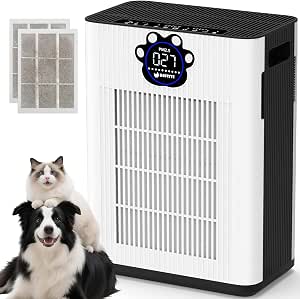 | Best Overall for VOCs | Coverage Area: Up to 3,400 sq. ft. | Filter Type: 2X H14 HEPA, washable pre-filters, activated carbon pellets | Sensors: PM2.5 and TVOC with color-coded indicator | VIEW ON AMAZON | See Our Full Breakdown |
| CleanForce MEGA1000 Extra Large Air Purifier |  | Best for Whole-Floor VOC Scrubbing | Model: MEGA1000 | Filter Type: H13 True HEPA, activated carbon, non-woven fabric pre-filters | Filtration Layers: 4-layer (2 pre-filters, 2 multi-integrated filter sets) | VIEW ON AMAZON | See Our Full Breakdown |
| Winix 5510 Air Purifier with App Support |  | Best Smart Pick for Set-and-Forget Use | Model: 5510 | Room Coverage: Up to 1,882 sq. ft. per hour | Filtration: True HEPA with carbon odor-control filter | VIEW ON AMAZON | See Our Full Breakdown |
| OdorStop OSAP5 H13 HEPA Air Purifier |  | Best Value for a Single 1,000 Sq Ft Room | Coverage Area: Up to 1,000 sq. ft. | Filter: H13 True HEPA with active carbon | Contaminant Capture: 99.97% | VIEW ON AMAZON | See Our Full Breakdown |
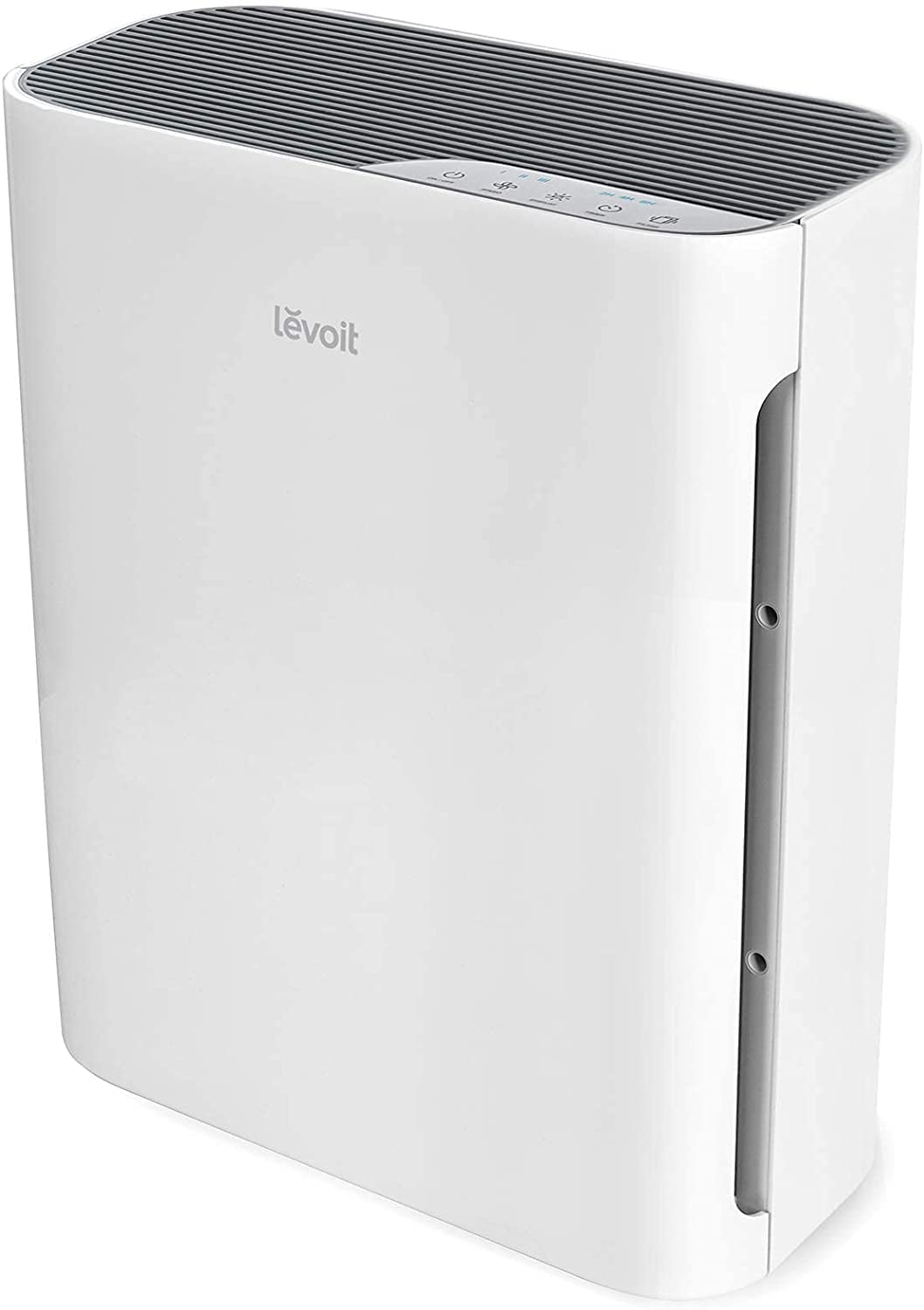
| LEVOIT Core 400S-P Smart Air Purifier for Large Rooms |  | Best for Data-Driven Air Monitoring | Coverage: Up to 1,733 sq. ft. per hour | Smoke CADR: 231 CFM | Dust CADR: 240 CFM | VIEW ON AMAZON | See Our Full Breakdown |
| H13 True HEPA Air Purifier for Large Rooms, 235 CFM CADR |  | Best Smart Air Quality Feedback | Filter: H13 True HEPA and activated carbon | CADR: 235 CFM | Coverage: Up to 3,500 sq. ft. (listed) | VIEW ON AMAZON | See Our Full Breakdown |
| Shark HP201 Air Purifier for Large Rooms (Renewed) |  | Best Brand-Name Value | Model: HP201 (Renewed) | Room coverage: Up to 1,000 sq ft at 1 air change per hour | Particle capture: 99.98% of particles 0.1–0.2 microns | VIEW ON AMAZON | See Our Full Breakdown |
| IQAir GC MultiGas XE Air Purifier with Activated Carbon and WiFi |  | Best Premium VOC Filtration | Coverage area: 1,125 sq ft | Filtration: HyperHEPA, activated carbon, gas cartridges, post-filter sleeves | Capture efficiency: 99% of targeted pollutants | VIEW ON AMAZON | See Our Full Breakdown |
More Details on Our Top Picks
DAYETTE Pet Air Purifier with H14 HEPA Filters, TVOC & PM2.5 Sensors
For a roundup centered on VOC removal in a 1,000 sq ft space, this model earns the top spot for one reason: it’s the only mid-priced option here with a dedicated TVOC sensor paired with a Smart Auto Mode. That means it doesn’t just filter VOCs when you happen to run it — it detects them in real time and ramps up fan speed automatically, which matters for intermittent VOC sources like fresh paint, new furniture, or cleaning products. The dual H14 HEPA filters (a grade above the H13 in the CleanForce MEGA1000) and activated carbon pellets give it genuine chemical-adsorption capacity, not just particle capture. Compared with the LEVOIT Core 400S-P, which shows PM2.5 but is blind to VOCs, the DAYETTE gives you visibility into the exact problem this roundup addresses. The tradeoff: the 3,400 sq ft headline coverage is optimistic for VOC work, and carbon saturation means filters need regular replacement.
Pros:- TVOC sensor with real-time auto response — rare at this price
- Dual H14 HEPA filters, a grade above typical H13 units
- 22dB Sleep Mode and washable pre-filters cut noise and maintenance
- Dual air intake purifies a 1,000 sq ft room quickly
Cons:- Headline 3,400 sq ft coverage overstates realistic single-room VOC performance
- Replacement filter costs add up with dual-filter design
- Pre-filters need frequent cleaning in dusty or pet-heavy homes
Best for: Homeowners dealing with VOC events — new paint, carpet, furniture off-gassing — who want automatic detection and response rather than manual control
Not ideal for: Buyers wanting the lowest long-term cost, since dual H14 filters plus carbon pellets make replacements a recurring expense
- Coverage Area:Up to 3,400 sq. ft.
- Filter Type:2X H14 HEPA, washable pre-filters, activated carbon pellets
- Sensors:PM2.5 and TVOC with color-coded indicator
- Noise Level:22dB (Sleep Mode)
- Modes:Smart Auto, Enhanced Pet, Sleep
- Timer:2/4/6/8-hour
- Special Features:Child lock, aroma diffuser, filter replacement indicator
Our verdict“If VOC detection and automatic response are the priority in a ~1,000 sq ft room, this is the most capable all-around pick here.”
CleanForce MEGA1000 Extra Large Air Purifier
The MEGA1000 takes a brute-force approach: dual air intake and twin-turbo fans moving enough air to cycle a 1,000 sq ft room several times per hour, with a 4-layer filtration stack that explicitly targets VOCs alongside particles. Unlike the DAYETTE, it lacks a TVOC sensor — its Smart Auto Mode responds to general air quality rather than chemical levels — but its carbon stage is generous, and the high airflow pushes more air through that carbon per hour, which is how VOCs actually get removed. Compared with the OdorStop OSAP5, which is a capable single-room unit, the MEGA1000 can handle open floor plans where a 1,000 sq ft rating is a floor, not a ceiling. The cost of that power is physical bulk and fan noise at higher speeds, plus a multi-layer replacement cycle that hits your wallet twice over.
Pros:- Twin-turbo fans deliver exceptionally high air changes per hour in 1,000 sq ft spaces
- 4-layer filtration with activated carbon explicitly rated for VOCs
- H13 True HEPA captures 99.97% of particles down to 0.1 microns
- Both touchscreen and remote control included
Cons:- No dedicated VOC sensor, so auto mode can’t target chemical spikes directly
- Bulky footprint dominates smaller rooms
- Multi-layer replacement filters double ongoing costs
Best for: Owners of open-concept homes or basements where VOC and odor problems span well beyond a single 1,000 sq ft room
Not ideal for: Apartments or bedrooms — the footprint and higher fan speeds make it overkill and intrusive in smaller spaces
- Model:MEGA1000
- Filter Type:H13 True HEPA, activated carbon, non-woven fabric pre-filters
- Filtration Layers:4-layer (2 pre-filters, 2 multi-integrated filter sets)
- Coverage:Up to 4,650 sq ft per hour / 2,325 sq ft in 30 minutes
- Particle Removal:99.97% of particles down to 0.1 microns
- Controls:Touchscreen and remote control
- Features:Auto Mode, Sleep Mode, Timer, Child Lock, dual air intake
Our verdict“Choose this when raw air throughput and carbon volume matter more than sensor-driven precision — think whole floors, not single rooms.”
Winix 5510 Air Purifier with App Support
The Winix 5510 balances capacity and convenience better than anything else in this batch. Its air-quality sensor with Auto Mode plus Winix Smart App control means you can monitor and adjust a 1,000 sq ft room from anywhere — useful if VOC sources spike while you’re out (a running printer, a fresh coat of paint drying). Its True HEPA captures 99.99% of allergens down to 0.01 microns, a finer claim than the 0.1-micron ratings of the CleanForce or LEVOIT, and the washable pre-filter trims long-term costs. The weak spot for this roundup specifically is carbon: the odor-control filter handles smells adequately but is thinner than the DAYETTE’s pellet bed, so heavy chemical off-gassing isn’t its strength. AHAM Verified and UL certifications give the performance claims independent backing that most rivals here lack.
Pros:- App control and air-quality sensing enable true remote management
- 99.99% capture down to 0.01 microns — the finest particle claim here
- AHAM Verified and UL Certified performance
- 23.5 dB low speed is quiet enough for bedrooms
Cons:- Carbon stage is lighter than VOC-focused competitors
- 1,882 sq ft coverage is a one-hour figure, so expect less in practice
- Filter replacement intervals and costs aren’t clearly documented
Best for: Connected-home users who want app scheduling and auto mode for everyday allergen and light-odor control in a large room
Not ideal for: Buyers fighting strong chemical VOC loads — the carbon stage is modest compared with dual-carbon designs
- Model:5510
- Room Coverage:Up to 1,882 sq. ft. per hour
- Filtration:True HEPA with carbon odor-control filter
- Pre-filter:Washable fine mesh
- Particle Capture:99.99% of allergens down to 0.01 microns
- Noise Level:23.5 dB on lowest speed
- Controls:Winix Smart App, air-quality sensor, Auto Mode
- Certifications:AHAM Verified, UL Certified
Our verdict“The best pick if smart control and verified performance top your list, provided your VOC concerns are moderate rather than severe.”
OdorStop OSAP5 H13 HEPA Air Purifier
The OSAP5 is the straightforward, right-sized choice: rated for exactly 1,000 sq ft with an H13 HEPA filter and active carbon, and none of the frills that inflate the price of larger units. Its 360-degree air intake is a design advantage over the boxier Winix 5510 — you can place it anywhere in the room without worrying about a wall blocking airflow. At 6 lbs, it’s the most portable option here, easy to move between a nursery and a home office as VOC sources shift. The feature set is more complete than its simplicity suggests: five fan speeds, auto and sleep modes, a 24-hour timer, child lock, and filter-life display. The honest tradeoff is capacity — it can’t match the air changes per hour of the CleanForce MEGA1000, and its carbon layer handles cooking odors and smoke better than concentrated chemical off-gassing.
Pros:- Right-sized 1,000 sq ft rating matches the target room exactly
- 360-degree intake allows flexible placement anywhere in the room
- Full feature set including timer, child lock, and filter-life display
- Lightweight 6 lb build with 3-year warranty
Cons:- Carbon capacity is modest for heavy chemical VOC removal
- No app control or PM2.5/VOC readouts — only basic air quality display
- Fan power trails the dual-intake competitors here
Best for: Budget-conscious buyers who need dependable odor and particle filtration for one properly sized room without paying for smart features
Not ideal for: Open floor plans or severe VOC episodes — a single-room rating and modest fan power can’t keep up with larger loads
- Coverage Area:Up to 1,000 sq. ft.
- Filter:H13 True HEPA with active carbon
- Contaminant Capture:99.97%
- Air Intake:360-degree
- Fan Speeds:5
- Modes:Auto, Sleep
- Timer:24 hours
- Other Features:Child lock, air quality display, filter life display
- Warranty:3 years
Our verdict“The sensible no-frills choice when one 1,000 sq ft room is the whole job and every dollar counts.”
LEVOIT Core 400S-P Smart Air Purifier for Large Rooms
If you want to see what’s in your air, the Core 400S-P is the transparent option. Its AirSight Plus laser sensor with a live PM2.5 readout gives you hard numbers instead of a vague colored light — something only the DAYETTE’s dual sensors rival, and the DAYETTE costs more up front. AHAM-verified CADR figures (231 CFM smoke, 240 CFM dust) let you calculate real air changes per hour, which matters because the 1,733 sq ft headline is a one-air-change-per-hour claim; in a 1,000 sq ft room you get closer to two, which is genuinely effective. The catch for this roundup: the three-stage 3-in-1 filter bundles a relatively thin carbon layer, so for VOC-heavy situations the DAYETTE’s pellet bed or the CleanForce’s dedicated carbon stage will adsorb more chemicals per pass. This is the pick for particulate precision with capable odor control, not the reverse.
Pros:- Live PM2.5 numeric display goes beyond simple color indicators
- AHAM-verified CADR ratings make performance claims calculable
- 99.97% filtration for fine 0.1–0.3 μm particles
- Single 3-in-1 filter simplifies maintenance
Cons:- Thin integrated carbon layer limits serious VOC adsorption
- 1,733 sq ft coverage assumes only one air change per hour
- 3-in-1 design forces full filter replacement when any stage exhausts
Best for: Data-minded buyers who want verified CADR numbers and a live PM2.5 display for tracking air quality changes over time
Not ideal for: Households with strong chemical VOC sources — the integrated carbon layer saturates faster than dedicated-carbon competitors
- Coverage:Up to 1,733 sq. ft. per hour
- Smoke CADR:231 CFM
- Dust CADR:240 CFM
- Pollen CADR:259 CFM
- Filtration:Three-stage, 3-in-1 filter
- Filtration Efficiency:99.97% for 0.1–0.3 μm particles
- Air Quality Sensor:AirSight Plus laser dust sensor with PM2.5 display
Our verdict“The clear choice for measurable, verifiable particulate performance with smart monitoring — just pair expectations on VOCs accordingly.”
H13 True HEPA Air Purifier for Large Rooms, 235 CFM CADR
Where most large-room purifiers in this roundup ask you to guess whether they’re working, this one puts a live PM2.5 readout right on the panel and lets Auto Mode respond to it. For a 1,000 sq ft space dealing with VOCs, that feedback loop matters — you can see when cooking or cleaning spikes particle counts and watch the fan ramp up on its own. Compared with the Shark HP201, this model offers a higher CADR (235 CFM) and dual-sided intake, which helps it cycle air through a carbon filter faster, though its carbon stage is thinner than the IQAir GC MultiGas XE’s dedicated gas cartridges. The 30 dB Sleep Mode with a dimmable panel makes it bedroom-friendly, and the child lock is a genuine plus for toddlers. The tradeoff: filters need swapping every 3–4 months, and the headline 3,500 sq ft claim assumes optimistic air-change math.
Pros:- PM2.5 display with Auto Mode adjusts fan speed to real air conditions
- High 235 CFM CADR with dual-sided intake moves air quickly through the filter
- Whisper-quiet 30 dB Sleep Mode with dimmable panel for bedrooms
- Child lock, timer, and ENERGY STAR certification at roughly 0.66 kWh per day
Cons:- Filter replacement every 3–4 months adds recurring cost and hassle
- The 3,500 sq ft coverage figure is optimistic; real-world VOC performance in 1,000 sq ft is more realistic
Best for: Owners of open-plan homes who want real-time PM2.5 data and automatic fan response without babysitting settings
Not ideal for: Buyers focused purely on heavy chemical and VOC removal — its carbon layer is lighter-duty than cartridge-based systems like the IQAir
- Filter:H13 True HEPA and activated carbon
- CADR:235 CFM
- Coverage:Up to 3,500 sq. ft. (listed)
- Noise level:30 dB in Sleep Mode
- Air quality monitor:PM2.5 display with Auto Mode
- Controls:Timer, child lock, panel dimmer
- Energy use:As little as 0.66 kWh per day, ENERGY STAR
- Filter replacement:Every 3–4 months
Our verdict“This pick makes the most sense for buyers who want visible, data-driven air cleaning in a large space, provided they accept a shorter filter-change cycle.”
Shark HP201 Air Purifier for Large Rooms (Renewed)
For shoppers who want a trusted appliance brand covering a full 1,000 sq ft room without paying premium prices, the renewed Shark HP201 hits a practical sweet spot. Its NANOSEAL HEPA filter captures 99.98% of particles down to 0.1–0.2 microns — a finer claim than standard H13 units like the OdorStop OSAP5 — and Clean SenseIQ tracks PM1, PM2.5, and PM10 to adjust purification automatically, a feature set that rivals the H13 235 CFM model above. Where it falls short for VOC-specific buyers is filtration depth: there’s no dedicated activated carbon stage comparable to the IQAir GC MultiGas XE’s gas cartridges, so chemical odors and gases get less aggressive treatment. Coverage is also rated at just one air change per hour, meaning slower turnover than higher-CADR rivals. The 6–12 month filter life, quiet operation, and dimmable display make it an easy everyday choice.
Pros:- NANOSEAL HEPA captures 99.98% of particles as small as 0.1–0.2 microns
- Clean SenseIQ auto-adjusts based on PM1, PM2.5, and PM10 readings
- Long 6–12 month filter replacement interval reduces upkeep costs
- Quiet operation with dimmable lights and filter-life display
Cons:- Coverage is rated at only one air change per hour — slower air turnover than higher-CADR picks
- Renewed condition means variable cosmetic and warranty terms versus new units
Best for: Budget-conscious buyers who want brand reliability, auto-adjusting purification, and long filter life in a 1,000 sq ft space
Not ideal for: Households battling strong chemical VOCs or heavy smoke — the lack of a substantial carbon stage limits gas-phase filtration
- Model:HP201 (Renewed)
- Room coverage:Up to 1,000 sq ft at 1 air change per hour
- Particle capture:99.98% of particles 0.1–0.2 microns
- Fan speeds:4
- Air quality monitoring:PM1, PM2.5, and PM10
- Filter replacement:Every 6–12 months
- Included:Purifier and NANOSEAL HEPA filter
Our verdict“This model is better suited to allergy-focused buyers in 1,000 sq ft rooms who value convenience over maximum VOC firepower.”
IQAir GC MultiGas XE Air Purifier with Activated Carbon and WiFi
If VOCs are your primary concern — off-gassing furniture, paint fumes, chemical sensitivities — the GC MultiGas XE is the only pick here built specifically for gas-phase pollution. Its multi-stage gas cartridge system with activated carbon and post-filter sleeves goes far beyond the thin carbon layers in the H13 235 CFM unit or the Shark HP201, targeting 99% of chemicals, odors, and smoke across 1,125 sq ft. Swiss manufacturing and a 10-year limited warranty signal a different build philosophy than the rest of this lineup. The WiFi AirVisual app adds real-time monitoring and remote control, closing the gap with smart rivals. Tradeoffs are real, though: this is the most expensive tier of the roundup, replacement cartridges carry ongoing costs, and delivery in two boxes with a possible signature requirement is a minor annoyance. For serious VOC removal, nothing else here matches it.
Pros:- Dedicated activated carbon gas cartridges plus post-filter sleeves for serious chemical and odor capture
- Covers up to 1,125 sq ft — the largest rated coverage in this batch
- WiFi app with real-time monitoring, remote control, and automatic adjustment
- Swiss-made build quality with a 10-year limited warranty and energy-efficient fan
Cons:- Premium purchase price plus ongoing replacement cartridge costs
- Ships in two boxes and may require a signature on delivery
Best for: Buyers with chemical sensitivities or persistent VOC sources who need dedicated gas-cartridge filtration, not just HEPA plus a dusting of carbon
Not ideal for: Casual users or allergy-only households — the premium price and cartridge upkeep buy VOC capability they may never need
- Coverage area:1,125 sq ft
- Filtration:HyperHEPA, activated carbon, gas cartridges, post-filter sleeves
- Capture efficiency:99% of targeted pollutants
- Connectivity:WiFi, IQAir AirVisual app
- Form factor:Floor-standing
- Made in:Switzerland
- Warranty:10-year limited
- Shipping:Two boxes, signature may be required
Our verdict“This option stands out as the definitive choice when VOC and chemical removal — not just particles — is the reason you’re buying.”

How We Picked
Because this roundup answers a specific question — VOC removal in a roughly 1000 sq ft space — I weighted gas-phase filtration capacity far above particulate performance. That means I looked at carbon bed weight and form (granular vs. coated), whether the design separates carbon from HEPA stages, and whether replacement carbon is sold separately or locked into bundled filters. A purifier with an H13 HEPA filter and a carbon sheet ranked below one with a dedicated carbon cartridge, even if the latter has weaker CADR numbers.
Second, I evaluated realistic coverage at usable noise levels. Manufacturer coverage claims usually assume a single air change per hour on the highest (often unusable) fan speed. For a 1000 sq ft room with an active VOC source like new furniture, paint, or cleaning products, I favored units that can deliver 2+ air changes per hour at under 55 dB. Finally, I factored filter replacement economics and monitoring: VOC filtration is an ongoing cost, and units with air quality sensors or app controls let you respond to spikes instead of running blindly. That combination of gas capacity, honest coverage, and long-term cost is what drives the ranking order below.
Factors to Consider When Choosing Air Purifier For Vocs 1000 Sq Ft
Before settling on any of the eight models above, it helps to understand why VOC purifiers are a different buying exercise than ordinary dust-and-pollen machines. These are the factors that separate genuine chemical filtration from marketing.Carbon Weight Matters More Than Carbon Existence
Almost every air purifier on the market claims to handle odors and chemicals because almost every purifier includes some carbon. The difference between marketing and performance comes down to mass. A carbon-coated pre-filter might hold a few grams of carbon dust; a serious VOC filter holds one to five pounds of granular activated carbon, and premium gas-phase systems hold more. Carbon adsorbs VOCs onto its surface area, and once that surface saturates, the filter stops working — a thin coating can exhaust itself in weeks near a persistent source like off-gassing furniture or fresh paint. If your VOC problem is ongoing rather than a one-time event, budget for a unit with a replaceable carbon stage measured in pounds, not grams. This single factor disqualifies more “VOC-rated” purifiers than any other spec.
Understand CADR Ratings and What They Leave Out
CADR (Clean Air Delivery Rate) is measured with particulates — smoke, dust, pollen — and says nothing about gas removal. A purifier with a 300 CFM CADR moves air well but may strip VOCs from that air poorly if the carbon stage is thin. Coverage math is the other trap: a “1,000 sq ft” rating typically assumes one air change per hour with 8-foot ceilings, which is marginal for chemical control. For meaningful VOC reduction, target two to four air changes per hour, which in a 1,000 sq ft space means a unit rated for 1,500–3,000 sq ft, or running a 1,000 sq ft unit on a mid-to-high fan speed rather than its quietest setting. Buyers who match the advertised coverage exactly to their room size are usually the ones disappointed by results.
Sensors Change How You Use the Machine
A TVOC or AQI sensor does not make a purifier clean better — it makes you operate it better. Without a sensor, most people run the purifier on low constantly and never notice that cooking, cleaning, or a new rug spiked chemical levels for a few hours. With a sensor and auto mode, the unit ramps up during those spikes and settles back down afterward, concentrating carbon life where it matters. The tradeoff is cost and, occasionally, false confidence: a sensor can report a VOC problem the machine’s small carbon bed cannot actually solve. If you buy a sensor-equipped model, check whether the carbon stage is replaceable separately, because sensor-driven heavy use will exhaust carbon faster than the filter-life indicator assumes.
Filter Costs Are the Real Price Tag
The sticker price of a large-room purifier is often less than two years of filters, and VOC-focused filtration is the most expensive kind to maintain. Granular carbon cartridges cost more than carbon-coated composites, and units that bundle HEPA and carbon into a single fused filter force you to replace both on the faster of the two schedules — carbon typically saturates long before HEPA clogs. Before buying, look up the replacement schedule and price for each stage and multiply by three years. A cheaper machine with fused filters can easily out-cost a premium machine with individually replaceable stages. This is also where renewed units carry hidden risk: a refurbished purifier may arrive with partially spent filters you cannot assess.
Noise and Placement Reality in Large Spaces
Effective VOC clearance in 1,000 sq ft requires sustained airflow, and airflow means noise and power draw. Compare noise output at medium speeds, not the whisper-quiet sleep mode nobody actually uses for chemical removal. Placement matters as much as specs: a single purifier in one corner of an open 1,000 sq ft floor plan will clean that corner well and the far side poorly, especially with partial walls or furniture blocking airflow. If your space has separated zones, one larger unit placed centrally usually beats one undersized unit in the room where the VOC source lives — unless the source is concentrated, in which case placement near the source (with some distance for air intake) wins. Also check airflow direction: units that exhaust upward work better in open plans than those that blow sideways into a wall.
When to Pay Premium — and When Not To
Gas-phase specialists like the IQAir GC MultiGas line justify their cost when the situation involves chemical sensitivity, remodeling off-gassing, wildfire-adjacent smoke gases, or work-from-home exposure to solvents and adhesives — scenarios where sub-par filtration has real consequences. For routine concerns like cooking smells, occasional paint fumes, or a new mattress airing out, a mid-range unit with a replaceable pound-plus carbon stage handles the job at a quarter of the cost. The mistake I see most often is buyers paying for maximum particulate filtration (H14, sealed systems) when their actual complaint is chemical, or the reverse — buying a gas specialist for a pollen problem. Match the machine’s strength to your contaminant, not to its overall prestige.
Frequently Asked Questions
Can one air purifier really handle VOCs across a full 1,000 sq ft, or do I need two units?
One adequately sized unit can do it, but “adequately sized” usually means buying above your square footage rather than matching it exactly. A purifier rated for exactly 1,000 sq ft delivers about one air change per hour at best, which is slow for an active VOC source. If the space is open-plan, a single unit rated for 1,500–3,000 sq ft placed centrally works well — models like the CleanForce MEGA1000 or IQAir GC MultiGas XE fall into that tier. If the 1,000 sq ft is split into separated rooms with doorways, one unit will struggle because walls block airflow; two smaller units, one per zone, will outperform a single large one. Also consider where the VOC source sits: placing the purifier nearer the source clears chemicals faster than a central placement, provided intake airflow is not blocked.
How do I know when the carbon filter is saturated and no longer removing VOCs?
Unfortunately, most filter-life indicators are timers, not chemical sensors — they estimate saturation from run hours and have no idea whether you’ve been fighting fresh paint fumes or clean air. The reliable signals are sensory: when odors that used to disappear start lingering, or a TVOC sensor (like the DAYETTE’s) begins reading consistently higher at the same fan speed, the carbon is likely spent. Saturation can also produce breakthrough, where previously adsorbed compounds release back into the air under humidity and temperature changes. A practical habit is to mark your calendar based on your VOC load — light use might stretch carbon six months, while continuous off-gassing can exhaust a modest bed in six to eight weeks. Units with separately replaceable carbon stages make this cheaper to manage than fused HEPA-carbon filters.
Is a renewed or refurbished purifier like the Shark HP201 a safe bet for VOC removal?
For particulate filtration, a renewed unit is a reasonable gamble — HEPA media either passes air or it doesn’t, and the savings can be substantial. For VOCs specifically, the risk is higher because carbon life is invisible: a refurbished unit may ship with filters that have months of adsorption already used up, and there’s no way to verify remaining capacity without a separate TVOC meter. If you go the renewed route, budget for a brand-new filter set on day one, which shrinks the cost advantage considerably. Check whether the seller specifies filter condition and warranty coverage on the filtration stages, not just the motor and electronics. If those details are vague, treat the unit as a fan with a mystery filter and price your expectations accordingly.
Do HEPA H13 vs. H14 ratings matter for chemical removal?
Barely — and this is one of the most common confusions in the category. HEPA grades describe particulate capture efficiency (H13 captures 99.95% of particles at 0.3 microns, H14 captures 99.995%), and VOCs are gas molecules thousands of times smaller that pass through any HEPA media untouched. Chemical removal happens entirely in the carbon or other adsorbent stage, so a unit with H14 HEPA and a thin carbon sheet will remove fewer VOCs than an H13 unit with a five-pound carbon bed. The DAYETTE’s H14 filter is excellent for allergens and fine dust, but its TVOC performance depends on its carbon stage, not the HEPA grade. Choose your HEPA grade based on particulate concerns like pollen, pet dander, or smoke; choose your carbon stage based on your chemical concerns. They solve different problems.
Will an air purifier fix a persistent VOC problem, or just manage it?
Honestly, it manages it — and how well depends on whether the source is a one-time event or ongoing. A purifier clears formaldehyde off-gassing from a new dresser faster than passive airing, and it handles episodic spikes from cooking or cleaning very effectively. But if the source is continuous — subfloor vapor intrusion, an attached garage, constant off-gassing from composite-wood construction — the purifier becomes a permanent running cost fighting an unwinnable race, and carbon replacement becomes a monthly line item. The right move is source-first: identify and reduce the emitter where possible (ventilate during painting, air out furniture before it enters the home, seal composite shelving), then use the purifier for what remains. A TVOC sensor-equipped unit helps here by showing whether levels actually fall when the machine runs, which tells you whether you’re managing a spike or masking a chronic problem.
Conclusion
Matching these eight models to buyer types is mostly a question of how serious your VOC problem is and how long you’ll fight it. For best overall VOC performance, the IQAir GC MultiGas XE is the clear choice — its dedicated multi-gas cartridge system is built for exactly this job, and the cost makes sense if chemical exposure is a health concern rather than a nuisance. The best value pick is the OdorStop OSAP5, which covers a genuine 1,000 sq ft with a proper replaceable carbon stage at a mid-range price. For best premium features short of the IQAir, the CleanForce MEGA1000 delivers oversized coverage and strong dual-stage filtration for open floor plans. The Levoit Core 400S-P is my pick for beginners and smart-home users — the app and auto mode teach you how VOC levels behave in your home, and it’s a forgiving first machine. For pet households with moderate chemical concerns, the DAYETTE pairs its TVOC sensor with strong particulate capture, though heavy VOC loads will outrun its carbon. The Winix 5510 suits budget-conscious buyers with light, episodic odor issues, and the renewed Shark HP201 only makes sense for particulate-first needs where filter condition is less critical. Whatever you choose, remember that the carbon stage — not the HEPA grade — decides whether your 1,000 sq ft actually gets cleaner air.
Fall yard work Picks
leaf blowers
As an affiliate, we earn on qualifying purchases.