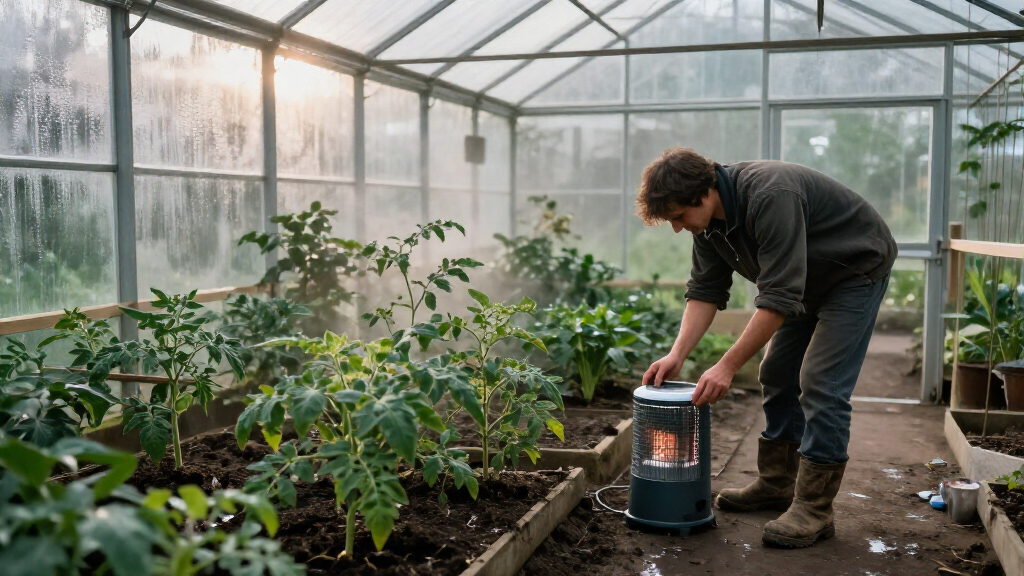

Choosing a greenhouse space heater is a choice between a heat source that is easy to control and one that can deliver substantial heat without relying on a powerful electrical circuit. Electric heaters suit small or well-insulated greenhouses with a suitable power supply, especially when stable temperatures and simple operation matter most. Propane heaters can make more sense in larger or remote structures where electrical capacity is limited, but combustion adds ventilation, moisture, and carbon-monoxide concerns.

Get garden gear delivered free with Prime
- Fast, free delivery on millions of items
- Prime Video, Amazon Music and more included
- Member-only deals all year

Greenhouse Heater with Thermostat, Auto Power Control with Digital Temperature Display, Fast Heating, Overheat Protection, Electr…
- ✔ Heat output: 1500W
- ✔ Power source: AC/DC (as listed)
- ✔ Amperage: 15A (as listed)

Greenhouse Heater 1500W Electric Space Heater with Thermostat, Fan & High Heat Modes, Adjustable Angle, IPX4 & Overheat Protection
- ✔ Power output: 1500W
- ✔ Voltage: 120V
- ✔ Amperage: 12.5A (as listed)

VEVOR 1500W Electric PTC Greenhouse Heater with Fan, Adjustable Angle, Overheat Protection
- ✔ Power output: 1500W
- ✔ Voltage: 120V
- ✔ Amperage: 8.33A (as listed)
The right comparison is not just the heater’s purchase price or advertised output. It is whether the heat source can meet the coldest-night demand safely, what it costs to run where you live, and how much attention the greenhouse needs while it is operating. The sections below compare those shared decisions and show when the extra convenience of electric heat is worth paying for, and when propane’s output and portability are more useful.
At a Glance
| Criteria | Electric greenhouse space heaters | Propane greenhouse space heaters | Winner |
|---|---|---|---|
| Heat output and capacity | Suitable for small and medium spaces if the electrical circuit supports the heater; high-output units may require dedicated circuits. | Can provide strong heat without drawing equivalent power from the electrical system; sizing and safe installation matter. | B |
| Running cost | Depends on local electricity rates and heat demand; can become expensive during long cold spells. | Depends on local propane prices, heater efficiency, and how often it runs; fuel delivery or tank costs may apply. | Depends |
| Installation and power needs | Needs a properly rated outlet or circuit; straightforward where power is already available. | Needs an appropriate cylinder or tank and compliance with the heater’s installation instructions and local rules. | A |
| Temperature control | Often easy to pair with a thermostat for steady temperatures. | Thermostat options vary; some units need more monitoring or adjustment. | A |
| Air quality and moisture | No combustion products or added combustion moisture inside the greenhouse. | Combustion produces exhaust and water vapor, so ventilation and humidity management are necessary. | A |
| Safety and supervision | Avoid overloads, wet connections, and contact with plants or combustible materials; use equipment rated for the setting. | Carbon monoxide, fire, and ventilation risks require appropriate equipment, placement, and supervision. | A |
| Portability and fuel resilience | No fuel tanks to refill, but operation depends on grid power. | Portable fuel supply can help where grid capacity is limited, but cylinders or tanks must be available and managed. | B |
Greenhouse Heater with Thermostat, Auto Power Control with Digital Temperature Display, Fast Heating, Overheat Protection, Electr…
For growers who want the heater to respond as conditions change, the SmterCon’s digital thermostat and automatic on/off control give it the strongest greenhouse-specific case in this group. Rather than relying only on manual heat and fan modes, it is described as switching power to maintain a set temperature. That can reduce the need to repeatedly adjust the unit during cool nights, though the listing does not establish sensor accuracy or how evenly it controls temperature across a greenhouse.Like both VEVOR options, this heater is rated at 1500W and uses a fan, so it shares their need for suitable electrical capacity and a placement plan that keeps airflow clear of foliage. Compared with the VEVOR 25° tilt heater, its standout advantage is automatic setpoint control rather than a stated broad temperature range and adjustable aiming. It is also less clearly differentiated from the compact PTC heater on portability: the supplied dimensions are moderate, but no weight is listed. The claimed fire-proof materials and independent overheat protection are useful safety features, but they do not remove the need to follow clearance and greenhouse-use instructions. Its fan may also be noisy, and high power draw can add to energy use.
Pros:
- Digital temperature display makes the selected setting easier to read.
- Automatic power control is designed to maintain the chosen temperature.
- Independent overheat protection is listed.
- 1500W output and adjustable speed are suited to supplemental heating needs.
Cons:
- The built-in fan may be noisy during operation.
- A 1500W heater can draw substantial electricity, especially during extended cold periods.
- The listing does not provide a unit weight or a stated temperature-setting range.
Best for: Growers who want a digital readout and automatic on/off temperature control in a greenhouse or grow tent with appropriate electrical capacity.
Not ideal for: Those who need a lightweight heater to carry around, quiet operation, or documented suitability for exposed or very cold greenhouse conditions.
Bottom line: Choose the SmterCon when automatic temperature control matters more than a tilt mechanism or the lightest portable form.
“Choose the SmterCon when automatic temperature control matters more than a tilt mechanism or the lightest portable form.”
Greenhouse Heater 1500W Electric Space Heater with Thermostat, Fan & High Heat Modes, Adjustable Angle, IPX4 & Overheat Protection
The VEVOR 25° tilt heater is the most adjustable choice in this lineup: its manual angle adjustment helps direct airflow toward a bench, seedling area or colder section rather than pointing heat in only one direction. It also lists a 40°F–108°F temperature setting range and separate heating and fan modes, giving growers more defined manual control than the compact VEVOR PTC unit’s stated low and high speeds. These controls make it a sensible option when a grower will be present to monitor conditions and reposition the unit as needed.Compared with the SmterCon, however, this model does not list a digital display or automatic thermostat power control. Its thermostat may still help regulate heat, but the provided details do not establish the same hands-off operation. It is also the heaviest pick at 7.1 pounds, which matters if the heater needs to be moved between growing zones. IPX4 is included in the product title, but greenhouse buyers should confirm the manual’s exact placement guidance and keep electrical equipment protected from water. The stated 1500W output suits supplemental heating, yet the listed maximum setting of 108°F does not guarantee adequate warmth in severe cold or a poorly insulated structure.
Pros:
- 25° adjustable angle provides the broadest stated aiming range here.
- Thermostat lists settings from 40°F to 108°F.
- Heating and fan modes allow airflow without heat.
- Portable handle and overheat protection are included.
Cons:
- At 7.1 pounds, it is heavier than the other VEVOR model.
- The provided details do not list digital display or automatic on/off control.
- The listed temperature ceiling may not be enough for very cold conditions.
Best for: Growers who want to aim warmth at a specific greenhouse zone and prefer a stated temperature range with separate heat and fan modes.
Not ideal for: Anyone seeking automatic digital temperature maintenance, the lightest unit for frequent relocation, or a primary heating solution for a large, exposed greenhouse in severe winter weather.
Bottom line: Pick this VEVOR when directing heat matters more than automatic control or easy carrying.
“Pick this VEVOR when directing heat matters more than automatic control or easy carrying.”
VEVOR 1500W Electric PTC Greenhouse Heater with Fan, Adjustable Angle, Overheat Protection
When greenhouse floor space is tight, this VEVOR stands out for being the smallest and lightest listed option: it measures 8.27 × 6.3 × 8.66 inches and weighs 3.7 pounds. A handle and stable base make it easier to move between a grow tent, flower room or small greenhouse than the 7.1-pound VEVOR 25° tilt model. Its PTC forced-air heating and two speeds combine heat with circulation, while the 15° adjustable angle offers some control over where the airflow goes.The compact form comes with a control tradeoff. Unlike the SmterCon, it does not list a digital thermostat with automatic on/off power management; unlike the larger VEVOR, it provides a narrower 15° adjustment and its two settings are described as low and high rather than separate heat and fan modes. That makes it more appealing for moving supplemental warmth than for maintaining a precise greenhouse setpoint. The listing gives a 75°C maximum temperature setting, but that is not a promise that the greenhouse itself will reach or hold a particular temperature. Fan noise is also noted, and the provided 8.33A specification alongside 1500W and 120V should be checked against the unit label before connecting it to a circuit.
Pros:
- Lightest listed option at 3.7 pounds.
- Compact dimensions help conserve floor space.
- 15° angle adjustment and stable base support directed placement.
- PTC forced-air heating, two speeds and overheat protection are listed.
Cons:
- No digital thermostat or automatic on/off control is specified.
- The 15° adjustment is narrower than the other VEVOR model’s 25° angle.
- Fan noise may be noticeable in quiet spaces.
- Listed current and power figures should be checked against the product label.
Best for: Growers with a compact greenhouse or grow tent who value a light heater they can reposition without much effort.
Not ideal for: Those who need automatic setpoint control, broader angle adjustment, quiet operation or clearly documented electrical specifications before purchase.
Bottom line: Choose this compact VEVOR when portability and small dimensions matter more than precise automatic temperature control.
“Choose this compact VEVOR when portability and small dimensions matter more than precise automatic temperature control.”
As an Amazon Associate we earn from qualifying purchases.
Key Differences
The main dividing line is the greenhouse’s access to power. An electric heater can be an uncomplicated choice when the structure already has a suitable circuit and its heat loss is modest. It produces heat without burning fuel in the growing space, and a compatible thermostat can keep temperatures more consistent. But a small plug-in unit may not cope with a large, leaky greenhouse on a severe winter night, while a powerful model may exceed what an ordinary circuit can safely support.
Propane shifts the constraint from electrical capacity to fuel, ventilation, and monitoring. It can deliver useful heat where wiring is limited or a greenhouse is remote, and it can be moved more readily than a permanently wired system. The cost is greater operational care: combustion adds moisture and exhaust, and carbon monoxide is a serious hazard if equipment is misused or ventilation is inadequate. Running expenses are not automatically lower; they depend on fuel prices, heater efficiency, and the greenhouse’s heat demand.
For most small hobby greenhouses with reliable power, electric heat is the easier default. Propane is a practical alternative when electric capacity is the limiting factor and the owner can follow the heater maker’s instructions, maintain ventilation, and manage fuel safely. In either case, heater choice cannot compensate for poor insulation, gaps, or an undersized unit. Estimate heat loss and check local installation and fire-safety requirements before buying.
Detailed Comparison
Heat output and capacity (Propane greenhouse space heaters wins — moderate)
Propane has the advantage where electrical capacity is limited. It can supply substantial heat without requiring a correspondingly high-power electrical circuit, which matters for a large greenhouse or a remote structure. This is a moderate advantage only when the heater is correctly sized and installed. Electric heat remains a sound fit for small, reasonably insulated spaces, but a low-output unit may struggle during severe cold, and a high-output model may require a dedicated circuit.
Running cost (major difference)
There is no universal cost winner. Electric heating costs reflect the local rate per kilowatt-hour and how many hours the heater runs; propane costs reflect fuel prices, heater efficiency, and tank or delivery expenses. The difference can be major over a long winter, but the answer is local and depends on heat loss. Compare expected seasonal consumption using current local rates before treating either fuel as the cheaper choice.
Installation and power needs (Electric greenhouse space heaters wins — moderate)
Electric is easier when suitable wiring is already in place. It avoids storing fuel and connecting a combustion appliance, so setup is generally simpler for a small greenhouse. That advantage is moderate, not absolute: a large electric heater may need a dedicated circuit and safe outdoor-rated connections. Propane is more useful where power is unavailable, but the tank, placement, and installation must follow the manufacturer’s instructions and applicable rules.
Temperature control (Electric greenhouse space heaters wins — moderate)
Electric usually offers simpler control. Many electric heaters can work with a compatible thermostat, helping maintain a set temperature without frequent manual adjustment. That is a moderate convenience for protecting temperature-sensitive plants. Propane models also vary: some support thermostat control, while others require closer monitoring. Check the specific heater’s controls rather than assuming all models in either category behave alike.
Air quality and moisture (Electric greenhouse space heaters wins — major)
Electric wins clearly inside the greenhouse. It adds heat without combustion exhaust or the water vapor produced by burning propane. That matters for ventilation, humidity management, and avoiding combustion-related air-quality hazards. Propane can still be appropriate when installed and operated as directed, but it requires deliberate ventilation and attention to humidity. The difference is major for growers who want to limit added moisture or cannot ventilate reliably.
Safety and supervision (Electric greenhouse space heaters wins — major)
Electric is generally simpler to manage, though it still needs care. Wet conditions, overloaded circuits, hot surfaces, and nearby combustible materials remain hazards. Propane adds risks from combustion, fuel handling, fire, and carbon monoxide, so suitable equipment, correct placement, ventilation, and supervision matter. This is a major practical difference in day-to-day operation. Neither type should be used contrary to its instructions or left in an unsafe setup.
Portability and fuel resilience (Propane greenhouse space heaters wins — moderate)
Propane is more flexible away from the grid. A heater supplied by a portable cylinder can serve a greenhouse without a high-capacity electrical connection, provided the fuel supply is managed safely. This moderate advantage matters for remote plots or sites with unreliable power. Electric heaters avoid refilling and storing propane, but stop producing heat in a power outage unless backed by an appropriate independent supply.
Electric greenhouse space heaters: Pros and Cons
Pros:
- No combustion exhaust or combustion moisture inside the greenhouse.
- Often straightforward to pair with a thermostat.
- No cylinders or fuel deliveries to manage.
- Simple fit when a suitable electrical circuit is already available.
Cons:
- High-output models may need a dedicated circuit.
- Seasonal cost can be high where electricity is expensive or heat demand is substantial.
- Depends on grid power unless backed by a separate supply.
- Small units can be inadequate for large or poorly insulated spaces.
Propane greenhouse space heaters: Pros and Cons
Pros:
- Can provide substantial heat without a high-capacity electrical connection.
- Can suit remote sites and offer more placement flexibility.
- Portable fuel supply may help where grid access is limited.
Cons:
- Combustion creates exhaust and water vapor, requiring ventilation and humidity management.
- Carbon-monoxide and fire risks call for careful setup and supervision.
- Fuel availability and cost can vary; storage and refilling take effort.
- Temperature controls differ by model and may require closer attention.
Who Should Choose What
Choose Electric greenhouse space heaters if:
- Your greenhouse is small or moderate in size and has a circuit rated for the heater.
- You want simple thermostat control without combustion exhaust or added combustion moisture.
- You prefer not to store or refill fuel and have reliable grid power.
Choose Propane greenhouse space heaters if:
- The greenhouse lacks the electrical capacity for the heat output you need.
- The site is remote and a managed propane supply is more practical than installing electrical service.
- You can provide the ventilation, placement, and supervision the specific heater requires.
Skip both if: Skip both as the first fix if the greenhouse has major drafts, poor insulation, or an unknown heat load. Improve the structure and estimate its heating requirement before selecting a unit; if reliable unattended frost protection is essential, compare a professionally installed system with suitable controls and backup.
Value for Money
Electric is often the better value for a modest greenhouse with an existing suitable circuit: the initial setup is simple, fuel handling disappears, and thermostat operation can reduce unnecessary attention. It is not automatically the cheaper way to heat, since electricity rates and run time determine the bill. Paying more for a higher-output electric heater makes sense only if the circuit can support it and the greenhouse’s heat-loss estimate justifies the capacity.
Propane can be worth its added equipment and fuel-management effort when electrical upgrades would be costly or impractical, or when the greenhouse is off-grid. Its value comes from supplying useful heat without a powerful circuit, not from a guaranteed lower running cost. Compare local propane and electricity rates against realistic seasonal consumption, and include tank, delivery, ventilation, and installation needs. If the greenhouse loses heat rapidly, improving insulation may save more than switching fuel types.
Final Verdict
For most small greenhouse owners with reliable power, choose an electric space heater sized to the structure and supported by the circuit. It is simpler to control and avoids combustion inside the growing space. Choose propane when electrical capacity or grid access is the real obstacle and you can manage ventilation, fuel, and safe operation carefully. The deciding factor is not the heater’s headline output: it is whether the site can support that heat source safely and affordably through the coldest weather. If neither option can meet the heat load safely, reduce heat loss or install a properly designed heating system before relying on a portable heater.
Frequently Asked Questions
Are electric or propane heaters cheaper to run in a greenhouse?
It depends on local electricity and propane prices, heater efficiency, and how much heat the greenhouse loses. Compare the expected energy use for your climate and structure, then apply current local rates. A heater’s purchase price alone does not show its seasonal cost.
Can I use a propane heater in an enclosed greenhouse?
Only if that specific heater is approved for the intended setting and is installed and operated according to its instructions and local rules. Propane combustion produces exhaust and water vapor, and carbon monoxide can be deadly. Ventilation and appropriate safety measures are necessary; do not assume a closed greenhouse is safe.
Will a plug-in electric heater protect plants through winter?
It can, if its capacity matches the greenhouse’s heat loss, the circuit can safely supply it, and controls keep temperatures within the plants’ needs. A small unit may not hold the target temperature in a large or leaky greenhouse during a cold snap. Check the expected minimum temperature and heater rating before relying on it.
Which type is better during a power outage?
A propane heater may continue operating if it does not rely on grid power for ignition or controls and has an available fuel supply. Check the model’s requirements. An electric heater stops when grid power fails unless an appropriate independent power system supports it. Plan for outage safety and follow the heater maker’s instructions.