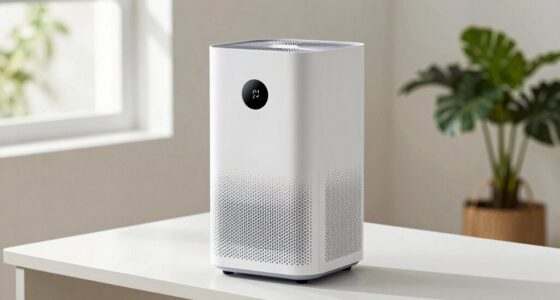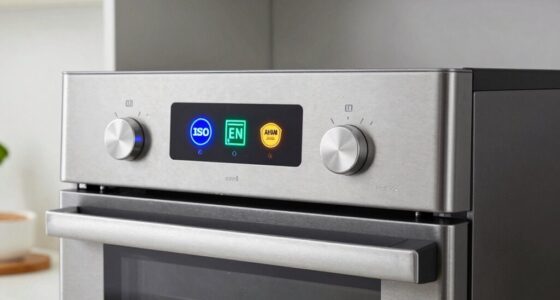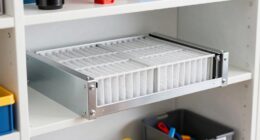
Many people think HEPA H13, H14, and ULPA filters are just about how well they filter particles, but the key difference lies in their efficiency levels and applications. H13 filters trap particles ≥99.95%, H14 filters catch ≥99.995%, and ULPA filters go even further at ≥99.999%, targeting much smaller particles. Choosing the right one depends on your needs—whether for general air quality or ultra-clean environments. Keep going, and you’ll uncover what makes each filter type unique.
Key Takeaways
- The main difference lies in filtration efficiency: H13 traps ≥99.95%, H14 ≥99.995%, ULPA ≥99.999%.
- Many assume higher efficiency filters are always better; choice depends on specific contamination control needs.
- ULPA filters are designed for ultra-clean environments and are more costly and maintenance-intensive than H13 or H14.
- H14 provides a significant increase in filtration over H13, often justifying the higher cost for stricter standards.
- Proper filter selection balances air quality requirements, budget, and maintenance, not just maximum efficiency.
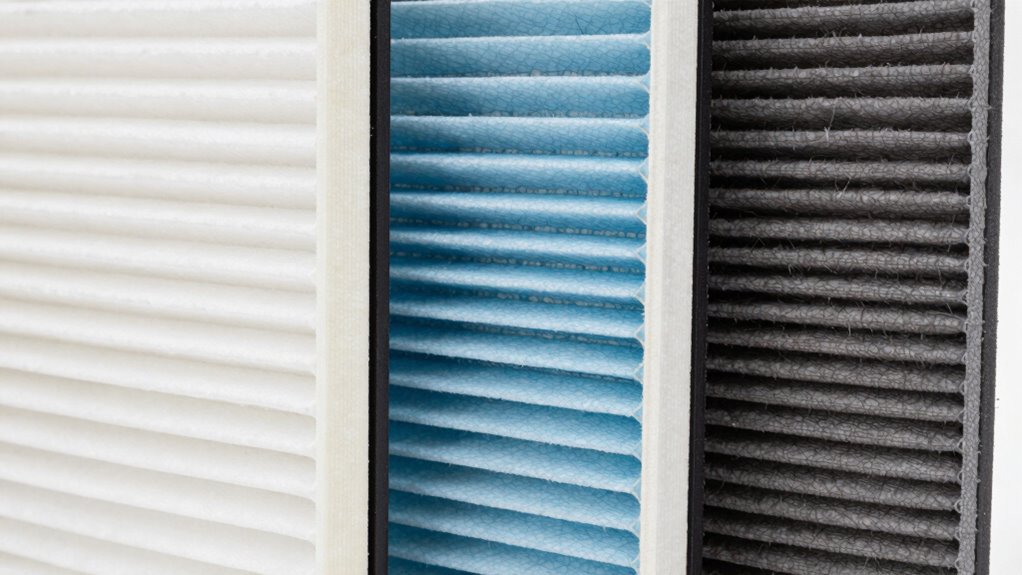
Are you trying to determine which high-efficiency filtration option best suits your needs? When it comes to air purification, understanding the differences between HEPA H13, H14, and ULPA filters can be confusing, especially since many people assume they’re interchangeable. However, these filters vary considerably in their filter efficiency and intended applications. Recognizing these distinctions allows you to select the right filter for your specific environment, whether it’s a medical setting, cleanroom, or industrial facility.
HEPA filters are designed to capture tiny particles from the air, and their efficiency levels are classified based on the percentage of particles they remove at a specified particle size. The H13 grade, for instance, can trap at least 99.95% of particles as small as 0.3 microns. This makes it highly effective for most air purification needs, including residential and commercial spaces. H13 filters strike a balance between high filter efficiency and affordability, making them a popular choice for maintaining clean indoor air.
Moving up in performance, H14 filters offer an even higher degree of air purification. They can remove at least 99.995% of particles at the same size. This small increase in efficiency can make a substantial difference in environments that require stricter air quality standards, such as hospitals, laboratories, or pharmaceutical manufacturing. If your priority is to minimize airborne contaminants to the greatest degree possible, H14 filters are often the best option. They also tend to have a longer service life due to their superior filtration capabilities, which can reduce overall maintenance costs.
ULPA filters, or Ultra Low Penetration Air filters, take filtration efficiency to an even higher level. They can trap 99.999% or more of particles as small as 0.12 microns. These filters are used in ultra-clean environments like semiconductor manufacturing, advanced research labs, and some aerospace applications. Because of their incredibly high filter efficiency, ULPA filters are more restrictive and often more expensive. They also require more robust fans and regular maintenance to ensure optimal performance. Filter efficiency continues to advance as technology improves, enabling even more precise air purification solutions.
Frequently Asked Questions
How Do HEPA and ULPA Filters Compare in Energy Consumption?
HEPA filters generally consume less energy than ULPA filters because they operate at lower air resistance levels, making them more energy-efficient. ULPA filters require more power due to their denser filtration, increasing operational costs. When comparing, you’ll find that HEPA filters offer better energy efficiency and cost savings for typical applications, while ULPA filters are suited for specialized environments demanding higher filtration, but at a higher energy and cost trade-off.
Are ULPA Filters Suitable for Residential Use?
Imagine breathing in pure, crisp mountain air—ULPA filters can deliver that level of cleanliness, but they’re generally too powerful for home use. While they excel in industrial settings, ULPA filters aren’t suitable for residential air quality because they require specialized installation, maintenance, and can be overkill for typical indoor environments. For better filter installation tips, opt for HEPA H13 filters, which balance efficiency and practicality for your home.
What Maintenance Is Required for HEPA H13, H14, and ULPA Filters?
You should regularly check your HEPA H13, H14, or ULPA filters for dust accumulation and replace them as recommended by the manufacturer, usually every 6 to 12 months. Filter replacement guarantees peak performance and prevents dust buildup that can reduce efficiency. Also, keep the surrounding area clean to minimize debris, and follow specific maintenance instructions for your filter type to maintain air quality.
Can HEPA Filters Remove Viruses Effectively?
Yes, HEPA filters can remove viruses effectively through viral filtration. Their high filter efficacy captures particles as small as 0.3 microns, including many viruses. You should guarantee the filter is properly maintained and replaced regularly to maintain ideal viral filtration. While HEPA filters are highly effective, they work best when combined with good ventilation and other infection control measures, providing a reliable barrier against airborne viruses.
What Certifications Validate the Efficiency of These Filters?
Think of filter certifications like a report card that proves their performance. You’ll want to look for certifications such as EN 1822, which validate efficiency standards for HEPA and ULPA filters. These certifications guarantee the filters meet strict standards, with H13, H14, and ULPA filters designed to trap particles down to specific sizes. Always check these certifications to confirm you’re getting a filter that performs as promised.
Conclusion
Now you know the nuances between HEPA H13, H14, and ULPA filters, you can confidently choose the cleanest, most capable filter for your needs. Recognize the range, realize the risk, and refine your research. Don’t let misconceptions multiply—master the material, measure the margins, and make your decision with clarity. With this knowledge, you’ll prevent poor choices, promote purity, and protect your space with precision. Perfecting your perception paves the path to pure, protected environments.