

Using machine learning for air quality trend prediction involves processing sensor data to correct errors, remove noise, and account for environmental factors like weather. You’ll need to clean and normalize the raw data, create meaningful features, and incorporate factors like wind and humidity. With well-prepared data, machine learning models can learn patterns and provide reliable forecasts. Keep exploring, and you’ll discover how proper data handling makes these predictions more accurate and impactful.
Key Takeaways
- Proper sensor calibration ensures accurate, reliable data for machine learning models predicting air quality trends.
- Data preprocessing, including noise filtering and normalization, enhances model performance and forecast accuracy.
- Feature engineering, such as incorporating meteorological variables, helps capture environmental influences on air quality.
- Handling missing data and outliers improves the quality of training datasets, leading to more precise predictions.
- Well-prepared, clean datasets enable machine learning algorithms to identify patterns and forecast air quality trends effectively.
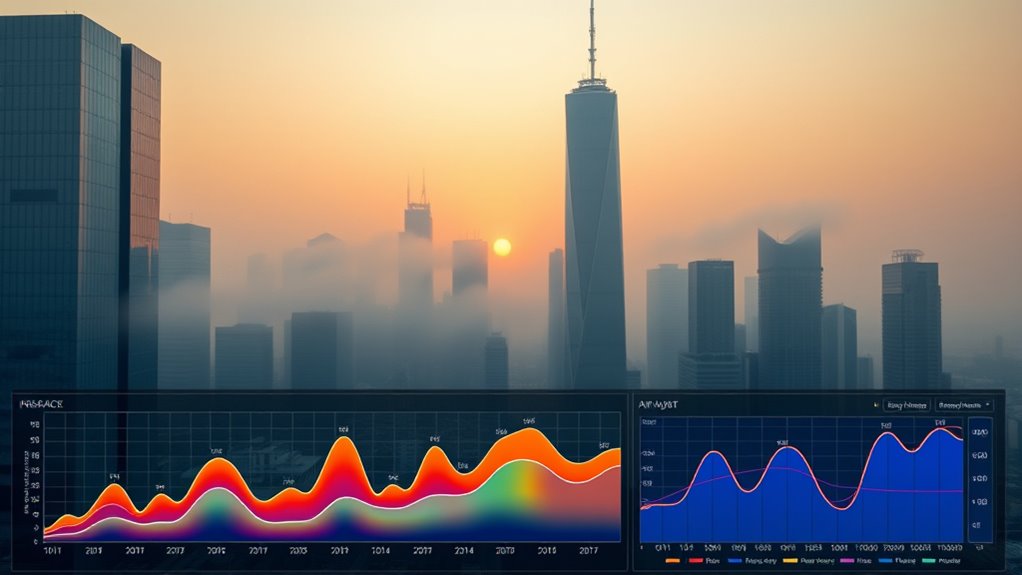
As air pollution continues to pose serious health and environmental risks, researchers are turning to machine learning to forecast air quality trends more accurately. This innovative approach relies on analyzing vast amounts of data collected from various sensors deployed across cities, industrial sites, and traffic hotspots. But before any meaningful predictions can happen, you need to ensure that the data you gather is reliable. That’s where sensor calibration becomes essential. Sensors can drift over time or respond inconsistently due to environmental factors, which can introduce errors into your dataset. Regular calibration helps you correct these inaccuracies, ensuring that the sensor readings reflect true air quality conditions. Without proper calibration, your machine learning models might learn from flawed data, leading to unreliable forecasts.
Once you’ve calibrated your sensors, the next step involves data preprocessing, a critical phase in preparing your raw data for analysis. Raw sensor data often contains noise, missing values, or outliers that can distort the model’s predictions. Data preprocessing involves cleaning the dataset by filtering out noise, filling in gaps, and normalizing the data so that different features are on comparable scales. For example, you might apply smoothing techniques to reduce sudden spikes caused by transient environmental factors or use interpolation methods to estimate missing values. These steps ensure that your machine learning algorithms work with high-quality, consistent data, which markedly improves the accuracy of air quality predictions. Data quality is crucial for effective model training and reliable forecasting.
Moreover, preprocessing isn’t just about cleaning; it also involves feature engineering—extracting relevant variables that can enhance model performance. You might create new features like moving averages, pollutant ratios, or temporal indicators that capture patterns over time. Incorporating meteorological data such as wind speed, temperature, and humidity can also boost your model’s ability to forecast air quality trends. These steps help your machine learning models understand complex interactions between pollutants and environmental conditions, leading to more precise predictions.
In essence, the foundation of any successful air quality forecasting system lies in meticulous sensor calibration and thorough data preprocessing. By ensuring your sensors are correctly calibrated, you eliminate a major source of measurement error. Then, by carefully preprocessing your data, you prepare a clean, informative dataset that allows your machine learning algorithms to learn effectively. When combined, these practices enable you to develop robust models capable of providing timely, accurate air quality forecasts—helping communities better prepare for pollution episodes and guiding policymakers in designing effective mitigation strategies.
Frequently Asked Questions
How Accurate Are Machine Learning Predictions for Long-Term Air Quality Trends?
Machine learning predictions for long-term air quality trends can be quite accurate if you carefully manage factors like sensor calibration and data imbalance. Regularly calibrate sensors to guarantee reliable data, and address data imbalance to prevent skewed results. While models improve over time, remember that unexpected events or changing conditions can still impact accuracy. So, stay vigilant and continuously refine your models for the best long-term predictions.
What Are the Main Challenges in Collecting Air Quality Data for Models?
Gathering air quality data is like assembling a complex puzzle—sensor calibration guarantees each piece fits correctly, but inconsistent calibration causes pieces to misalign. Data heterogeneity, from different sensor types and locations, complicates model training. You face challenges in standardizing measurements and maintaining data quality. Without addressing calibration issues and data variability, your models can produce unreliable predictions, making it harder to understand true air quality trends.
Can Machine Learning Predict Sudden Air Quality Changes or Only Trends?
Machine learning can predict both sudden air quality changes and general trends, but it’s challenging. Sudden shifts often result from events like fires or industrial accidents, which require well-calibrated sensors and diverse data to detect accurately. Data imbalance, where rare events are underrepresented, can hinder prediction. To improve accuracy, you need to continuously calibrate sensors and gather extensive data to help models recognize both typical patterns and anomalies effectively.
How Do Different Machine Learning Algorithms Compare in Air Quality Forecasting?
Think of machine learning algorithms as different tools in your toolbox for forecasting air quality. You’ll find that decision trees excel with structured data, while neural networks handle complex patterns better, showing higher algorithm performance. Data preprocessing is essential; it cleans and transforms data for accuracy. Comparing these algorithms helps you choose the best fit, ensuring your predictions are reliable, like a compass guiding you through the foggy landscape of air quality data.
What Are the Ethical Considerations When Using Predictive Air Quality Models?
When using predictive air quality models, you need to take privacy concerns and data bias into account. You might handle sensitive location data, risking privacy violations if not properly secured. Data bias can lead to inaccurate forecasts, especially for underserved communities. It’s your responsibility to ensure data is fair and transparent, protecting individuals’ privacy and avoiding discriminatory outcomes. Ethical use of these models promotes trust and improves public health efforts.
Conclusion
By embracing machine learning, you open the door to a future where air quality insights become clearer and more reliable. While challenges remain, these advanced techniques gently guide us toward healthier environments, subtly shaping a world where pollution risks are better managed. With continued innovation, you’ll find yourself better equipped to anticipate and respond to air quality changes, turning what once seemed uncertain into an opportunity for proactive change. The journey toward cleaner air becomes a shared, hopeful endeavor.