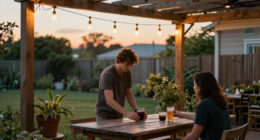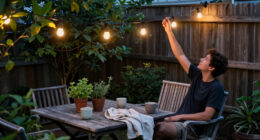
TL;DR
To choose outdoor string lights for a patio, measure the route you want to light, map the support points, and add enough strand length for the actual path. Pick a power source and brightness for how you use the space, then check the outdoor rating, connection limits, and mounting instructions before hanging anything.
One loose strand can turn a welcoming patio into a dark tangle after the first gust of wind. A little planning changes the scene: warm bulbs glow above dinner, the walkway stays clear, and the cable hangs neatly instead of tugging at its sockets.

Get garden gear delivered free with Prime
- Fast, free delivery on millions of items
- Prime Video, Amazon Music and more included
- Member-only deals all year
This guide helps you choose outdoor string lights by matching their length, brightness, power source, and weather rating to your space. You’ll also learn how to map a route, support a long span, and avoid common electrical and clearance problems. That way, you can enjoy the soft glow without asking the bulbs to light the grill or the stairs.
Think of the installation as a small bridge: the bulbs make it beautiful, while the supports carry the load. Measure first, check the product details, and the finished patio will feel like a room with a ceiling made of evening sky.
Measure the actual cable route, including turns, outlet distance, and the space needed for a zigzag.
Use warm light for atmosphere, and check lumens plus a separate task light for cooking or stairs.
Choose plug-in, solar, or battery power based on outlet access, shade, season, and expected runtime.
Support long or windy spans with suitable anchors or a guide wire so the electrical strand does not carry the load.
Check the weather rating, bulb compatibility, and maximum strand connections in the manufacturer’s instructions.
Measure your patio before you buy a strand
For outdoor string lights on a patio, measure the full route the cable will follow, including turns and dips, before choosing a strand. The straight-line distance between two walls rarely matches the real hanging path. A tape measure, sketch, and marked support points can save you from a strand that stops short above the table.
Decide whether the lights will span a dining table, follow a fence, run along a pergola, or zigzag overhead. For a 10-by-12-foot patio, for example, two diagonal runs may need considerably more cable than a single line across the 10-foot side. Note where the outlet sits, where people walk, and whether a door swings through the proposed route.
Measure each section along the intended path rather than estimating from the patio’s dimensions. Add a little length for the route from the outlet to the first support and for the shape you want between anchors. Leave slack only where the manufacturer’s instructions allow; a deep droop can catch a tall guest or block your view of the garden.
Then check the strand’s bulb spacing. Wide spacing can leave dark gaps over a long dining table, while close spacing creates a more continuous canopy. Mark the positions on your sketch. If the last bulb would sit awkwardly in the middle of a fence, shift the pattern or choose a different strand length.
Products Worth Considering

Dyson Purifier Hot+Cool HP2 De-NOx

Dyson Cyclone V10 Origin Cordless Vacuum

Hisense 40-Inch QD4SR Series Hi-QLED FHD Roku Smart TV
As an affiliate, we earn on qualifying purchases.
Choose warm glow for mood and brighter light for tasks
Outdoor string lights work best as mood lighting, with a separate brighter source for cooking, stairs, and other tasks. Warm white light around 2,200–3,000 K gives many patios a soft amber glow, like a candlelit café. But bulb count alone does not tell you how well you’ll see: compare the product’s lumen output and follow the manufacturer’s guidance.
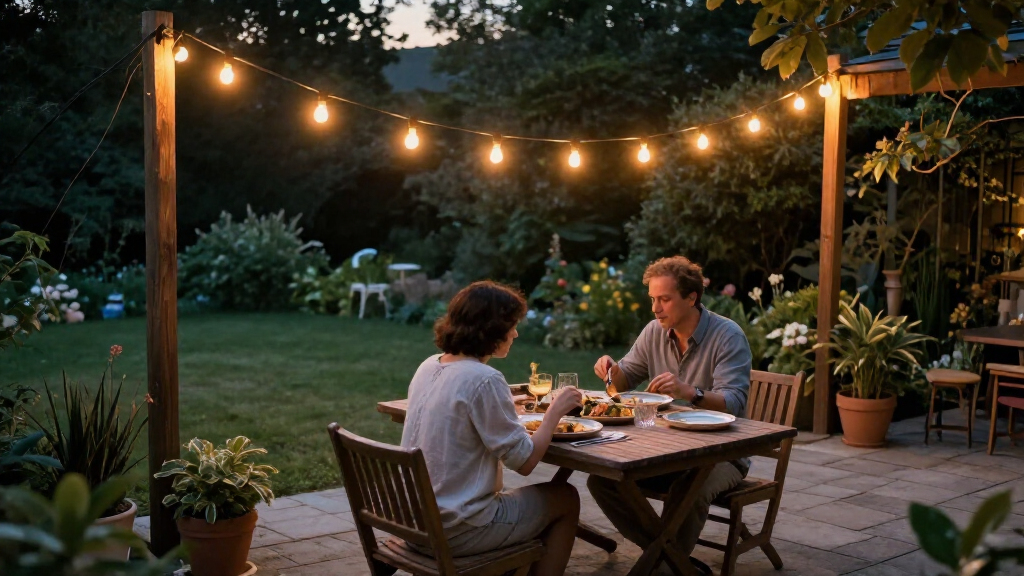
Imagine serving dinner under large vintage-style bulbs: their golden light makes a wooden table feel welcoming, but it may not show whether a steak is cooked through. A focused light near the grill or a brighter fixture by the steps fills that practical gap. Keep the decorative strand in its own role, and the patio feels layered rather than glaring.
Bulb spacing and height change the effect, too. Closer bulbs spread light more evenly across a small table; widely spaced bulbs make a looser, more open pattern above a larger space. A high span spreads the glow broadly, while a lower span feels intimate but can interrupt sightlines. If your patio is narrow, mock up the height with temporary string before mounting the strand.
LED bulbs generally use less electricity and produce less heat than incandescent bulbs, though actual brightness, color, and energy use vary by model. Dimmable strands can help you shift from dinner to a quieter late-night glow. Check that the strand, dimmer, and any smart plug are compatible; matching plugs does not guarantee compatible controls.
Pick plug-in, solar, or battery power for your patio
Choose a power source according to your outlet access and the amount of dependable evening light you need. Plug-in strands suit patios with a safe, accessible outdoor outlet; solar strands avoid nearby mains power but depend on sunlight; battery-powered strands offer flexible placement and need periodic recharging or replacement.
For example, a sunny south-facing balcony may give a solar panel plenty of daylight, while a shaded courtyard under a maple tree may not. Short winter days, dirty panels, battery age, and lighting settings can all cut solar runtime. Treat claims such as “all night” as product-specific, not a promise for every season or garden.
A plug-in model can give you more predictable use for regular dinners, but its cord needs a safe route that does not cross a doorway or become pinched in a window. Use outdoor-rated cords and accessories, protect connections as the manufacturer directs, and plug into an appropriate protected outlet. Keep cords away from standing water and busy footpaths.
Before choosing, consider how often you use the patio and whether you can reach the switch or panel easily. A renter who moves furniture might prefer a rechargeable strand. Someone hosting weekly suppers may value the steady output of a plug-in model. In either case, read the stated runtime, charging method, and care instructions rather than shopping by a “solar” or “smart” label alone.
Hang long spans securely with proper supports
Use hooks, poles, or a guide wire to support patio lights; do not make the electrical cord carry the weight of a long span. Wind can tug a strand again and again, loosening sockets or stressing its connections. A guide wire attached to suitable anchors takes that pull, much like a clothesline holds fabric while the line stays under tension.
If you have no pergola or nearby trees, freestanding poles designed for outdoor string lights can create anchor points. Place them where they won’t narrow a walkway or interfere with chairs and doors. For a long run from a house to a pole, attach the strand to a separately supported guide wire according to the installation instructions, rather than tightly binding the cord to the wire.
Choose a height that suits both the view and the people moving below it. A low canopy above a small seating nook can feel cozy, but a taller guest may brush it. Check the entire route with doors open and chairs pulled back. A real-life test helps: hold a broom upright where a person might walk, and see whether the proposed line leaves comfortable clearance.
Use hardware suited to the mounting surface and follow the product’s instructions for spacing and tension. Avoid pulling the strand tight like a guitar string; supports should keep it steady while allowing the installation to match the maker’s guidance. If the area gets gusty, reduce unsupported spans and check anchors periodically for movement, corrosion, or loosening.
Read weather ratings and connection limits before installation
An outdoor rating tells you how a light handles specified exposure; it does not mean you can submerge it or leave it exposed in every storm. IP44 is commonly used to indicate protection against splashing water, while more exposed locations may call for a higher level of protection. Check the exact product rating and the manufacturer’s limits for the strand, plug, and connections.
A covered patio and an open deck face different conditions. Under a roof, a strand may see occasional damp air and windblown rain; on an exposed deck, driving rain can hit sockets directly. Even a weather-rated product has boundaries. Follow instructions for severe weather, and take down or protect the lights when the maker calls for it.
Look for features that suit the way you use the space. Shatter-resistant lenses can be practical near children, pets, or a busy dining table. Replaceable bulbs make repairs easier, but bulbs and strands are not universally interchangeable: check socket type, voltage, dimmer compatibility, and the manufacturer’s replacement guidance before swapping one.
Some strands connect end to end, and some do not. Check the permitted connection count and maximum load in the product instructions before adding another run. Never overload an outlet or assume that matching connectors mean the products can safely join. If one bulb fails, use the specified replacement and troubleshooting steps; avoid improvised repairs to damaged cords or sockets.
Use this four-step plan to get the layout right
A simple plan helps you choose for the space instead of buying a strand because its box looks charming. Start with the patio’s shape and the way you use it, then match the cable route, light output, and installation hardware. Here’s a practical order you can follow before checkout.
- Sketch the patio. Mark the table, doors, walking routes, outlet, and likely anchor points. A quick phone photo with lines drawn over it works well.
- Measure each run. Follow the proposed route with a tape measure, including corners and the route from the outlet. Compare the total with strand length and bulb spacing.
- Match light and power. Pick a warm color temperature for atmosphere, check lumens for useful brightness, and choose plug-in, solar, or battery power based on the site.
- Verify the installation details. Confirm outdoor rating, support method, compatible bulbs and controls, connection limits, and the clearance below the finished span.
For a concrete example, imagine a 10-by-12-foot rental patio with one outdoor outlet, a dining table, and a fence on two sides. The renter might sketch a zigzag that starts near the outlet, follows approved removable supports, and leaves the door swing clear. They can then compare strand length and allowed connection limits before buying, instead of discovering after dark that the final run ends short.
This order also reveals when a decorative strand will not solve the whole lighting problem. If the steps remain dim on the sketch, add a suitable task light to the plan. Taking five minutes to map the space can make installation simpler and the finished glow far more useful.
Frequently Asked Questions
How many string lights do I need for my patio?
Measure every planned run along its actual route, including turns and the distance from the outlet to the first anchor. Compare that total with the strand length and bulb spacing; a zigzag needs more cable than one straight span across the same patio.
Should I use a guide wire for patio string lights?
A guide wire can help support a long or windy span by carrying the physical strain instead of the light strand. Use suitable anchors and follow the light manufacturer’s mounting instructions, since the correct support depends on the product and installation.
Are outdoor string lights safe in rain?
Only use a product rated for outdoor conditions, and follow its instructions for rain, connections, and severe weather. A rating such as IP44 commonly indicates splash protection; it does not mean the strand can be submerged or exposed to every storm.
Are solar or plug-in patio lights better?
Plug-in lights offer more predictable use when you have a safe outdoor outlet. Solar lights avoid a nearby outlet but depend on sunlight, season, panel cleanliness, battery condition, and settings, so runtime can vary.
Can I connect patio string light strands end to end?
Only if the manufacturer permits it, and only within the stated maximum number of strands or load. Check the product instructions and compatible connection details before extending a run; similar-looking plugs do not prove that two products can safely connect.
Conclusion
Before you buy, sketch the patio, measure the path, and check how the product handles power, weather, and support. That small bit of planning keeps the glow where you want it and the cables out of the way.
Then switch on the warm bulbs, set dinner beneath them, and let the evening settle over your patio like a soft golden roof.